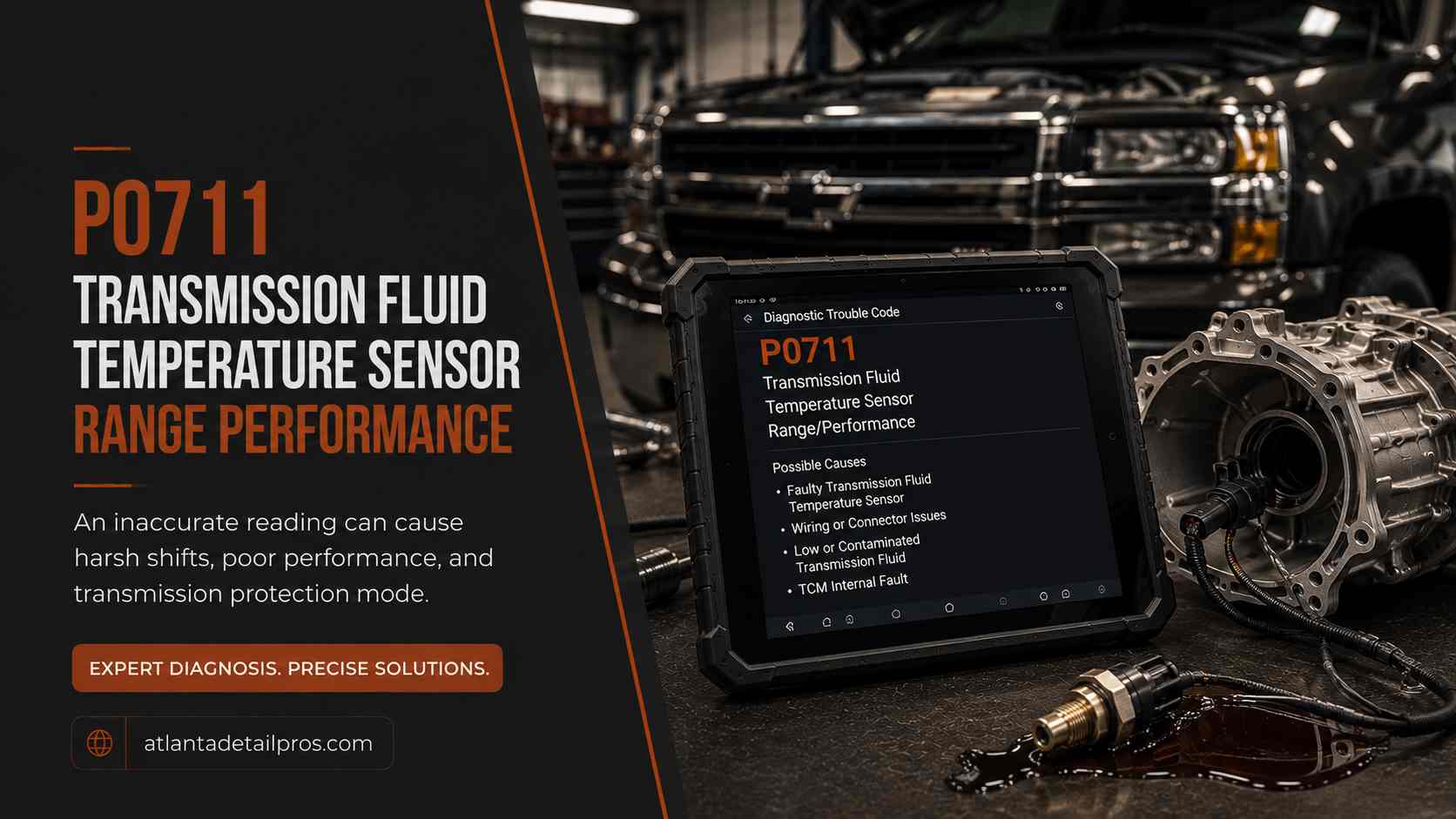
The P0711 code can sound alarming because it involves the word “transmission,” but it does not automatically mean your transmission is failing. What it means is that the Transmission Control Module (TCM) is receiving temperature data from the Transmission Fluid Temperature (TFT) sensor that falls outside the expected range or behaves in a way that does not make logical sense given the operating conditions. That is the “range/performance” part of the code.
In plain terms: the sensor is sending data that the TCM cannot trust. This could be because the sensor itself has failed, because the wiring between the sensor and TCM is compromised, because the transmission fluid is in such poor condition that it is affecting sensor readings, or in serious cases because the transmission fluid is genuinely overheating from an internal problem. This guide works through every one of these possibilities in the right order.
Understanding What the TFT Sensor Does and Why P0711 Matters
The Transmission Fluid Temperature sensor is a thermistor, which means its electrical resistance changes as temperature changes. The TCM reads the resistance and converts it to a temperature value. It uses this temperature to make critical decisions: when to engage the torque converter clutch, how to adjust line pressure for gear changes, and whether to enter a protective reduced-power mode if the fluid is dangerously hot.
P0711 is specifically a range and performance code, not a simple circuit failure. A simple circuit failure (open or short) would store P0710. P0711 means the signal is present but implausible, for example a sensor that reads -40 degrees Fahrenheit even after the engine and transmission have been running for 20 minutes, or a sensor that reads 300 degrees Fahrenheit when the transmission clearly has not had time to overheat. The TCM sees this data and flags it as untrustworthy.
NOTE: If P0711 appears alongside symptoms of harsh or erratic shifting, slipping, or an over-temperature warning on the instrument cluster, do not dismiss this as just a sensor issue. Genuine transmission overheating produces the same code and carries the risk of internal transmission damage if driving continues.
Problem 1: Failed or Degraded Transmission Fluid (Easiest Fix, Check First)
Before suspecting the sensor or wiring, check the transmission fluid. This is the most overlooked cause of P0711 and also the most frequently resolved by a simple fluid service. Transmission fluid that is severely degraded, contaminated with moisture, burned from overheating, or at a critically low level can cause abnormal temperature readings from an otherwise functional sensor. Contaminated fluid changes viscosity differently than clean fluid with temperature changes, which can throw off the sensor reading pattern the TCM expects.
Step 1: Check Transmission Fluid Level and Condition
With the vehicle on level ground and the engine warmed to operating temperature, locate the transmission dipstick (on vehicles equipped with one). Wipe it clean, reinsert fully, and pull again. The fluid level should be in the correct range for hot fluid (the dipstick usually has separate marks for cold and hot). More importantly, look at the fluid on the dipstick.
- Healthy ATF: Transparent red or pink, faint sweet petroleum smell.
- Degraded ATF: Dark brown or black, strong burnt smell, may feel gritty.
- Contaminated ATF: Milky, foamy, or water-thinned appearance.
If the fluid looks dark or burnt, a complete drain-and-fill with fresh manufacturer-specified ATF should be your first repair step. Clear the code afterward and drive through two complete drive cycles before evaluating whether P0711 returns.
Problem 2: Damaged Wiring or Corroded Connector
The wiring harness connecting the TFT sensor to the TCM runs through the transmission and along the underside of the vehicle. This routing exposes it to heat, vibration, road debris, and moisture. Wiring problems are the second most common cause of P0711 after fluid condition, and they frequently cause the range/performance code specifically because damaged insulation or a corroded connector introduces resistance or intermittent open circuits that make the signal appear implausible rather than completely absent.
Step 1: Inspect the Connector and Harness
Locate the TFT sensor connector, which is typically accessible on the outside of the transmission case or from the transmission pan area. Disconnect the connector and look at both sides: the harness side and the sensor side. Green or white powdery corrosion on the terminals is a clear contamination problem. Terminals that appear pushed back, spread apart, or bent cannot make reliable electrical contact. Clean corroded terminals with electronic contact cleaner and a pin tool. Make sure the connector locking tab clicks fully into place when reconnected.
Step 2: Test Wiring Continuity with a Multimeter
Set the multimeter to continuity mode or resistance mode. With the connector unplugged from both the sensor and the TCM, probe each wire from the sensor connector end to the TCM connector end. A healthy wire reads near-zero resistance (continuity). An open circuit reads infinite resistance (OL). Probe each of the sensor circuit wires separately. Also probe between each signal wire and the chassis ground: a reading anywhere other than infinite indicates insulation damage and a short to ground.
Problem 3: Failed Transmission Fluid Temperature Sensor
If the fluid is in good condition and the wiring tests clean, the sensor itself is the next target. The TFT sensor is a thermistor that changes resistance predictably with temperature. Testing the sensor resistance at a known temperature gives you a definitive pass or fail result that no amount of guessing can match.
Step 1: Test Sensor Resistance
Disconnect the TFT sensor connector. Set your multimeter to the Ohms setting. Probe the two terminals of the sensor (the sensor side, not the harness side). The resistance reading should correspond to the current transmission temperature. Most TFT sensors follow this approximate pattern: approximately 2,000 to 3,000 ohms when cold (ambient temperature), decreasing to approximately 200 to 300 ohms at normal operating temperature around 180 to 200 degrees Fahrenheit. The exact specification varies by manufacturer, so confirm the correct value for your vehicle in the service manual.
If the sensor reads OL (open circuit) or zero ohms (short circuit), it has failed electrically. If the resistance is wildly out of range for the current temperature, or if it reads a stable fixed resistance regardless of temperature change, the thermistor element is defective. Either confirms sensor replacement.
Step 2: Replace the TFT Sensor
On most vehicles, the TFT sensor is located inside the transmission, either mounted on the valve body or integrated into the wiring harness that enters the transmission pan. Replacing a valve body-mounted sensor typically requires dropping the transmission pan and draining the fluid. Always replace the pan gasket and refill with fresh fluid when you have the pan off. The sensor itself costs $20 to $80. With pan drop and fluid refill, plan for $150 to $350 at an independent shop.
Problem 4: Active Transmission Overheating
If all the above components test as healthy and P0711 persists with symptoms of harsh shifting, slipping, or loss of certain gear ranges, the code may accurately reflect that the transmission fluid is genuinely overheating during operation. This is the most serious scenario and is not a sensor problem at all.
Step 1: Monitor Live Temperature Data
Using a scan tool with live data, watch the transmission fluid temperature reading during a normal drive cycle. Normal operating temperature for ATF is typically 175 to 225 degrees Fahrenheit. Temperatures above 250 degrees Fahrenheit indicate overheating. Sustained temperatures above 300 degrees Fahrenheit cause permanent damage to ATF and internal clutch friction material. If the temperature climbs into dangerous ranges during normal driving, the cause is internal: low fluid, failing transmission cooler, blocked cooler lines, or an internal transmission problem generating excessive heat.
Do not continue driving a vehicle that shows genuine transmission fluid temperatures above 275 degrees Fahrenheit on live data. Transmission fluid breaks down rapidly above this threshold and clutch friction material begins to be damaged. Have the cooling circuit (transmission cooler, cooler lines, and fan operation) inspected before driving further.
Problem | Key Symptom | Test Method | Repair |
|---|---|---|---|
Degraded ATF | Code appears on high-mileage vehicle with old fluid | Dipstick: dark, burnt, gritty fluid | Drain and fill with fresh ATF |
Corroded connector | Code intermittent; corrosion visible at connector | Visual + electronic contact cleaner test | Clean terminals; replace pigtail if needed |
Damaged wiring | Code after undercar work or high mileage | Multimeter continuity test on each wire | Repair or replace affected wires |
Failed TFT sensor | Resistance out of range for current temperature | Multimeter resistance test at known temp | Replace sensor ($20-$80 part) |
Genuine overheating | Live data shows 250+ degrees; shifting problems | Live data temperature monitoring during drive | Inspect cooler, lines, fluid level |
Frequently Asked Questions
What does P0711 mean?
P0711 means the Transmission Fluid Temperature sensor is reporting values outside the expected range for the current operating conditions, or the signal is behaving in a way the TCM cannot trust. The most common causes are degraded transmission fluid, corroded wiring or connector, or a failed sensor thermistor element. In serious cases, it indicates actual transmission overheating.
Can I drive with P0711?
With P0711 alone and no shifting problems, you can drive carefully for short distances while arranging diagnosis. If P0711 is accompanied by harsh, erratic, or delayed shifting, a transmission over-temperature warning, or the transmission entering limp mode, stop driving and have the vehicle inspected. Genuine overheating with continued driving causes permanent internal damage.
How much does a TFT sensor replacement cost?
The sensor part itself is $20 to $80. If the sensor requires dropping the transmission pan for access, the job includes a fluid refill and new pan gasket. Total cost at an independent shop runs $150 to $350. If the sensor is externally mounted on the transmission case, labor is minimal and the total is closer to $80 to $150.
Will a transmission fluid change fix P0711?
Often, yes, when the code has appeared on a high-mileage vehicle with ATF that has never been serviced or has been in service well past its interval. Degraded fluid affects sensor readings. Fresh fluid with the correct specification sometimes clears P0711 permanently. It is always the first and cheapest repair to attempt.
The Bottom Line
P0711 has a clear diagnostic order: check the fluid first, inspect the wiring and connector second, test the sensor resistance third, and monitor live temperature data if all three check out. The fluid check costs nothing and resolves a meaningful percentage of cases. Work through the steps methodically before concluding you need a new sensor or a transmission inspection.