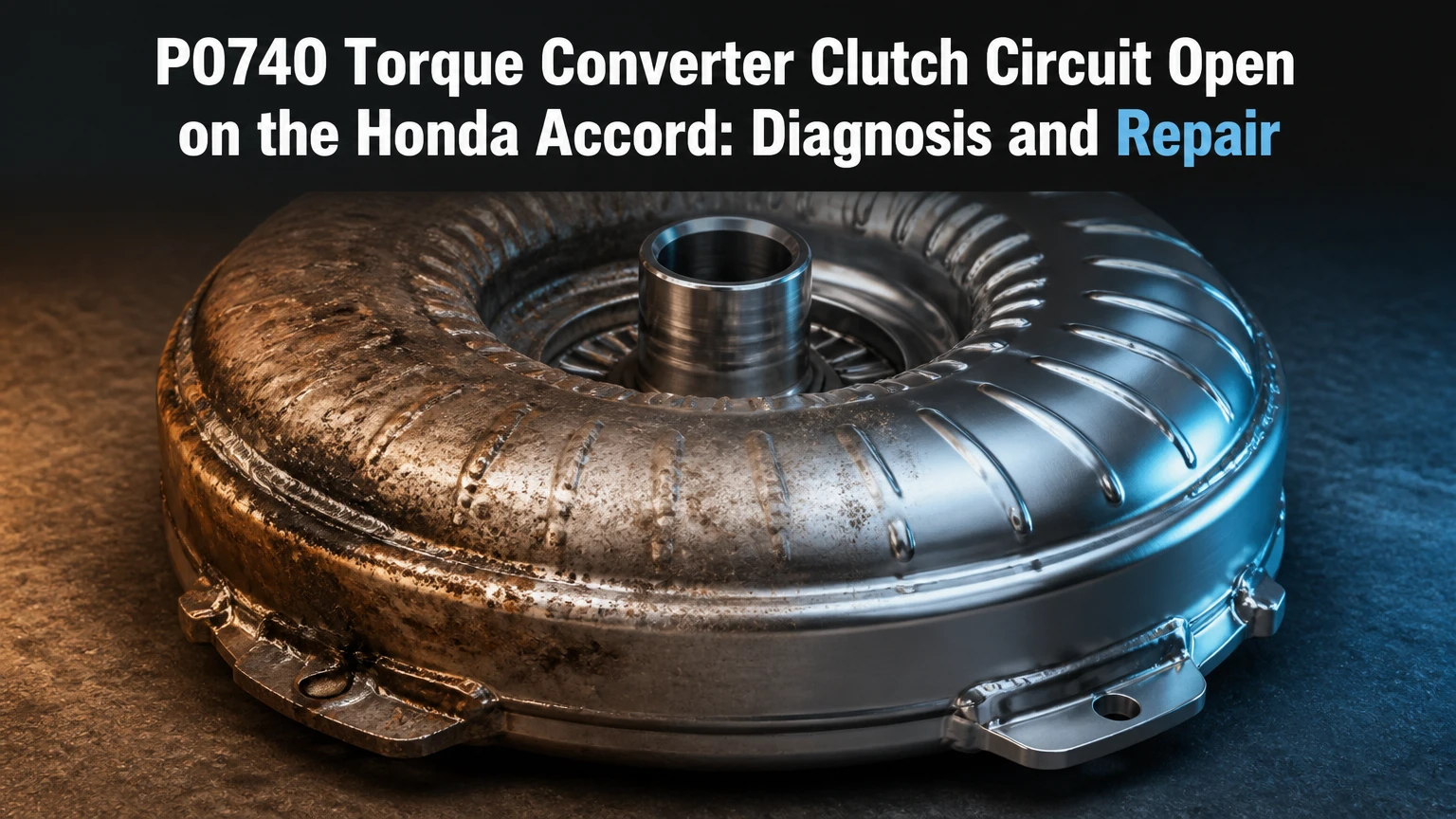
A P0740 code on the Honda Accord means the TCM (transmission control module) has detected an open circuit in the torque converter clutch solenoid electrical circuit, and the most common cause on the Accord is a failed TCC solenoid whose internal coil winding has developed an open, followed by corrosion in the multi-pin transmission harness connector that breaks electrical continuity to the solenoid.
This is an electrical circuit fault, not a hydraulic TCC failure: P0740 specifically indicates the wiring or solenoid coil circuit cannot carry current, not that the torque converter clutch is slipping or failing mechanically.
P0740 vs. P0741: Understanding the Difference
These two codes are often confused and produce different symptoms. P0740 is a circuit fault: the wiring or solenoid coil is open (no current path). The TCC cannot engage at all because the electrical command cannot reach the solenoid. P0741 is a range or performance fault: the TCC is commanded on but the transmission ratio does not match the expected locked-converter ratio, indicating the TCC is slipping hydraulically. P0741 is the hydraulic shudder code; P0740 is the electrical open code.
With P0740 active, the Accord may experience reduced fuel economy (the TCC cannot lock the converter at highway cruise, causing continuous fluid slippage), a flare in RPM at highway cruise, or a DRL pattern where the D4 gear indicator behaves unusually. The transmission may still drive in all forward gears, but TCC lock-up will not occur.
The Honda Accord Automatic Transmission Connector: A Known Failure Point
Honda automatic transmissions use a multi-pin electrical connector at the side of the transmission housing that carries signals to and from all solenoids, the speed sensors, and the temperature sensor. On Accords from 1994 to 2017, this connector is positioned low on the transmission, where it is exposed to road water, salt spray, and temperature cycling. The connector uses female pins that develop corrosion and oxide buildup that increases pin resistance to the point of an effective open circuit.
The connector can test as electrically continuous with a basic continuity test (because even corroded pins maintain minimal contact), but under the small signal voltages and currents of solenoid operation, the resistance is too high for the TCM to complete the circuit and the P0740 open code sets. This is why the connector must be tested under load, not just with a continuity test.
Inspection: disconnect the transmission main harness connector (typically a 20 to 26 pin connector on the side of the transmission). Look for: green or white oxidation on any pin terminals, moisture inside the connector body, deformed or backed-out terminal pins, or melting or discoloration suggesting a previous heat event. Clean corroded terminals with electronic contact cleaner and a small brass bristle brush. Apply dielectric grease to the connector before reinstallation. If any pin is severely damaged, the connector or harness section requires replacement.
Cause 2: Failed TCC Solenoid
Honda automatic transmissions use a linear solenoid pack that includes the TCC control solenoid. On the 4-speed automatic (BAXA, MPWA, BYBA series) and 5-speed automatics used in the Accord, the TCC solenoid is part of the solenoid assembly mounted inside the transmission on the valve body. When the solenoid’s internal copper wire coil develops an open break (from heat cycling and age), the circuit is permanently open and P0740 sets.
Solenoid resistance test: locate the TCC solenoid terminal in the transmission connector (refer to the vehicle-specific wiring diagram for pin identification). Measure resistance between the TCC solenoid terminal and chassis ground with the connector unplugged from the TCM side. On Honda automatic TCC solenoids, normal resistance is typically 12 to 25 ohms. An infinite (OL) reading on the meter confirms an open circuit in the solenoid coil. A reading of zero ohms indicates a shorted coil.
On transmissions where the solenoid assembly is externally accessible (removable from the transmission without full disassembly), the solenoid pack replacement is a moderate DIY job costing $80 to $200 in parts. On transmissions requiring valve body access, shop labor adds $300 to $600.
Cause 3: Open in the Wiring Harness Between Connector and TCM
The wiring between the transmission connector and the TCM can develop an internal break from repeated flexing, chafing against a frame rail or bracket, or corrosion in the middle of the wire that is not visible from either end. This type of fault is the most difficult to find because it requires a wiring diagram, a test light or voltmeter, and systematic probing along the wire path between the connector and the TCM.
Diagnosis: with the transmission connector unplugged and the TCM side of the harness accessible, check continuity from the TCM side of the TCC circuit terminal to the transmission connector terminal. Infinite resistance indicates a break somewhere in between. Flex and wiggle the harness between the connector and the TCM while monitoring continuity: intermittent continuity that changes with harness movement confirms an internal wire break at a flex point.
Cause 4: TCM Internal Failure
The TCM (transmission control module) drives the TCC solenoid with a controlled ground signal. If the TCM’s output driver for the TCC circuit fails internally (from overheating, moisture, or age), it cannot pull the solenoid circuit to ground and P0740 sets. TCM failure is the least common cause and should be confirmed only after verifying the solenoid, connector, and wiring are all fault-free.
TCM fault confirmation: measure voltage at the TCC solenoid terminal at the transmission connector with the ignition on. Battery voltage (12V) should be present (this is the solenoid supply voltage). Then ground the TCC terminal directly and verify the solenoid clicks: if it does, the solenoid and wiring are fine and the TCM output driver is suspect. TCM replacement costs $150 to $400 for a used unit or $400 to $900 for a remanufactured one.
Cause Hierarchy for Honda Accord P0740
Cause | Test Method | Result Indicating This Cause | Repair | Cost Range |
|---|---|---|---|---|
Corroded transmission connector | Visual inspection; load test of pins | Green oxidation; high pin resistance under load | Clean connector; apply dielectric grease | $0 to $150 (connector replacement if needed) |
Failed TCC solenoid (open coil) | Resistance test at solenoid terminals | Infinite (OL) resistance reading | Solenoid or solenoid pack replacement | $150 to $600 |
Open in harness wiring | Continuity test with wiggle test | Intermittent or infinite continuity | Harness repair or replacement | $100 to $400 |
TCM output driver failure | Ground solenoid directly; verify solenoid clicks | Solenoid clicks but P0740 persists | TCM replacement | $300 to $900 |
Accord Generation-Specific Notes
6th generation Accord (1998 to 2002): the BAXA and MPWA 4-speed automatics have a documented history of solenoid failures including the TCC solenoid. The entire linear solenoid assembly is the most common repair at $200 to $350 for the assembly. Ensure the ATF is Honda ATF-Z1 or DW-1 specifically: incorrect ATF accelerates solenoid wear.
7th generation Accord (2003 to 2007): similar solenoid and connector issues apply. Additionally, the 7th generation transmission uses a 5-speed that is sensitive to ATF quality. Check the ATF level and condition when diagnosing P0740: dark, burnt ATF can cause solenoid stiction that eventually damages the coil.
8th generation Accord (2008 to 2012): the transmission harness connector is particularly vulnerable on this generation in humid climates. Clean the connector before condemning any solenoid.
“I pulled the transmission connector on my Accord and it looked fine from the outside, but when I touched the terminals with my finger I could feel corrosion grit on three of them. Cleaned them out with contact cleaner and a small brush, put dielectric grease on the connector, plugged it back in, and the P0740 never came back. I had already ordered a solenoid I did not need. Always check the connector first on a Honda.” — Sandra Obi, 2006 Honda Accord EX 2.4L 5-speed automatic
Frequently Asked Questions
Is the Honda Accord driveable with a P0740?
Yes, but with reduced fuel economy and without torque converter lock-up at highway speeds. The transmission will still shift through all gears. The engine will rev higher than normal at highway cruise because the converter is not locking up and fluid is slipping inside the converter continuously. Long-term driving without TCC lock-up increases heat in the transmission fluid, which accelerates fluid degradation.
Can I fix P0740 by changing the transmission fluid?
No. P0740 is an electrical circuit fault: changing the fluid does not affect solenoid coil resistance or connector pin corrosion. If the fluid is old or burnt, change it for general maintenance, but do not expect it to clear P0740. A fluid change is appropriate maintenance alongside the electrical diagnosis but is not a substitute for it.
What Honda transmission fluid should I use?
Use Honda Genuine ATF DW-1 (current specification) for all Honda automatic transmissions regardless of generation. This fluid replaced ATF-Z1 and is backward compatible. Do not use Dexron, Mercon, or multi-vehicle ATF fluids in a Honda automatic transmission: the Honda fluid contains specific friction modifier chemistry that the solenoids and clutch packs require. Incorrect fluid causes degraded shift quality and can damage solenoids.
Will P0740 trigger a torque converter replacement?
Not necessarily. The torque converter itself is usually fine when P0740 is present: the code indicates an electrical open, not a failed torque converter. Only if additional codes like P0741 are present (TCC slipping) or if there is physical evidence of converter damage (metal particles in the fluid, shudder at lock-up speed) should the converter itself be evaluated.
The Bottom Line
P0740 on the Honda Accord is an electrical diagnosis, not a transmission rebuild. Clean and inspect the transmission harness connector as the first step: it takes 20 minutes and resolves a significant percentage of Honda P0740 cases. If the connector is clean and tight, measure solenoid resistance at the connector terminal. An open reading confirms the solenoid coil failure that requires solenoid replacement. Work through the connector, solenoid, and harness in sequence before considering TCM replacement.