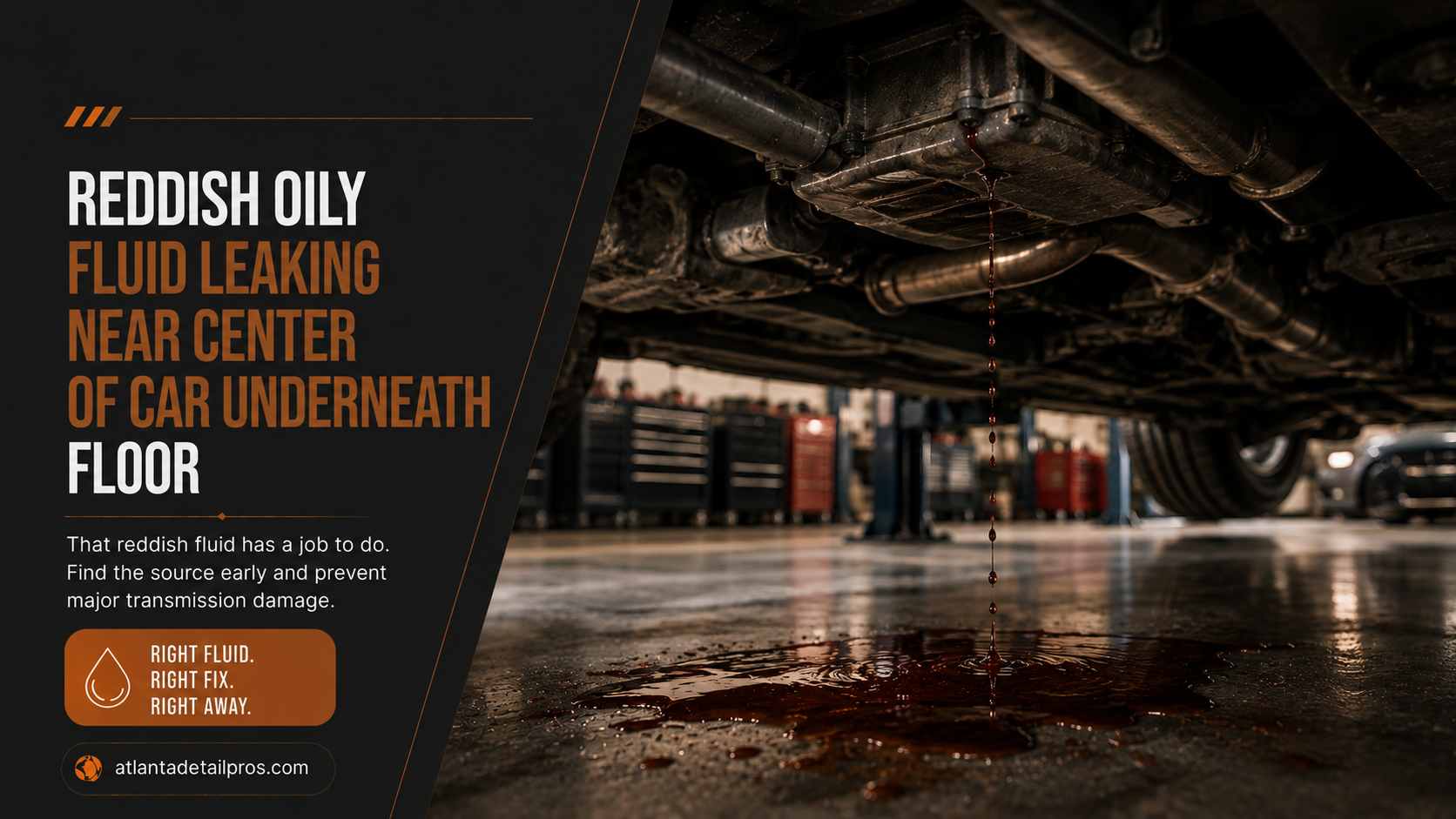
Reddish oily fluid leaking from near the center of the car underneath the floor is almost always automatic transmission fluid, and the most common source is a leaking transmission pan gasket, cooler line fitting, or front pump seal.
The color is the primary diagnostic indicator: automatic transmission fluid (ATF) is dyed red or pinkish-red from the factory, which makes it one of the most identifiable fluids under a vehicle. Power steering fluid is also red or reddish-pink on many vehicles but leaks from the front of the car near the steering rack, not the center floor area. If you are seeing red fluid specifically under the transmission tunnel or center hump of the floor, the transmission or transfer case is the most likely source.
The leak location matters as much as the color. A transmission sits roughly under the front seat area on most rear-wheel-drive vehicles, and slightly forward of that on front-wheel-drive platforms where the transaxle is integrated with the engine. Identifying the precise drip point before calling a shop saves you money and gets the diagnosis right the first time.
Automatic transmission fluid leaks are not emergencies if the transmission is still shifting normally and the fluid level is not critically low. They do become emergencies quickly because ATF performs double duty as both a lubricant and a hydraulic fluid: when the level drops enough to cause aeration in the pump, the transmission can slip, overheat, or fail within a single long drive.
What Fluid Is Actually Leaking: Identification Guide
Fluid | Color | Texture | Smell | Typical Leak Location |
|---|---|---|---|---|
Automatic transmission fluid | Red to pinkish-red (dark reddish-brown when old) | Thin and oily | Slightly sweet, synthetic | Center floor, under transmission tunnel |
Power steering fluid | Red or amber | Thin | Mild mineral or synthetic oil | Front of car, near steering rack |
Engine coolant | Green, orange, pink, or blue-green | Watery, slight slickness | Sweet, slightly fruity | Near radiator, hose connections, front of engine |
Differential gear oil | Dark brown to black | Thick | Sulfur, sharp chemical | Rear axle area |
Engine oil | Amber to dark brown or black | Moderately thick | Burnt oil | Under engine, forward of transmission |
Transfer case fluid | Red, amber, or dark (varies) | Thin to moderate | Mineral or gear oil | Center, aft of transmission |
Common Sources of Red Fluid Leaks Under the Center Floor
Transmission Pan Gasket
The transmission pan sits on the bottom of the automatic transmission and is sealed with a gasket or RTV. This is the single most common source of ATF leaks. The pan gasket compresses over years of thermal cycling and eventually allows fluid to seep around the perimeter. Leaks from the pan gasket typically leave a broad wet area across the bottom face of the pan with fluid dripping from the lowest point. This is generally the most DIY-accessible transmission leak: drain the fluid, remove the pan, clean the mating surfaces, install a new gasket, reinstall the pan, and refill with the correct ATF specification.
Transmission Cooler Lines
All automatic transmissions route ATF through an external cooler, either integrated into the radiator or a separate transmission cooler mounted in front of the radiator. The rubber and metal lines running from the transmission to the cooler develop leaks at the fittings where rubber meets metal, or along the rubber sections that degrade with age. Cooler line leaks can deposit fluid at multiple points along the line’s path from the front of the transmission toward the front of the vehicle. If the fluid trail leads forward from the center, follow it.
Front Pump Seal (Input Shaft Seal)
The front pump seal sits at the very front of the transmission where the torque converter input shaft enters the pump housing. This seal sees both rotational contact and transmission line pressure. A failing front pump seal typically produces a leak from the bell housing area, where the transmission meets the engine. The fluid pattern often resembles engine oil leaks in location, which can confuse the diagnosis. The distinction is straightforward: transmission fluid is red, engine oil is not.
Shift Shaft Seal
The shift shaft seal sits where the gear selector shaft exits the transmission case. It is a relatively small seal and the volume of fluid it can leak is usually modest, but over time it can drain enough fluid to cause problems.
Transfer Case Seal (Four-Wheel-Drive Vehicles)
On four-wheel-drive and all-wheel-drive vehicles, the transfer case sits directly behind the transmission under the center floor area. Transfer case fluid varies in specification (some use ATF, others use gear oil, others use proprietary fluid) but can be red or reddish, leading to confusion with a transmission leak. A transfer case seal leak typically shows fluid at the output shaft where the front or rear driveshaft attaches.
Cause Hierarchy Table
Cause | Symptom Pattern | Repair Cost (Independent Shop) |
|---|---|---|
Transmission pan gasket | Broad wet area on pan bottom, steady drip | $80 to $200 including fluid refill |
Cooler line fitting leak | Fluid trail leading forward, wet at fitting junction | $60 to $180 per line |
Front pump seal | Leak at bell housing, may be confused with engine leak | $300 to $600 (requires trans removal on some platforms) |
Shift shaft seal | Minor drip at selector shaft exit point | $60 to $150 |
Transfer case output shaft seal | Leak at driveshaft connection point on transfer case | $100 to $250 |
Torque converter seal | Large volume leak from bell housing | $400 to $800 (major job) |
How to Confirm the Fluid Level and Assess Urgency
Most rear-wheel-drive automatic transmissions have a dipstick accessible from the engine bay, typically located toward the firewall on the passenger side. Some front-wheel-drive transaxles and many modern transmissions are “sealed for life” and require a fill plug check on the pan, similar to a differential.
If your vehicle has a dipstick: 1. Warm the transmission by driving for 10 to 15 minutes in stop-and-go conditions. 2. Park on a level surface with the engine idling. 3. Pull the dipstick, wipe it clean, reinsert fully, pull again and read the level. 4. Hot level should fall between the MIN and MAX marks on the hot side of the dipstick.
A level below MIN after visible leaking means the leak rate is significant and the vehicle should not be driven far before the repair is completed.
Urgency Assessment
Leak Rate | Transmission Behavior | Action |
|---|---|---|
Small stain, fluid level normal, shifts fine | None noted | Schedule repair within 2 weeks |
Wet puddle, level slightly low, shifts normally | Minor hesitation possible | Repair within 3 to 5 days, top off fluid if needed |
Active drip, level below MIN, occasional slip | Shift slip or hesitation | Do not drive: repair immediately or tow |
Large puddle, level critically low | Harsh shifts, overheating, slip | Do not drive: tow |
“My 4Runner left a small red spot in the parking lot every day for weeks. I assumed it was nothing serious since it was shifting fine. Eventually it started slipping on the highway. Turned out the cooler line had been seeping and the level had dropped two quarts without me realizing. The repair itself was inexpensive but I came very close to burning the transmission.” : Vanessa Ruiz, 2016 Toyota 4Runner owner
Vehicle-Specific Notes
GM 4L60E and 4L80E transmissions (used in Chevrolet and GMC trucks and SUVs through the mid-2000s) are extremely common leakers at the pan gasket and shift shaft seal. The pan gaskets on these units are thin and tend to be over-tightened at the factory, which accelerates failure.
Ford 4R70W and 5R55 transmissions (Explorer, F-150, Mustang) frequently develop front pump seal leaks and cooler line fitting corrosion, particularly in northern states where road salt accelerates line degradation.
Chrysler 45RFE and 68RFE transmissions (Ram trucks) are known for pan gasket failures and, on high-mileage examples, front pump seal wear.
Toyota A340, A750, and A960 series transmissions are generally reliable but develop pan gasket and cooler line leaks after 120,000 to 150,000 miles without fluid service.
DIY Diagnosis: Find the Exact Source
Step 1: The Cardboard Test
Park on cardboard or clean concrete overnight after a drive. In the morning, note the position of the drip relative to the vehicle’s wheelbase. Under the front seats: transmission. Behind the rear axle: rear differential (and the fluid will be dark, not red). Under the engine: engine oil or coolant. The cardboard test positions the drip point and rules out multiple components in one step.
Step 2: UV Dye Confirmation
Most auto parts stores sell UV dye kits for transmission fluid. Add the dye, drive for 30 minutes, then use the UV light to trace the exact leak path. UV dye makes distinguishing between ATF and power steering fluid definitive even when both are red.
Step 3: Clean and Inspect
Degrease the entire underside of the transmission with brake cleaner. Drive for 20 minutes including highway speed and some stop-and-go. Inspect immediately after parking. The first wet spot to reappear identifies the source.
FAQ
Is red fluid leaking from my car dangerous to drive on?
It depends on the volume and the effect on fluid level. A minor seep that does not affect the transmission fluid level or shift quality is not an immediate danger but should be repaired promptly. A moderate to severe leak that drops the fluid level can cause the transmission to slip, overheat, or fail within a single long drive. Check the dipstick first before deciding whether to drive.
Can I use stop-leak product in my automatic transmission?
Transmission stop-leak products can swell rubber seals and slow minor seepage. They will not repair a torn gasket, a failed metal line fitting, or a seal that has physically separated. Use them only as a temporary measure with the understanding that proper repair is still required. Some formulations are not compatible with certain ATF specifications: always verify compatibility with your transmission’s required fluid type.
How often should transmission fluid be changed to prevent leaks?
Most automatic transmissions benefit from a fluid and filter service every 30,000 to 60,000 miles, though many manufacturers specify longer intervals for normal driving conditions. Fresh fluid maintains the additive package that conditions and preserves seals. Degraded fluid accelerates seal hardening and shrinkage, which contributes directly to the leak you are experiencing.
What does it mean if the red fluid is very dark or brownish?
Dark reddish-brown to brown ATF indicates the fluid has been in service past its effective service life and the additive package is depleted. This is common in high-mileage vehicles where the fluid was never changed. The darker fluid itself does not indicate internal damage, but it does mean the seals and clutch packs have been running in a degraded lubrication environment for an extended period.
Can a transmission seal leak cause damage to the ground underneath my car?
Transmission fluid is highly toxic to vegetation and can stain concrete permanently. Some municipalities consider automotive fluid spills a reportable environmental event if they reach storm drains. Beyond the environmental concern, a large fluid loss creates a slipping hazard for other vehicles. Addressing the leak promptly is both the practical and responsible course of action.
Bottom Line
Red fluid under the center of the car is almost always automatic transmission fluid, and the source is almost always a pan gasket, cooler line, or front pump seal.
None of these is a catastrophic failure on its own, but ATF serves as both lubricant and hydraulic medium: once the level drops far enough, the pump aerates and shift quality degrades rapidly. The window between a minor leak and transmission damage can be as short as one highway drive.
Check the fluid level before the next trip. Identify the source using the clean-and-inspect method or UV dye. Then get it repaired with urgency proportional to the leak rate. A pan gasket job done today costs $80 to $200. A replacement transmission costs $1,500 to $4,000 installed. The math is straightforward.