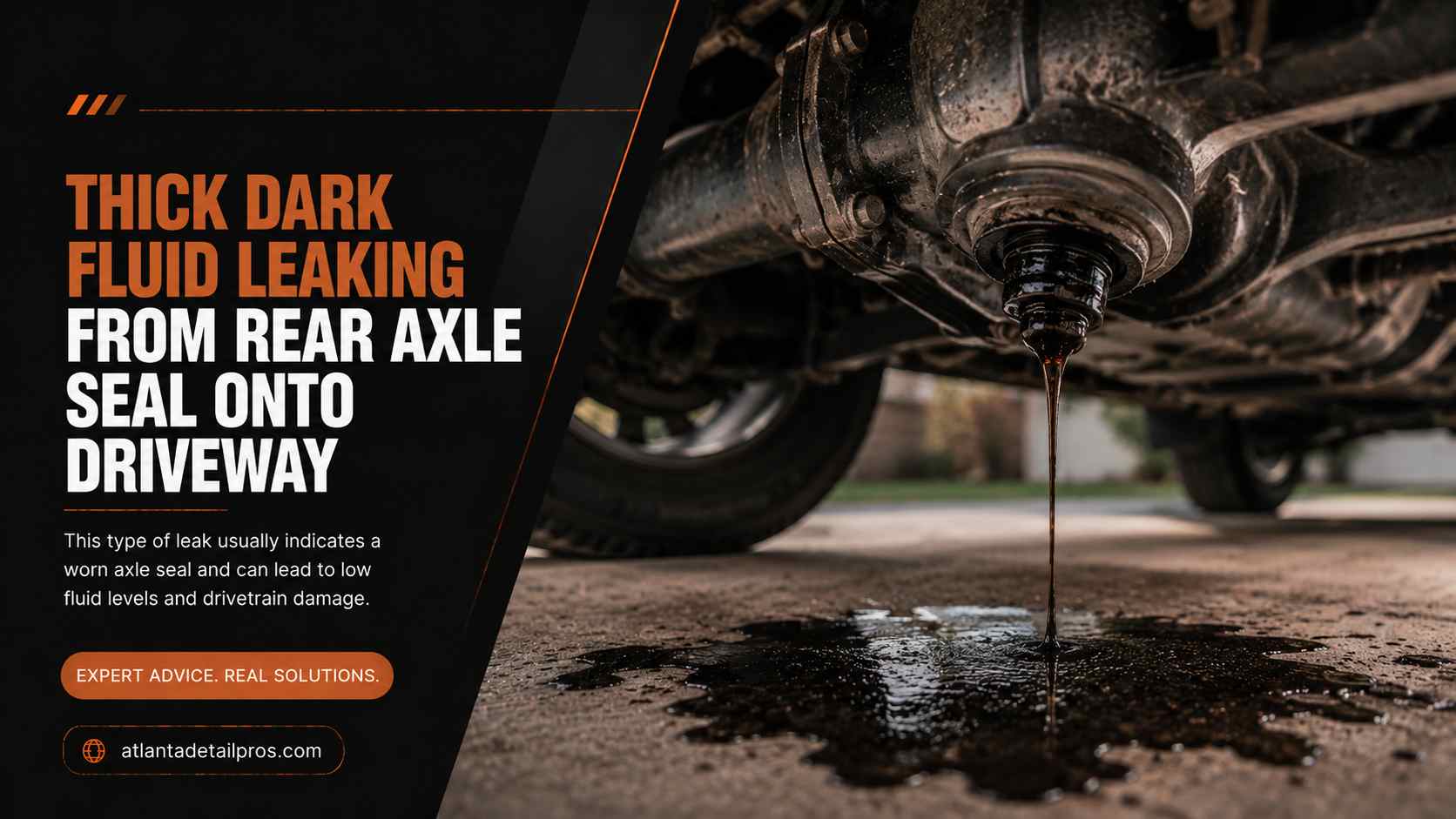
Thick dark fluid on your driveway beneath the rear axle is almost certainly gear oil escaping through a failed axle shaft seal, and the most common triggers are seal lip wear from age and mileage, a worn axle bearing allowing shaft movement that destroys the seal, or a clogged differential vent creating overpressure that blows past an otherwise serviceable seal.
The fluid’s dark color and thick consistency distinguish it immediately from brake fluid (thin and clear to pale yellow), transmission fluid (red to reddish-brown), and engine oil (which leaks further forward). Finding the puddle directly under the rear axle tube, inboard of a rear wheel, confirms the axle seal as the source with near certainty.
Rear axle seals are inexpensive parts: most cost $8 to $25. The labor to access and replace them is what drives the bill, and that labor cost is dwarfed by what a dry differential does to a ring and pinion gear set. Catching this leak at the driveway-puddle stage means you still have a straightforward seal replacement ahead of you. Catching it after the differential has run dry means a rebuild or housing replacement.
This article covers exactly where rear axle seal leaks originate, how to confirm the source, and what your repair options look like at an independent shop versus doing it yourself.
What a Rear Axle Seal Actually Does
The axle shaft seal sits at the point where the axle shaft passes through the differential housing or axle tube and exits toward the wheel hub. Its job is to retain differential gear oil inside the housing while keeping road contamination outside. The seal consists of a metal outer ring pressed into the axle tube bore and a rubber lip that rides on a precision-ground surface of the axle shaft.
That rubber lip is the failure point. After years of heat cycling, the lip hardens and loses the elasticity that keeps it in contact with the shaft. Once contact becomes inconsistent, gear oil works past the lip on every revolution and migrates outward along the axle shaft toward the wheel, eventually reaching the hub flange and dripping onto the driveway.
Why the Driveway Puddle Forms Where It Does
The fluid trail from an axle seal leak follows the axle shaft outward. On a vehicle parked overnight, oil accumulates in the drum or disc hat area and drips from the lowest accessible point: the bottom of the backing plate or the inner edge of the wheel. The driveway puddle is typically positioned inboard of the rear tire, slightly forward of the rear axle centerline depending on how the vehicle is parked.
On vehicles with rear drum brakes, gear oil from a failed axle seal contaminates the brake shoe friction material. Contaminated shoes lose coefficient of friction unpredictably and may perform adequately until heat builds during a long stop, then fade suddenly. This is why rear axle seal leaks on drum-brake vehicles are treated with greater urgency than the fluid volume alone might suggest.
Root Causes and Failure Hierarchy
Seal Lip Wear from Age and Mileage
The most common cause. Rubber deteriorates. Most axle seals have a service life of 80,000 to 150,000 miles under normal conditions, though heat, towing, off-road use, and infrequent fluid changes shorten that range. A seal worn from mileage is replaced and the job is complete.
Worn Axle Shaft Bearing
The axle shaft bearing sits inside the axle tube, inboard of the seal, holding the shaft in precise alignment. When the bearing wears, the shaft develops runout: a slight wobble on each revolution. That wobble causes the axle shaft to contact the seal lip unevenly, accelerating wear on one arc of the lip. A replacement seal installed on a worn bearing will fail early, sometimes within months. On most solid rear axle vehicles the bearing and seal are replaced together as a unit.
Clogged Differential Vent
The differential housing breathes through a vent tube or vent plug, typically mounted near the top of the housing. As the differential heats during operation, air and vapor expand inside the housing and the vent releases that pressure. When the vent clogs with road grime or mud, internal pressure builds and pushes gear oil past the axle seals and pinion seal at a rate far beyond normal seepage. Multiple seals weeping simultaneously, or a fresh seal leaking immediately after replacement, points to vent restriction as the root cause.
Axle Shaft Wear at the Seal Journal
On very high-mileage vehicles, the axle shaft can develop a wear groove where the seal lip contacts it. Even a new seal installed over a grooved shaft will leak. The fix is axle shaft replacement or installation of a speedy sleeve: a thin stainless sleeve pressed over the worn journal to restore a smooth sealing surface.
Cause Hierarchy Table
Cause | Distinguishing Sign | Typical Repair Cost (Shop) |
|---|---|---|
Seal lip wear from age or mileage | Clean oil trail from axle tube, bearing feels solid | $80 to $200 per side |
Worn axle bearing and seal | Rumble or growl from rear axle under load | $150 to $320 per side |
Clogged differential vent | Multiple seals seeping, fresh seal fails quickly | $20 to $60 vent cleaning plus seal cost |
Axle shaft journal wear | New seal leaks immediately at groove location | $200 to $450 shaft replacement or sleeve |
Differential overfilled after service | Fluid loss from multiple points post-service | $40 to $80 drain to correct level |
How to Confirm the Source Is the Axle Seal
Step 1: Locate the Puddle Precisely
Measure the puddle position relative to the rear axle centerline and the wheel. Directly under the axle tube inboard of the wheel: axle seal. Under the center of the differential housing: pinion seal or cover gasket. Location alone narrows the diagnosis before you get under the vehicle.
Step 2: Check the Bearing Condition
With the wheel off and the vehicle on jack stands, grip the axle shaft or hub flange and attempt to move it in and out along the shaft axis. Any detectable play indicates bearing wear and means the bearing must be replaced alongside the seal. Also rotate the hub by hand: roughness or grinding confirms the bearing is past its service life.
Step 3: Inspect the Brake Components
On drum brake vehicles, remove the drum and inspect the shoe friction material. Gear oil contamination appears as a wet, darkened stain spreading from the axle tube end. Contaminated shoes must be replaced along with the seal: cleaning contaminated brake shoes does not restore friction properties reliably.
Urgency Assessment
Puddle Size | Brake Behavior | Recommended Action |
|---|---|---|
Small spot under 2 inches diameter | Normal | Schedule repair within 1 week |
Wet streak on axle tube, small puddle | Normal | Repair within 3 to 5 days |
Oil visible on drum or disc hat | Soft or grabby rear brake feel | Repair immediately: safety concern |
Large puddle, gear oil level low | Any change in rear brake feel | Do not drive: tow to shop |
“Noticed a small dark spot under the passenger rear for a few weeks. Finally looked underneath and found gear oil all over the inside of the drum. Both rear shoes were soaked. By the time I got it fixed it was a seal, bearing, shoes, and drum job. Would’ve been seal and bearing only if I’d caught it at the first spot on the driveway.” : Marcus Delgado, 2005 Ford Explorer Sport Trac owner
Repair Costs (Independent Shop)
Repair Scope | Typical Cost Range |
|---|---|
Axle shaft seal only, one side | $80 to $160 |
Axle shaft seal and bearing, one side | $150 to $320 |
Both sides, seals and bearings | $280 to $580 |
Add rear brake shoes if contaminated | $80 to $150 additional |
Add rear brake drums if scored | $60 to $120 additional |
Axle shaft replacement if journal worn | $180 to $350 additional |
FAQs
Can I drive with a leaking rear axle seal?
Short distances with no hard braking: cautiously, while monitoring the differential fluid level and brake feel before each trip. Any drive where the rear brakes feel soft, grabby, or inconsistent means gear oil has reached the friction material and the vehicle should not be driven further. Check the differential fill plug level before each drive.
How do I know if the axle bearing needs replacing along with the seal?
With the wheel removed and the vehicle on jack stands, grip the hub flange and push and pull along the shaft axis. Any movement confirms bearing wear. Rotate the hub slowly by hand: roughness or a notchy feeling confirms the bearing is past its service life. Replace both the seal and bearing as a unit.
What happens if gear oil gets into rear drum brakes?
Gear oil penetrates brake shoe friction material quickly and cannot be cleaned out effectively. Contaminated shoes lose their friction coefficient and become unpredictable under hard braking, particularly when the drums are hot. Both rear brake shoes must be replaced, and the drum should be inspected for scoring or oil impregnation.
Is it safe to top off the differential and drive until the repair is scheduled?
Topping off is a reasonable short-term measure to protect the gear set, but it does not reduce the risk to the rear brakes if the leak rate is moderate or high. If you are adding more than a few ounces per week, the leak rate is significant enough to require immediate repair.
Will the leak get worse over time?
Yes. The hardened seal lip loses more contact area as mileage accumulates and differential heat cycles continue. A seal that currently produces a small spot on the driveway will eventually produce a steady drip. Cold-weather driving tends to reveal or worsen axle seal leaks that were borderline during warmer months.
Bottom Line
Thick dark fluid under your rear axle is gear oil from a failed axle shaft seal, and the clock on your rear brake system starts the moment that oil reaches the drum or disc hat.
A driveway puddle at the early stage is the cheapest version of this repair: a seal and bearing job costs $150 to $320 per side at a shop. The version where gear oil has soaked the brake shoes adds another $150 to $270 to the bill and introduces a genuine stopping-distance safety risk.
Check the differential fluid level through the fill plug now. Remove a rear wheel if you can and look at the axle tube end for oil residue. If you see gear oil anywhere near the drum or disc hat, do not drive the vehicle until the repair is complete. Early action keeps this a simple seal job. Delayed action makes it a brake job too.