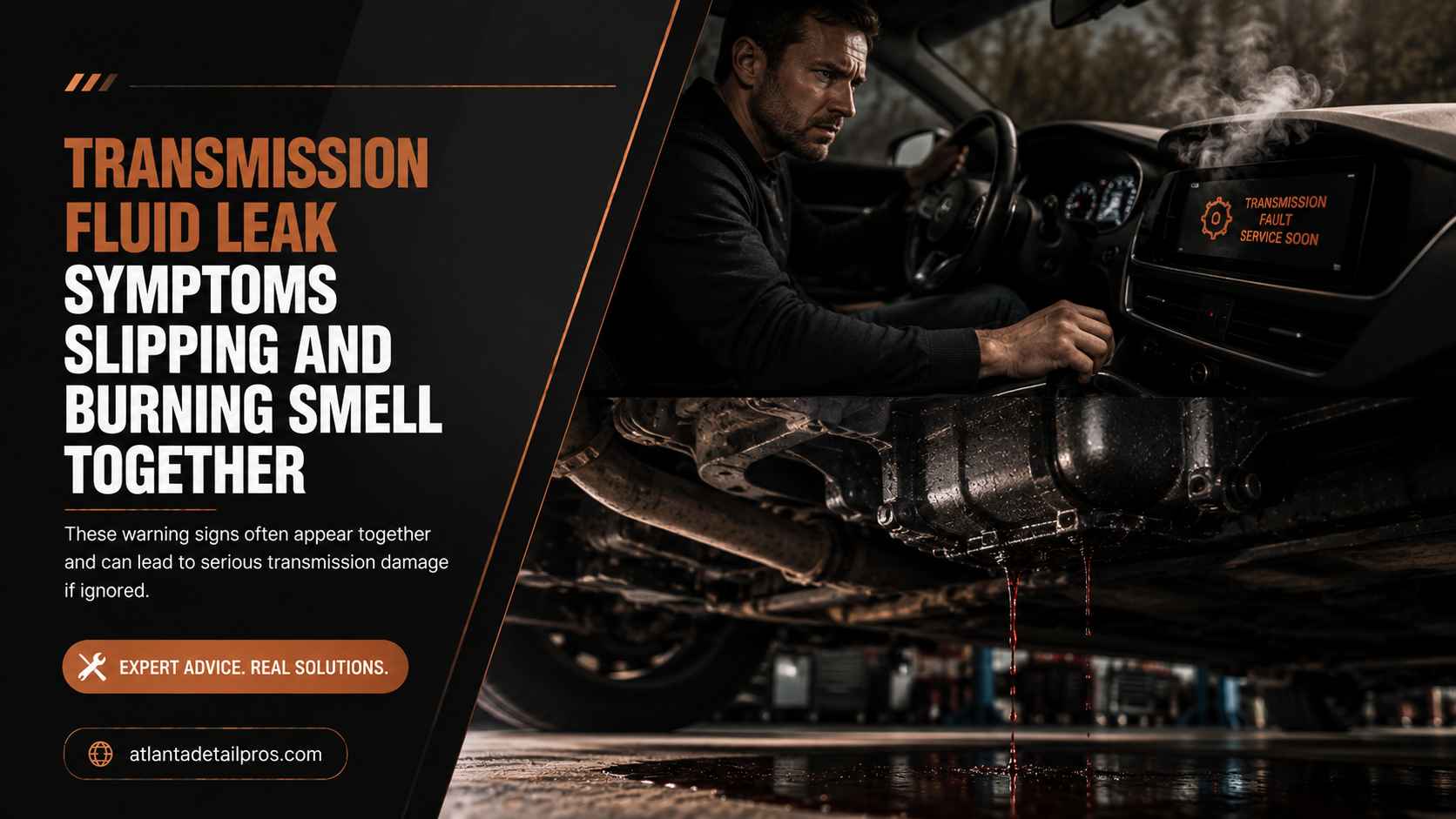
When transmission slipping and a burning smell occur together, the automatic transmission is operating with critically low or severely degraded fluid, and continued driving risks destroying the clutch packs and band friction material within a single trip.
These two symptoms together are not a coincidence: they are sequential events driven by the same cause. Fluid loss reduces the hydraulic pressure that applies the clutch packs and bands. As those components slip against each other under load without full hydraulic engagement, friction generates heat. That heat degrades whatever fluid remains, producing the acrid burning smell you are detecting. The longer you drive in this state, the less recoverable the damage becomes.
A transmission that slips occasionally and smells faintly of burnt fluid might be salvageable with a fluid service and leak repair. A transmission that slips consistently and smells strongly of burning on every drive has almost certainly sustained clutch pack damage, and the repair conversation changes from a $200 fluid service to a $1,500 to $4,000 rebuild or replacement.
This article covers the exact mechanism of why slipping and burning smell occur together, how to assess where your specific situation falls on the damage scale, and what the repair options look like from cheapest to most expensive.
How Fluid Loss Causes Both Symptoms
Why Low Fluid Causes Slipping
An automatic transmission is a hydraulic machine. Every clutch pack and band engagement that produces a gear change is driven by pressurized transmission fluid delivered through the valve body. The transmission pump, driven by the torque converter, maintains system pressure any time the engine is running.
When fluid level drops below the pickup tube inlet inside the transmission pan, the pump begins drawing air. Air does not transmit hydraulic pressure. The result is a drop in line pressure that prevents clutch packs from engaging fully. The clutch disc and steel plate stack spins against each other without full contact force: this is slipping. The driver experiences it as a loss of drive, a sudden RPM flare without a corresponding increase in vehicle speed, or a shudder during acceleration.
Why Slipping Causes Burning Smell
Clutch disc friction material generates substantial heat when it slips. The paper-based or carbon friction material on the clutch discs operates safely within a temperature range when transmission fluid is cooling and lubricating the pack. When slipping elevates pack temperature past that range, the friction material begins to char. Charred friction material smells strongly and distinctively: a sharp, acrid burning smell that is different from burning oil and different from burning rubber. It has a chemical, almost electrical quality. This is the smell of ATF and clutch material degrading simultaneously.
Symptom Combination Severity Table
Symptom Combination | Likely Fluid Status | Transmission Condition | Recommended Action |
|---|---|---|---|
Occasional slip on hard acceleration, faint smell | Low but not critical | Early damage possible | Check fluid immediately and repair leak |
Frequent slip in multiple gears, moderate smell | Critically low or degraded | Clutch pack damage likely | Do not drive: fluid service and diagnosis |
Slip in all forward gears, strong burning smell | Near-empty or fully degraded | Severe internal damage | Do not drive: rebuild or replacement likely |
Slip in reverse only, mild smell | Low fluid or worn reverse band | Band wear or fluid issue | Immediate diagnosis required |
Harsh shifts plus slip plus smell | Fluid gone or contaminated | Valve body and clutch damage | Do not drive: major repair required |
Common Leak Sources That Lead to This Symptom Pair
Pan Gasket Failure
A degraded transmission pan gasket can lose fluid at a significant rate if the leak has been progressing for weeks or months undetected. By the time slipping begins, the pan has often lost multiple quarts. This is the most common scenario: a slow leak that was never noticed because the driver did not monitor the fluid level between service intervals.
Cooler Line Rupture
Transmission cooler lines run from the transmission to the cooler at the front of the vehicle and back. A line that ruptures rather than seeps can drain the transmission within a single drive. If the slipping and burning smell appeared suddenly rather than progressively, a ruptured cooler line is a strong candidate.
Front Pump Seal Blow-Out
The front pump seal can fail progressively or acutely. An acute failure dumps fluid from the bell housing rapidly, often presenting as sudden slipping and smell without prior warning, combined with a visible red fluid trail from the bell housing area.
Torque Converter Seal Failure
The torque converter seal sits inside the bell housing where the converter neck passes into the pump. A failing torque converter seal can drain significant fluid volume into the bell housing and onto the ground rapidly. This is typically a large-volume leak that accelerates fluid loss far faster than a pan gasket seep.
How to Assess the Damage Before Going to a Shop
Check the Fluid Level and Color
If your transmission has a dipstick: with the engine warm and idling in Park, pull and read the dipstick. If the fluid is below MIN, you have identified the fluid loss. More importantly, note the color. Fresh ATF is bright red. Slightly aged ATF is darker red. ATF that has been subjected to clutch pack overheating is dark brown to black with visible contamination and a strong burned odor even on the dipstick. Brown or black fluid with a burnt smell means internal damage has already occurred.
The Cardboard Floor Test
Park on clean concrete or cardboard immediately after noticing symptoms. Active drips while the vehicle sits confirm an ongoing leak. Red fluid under the center of the vehicle: transmission pan or cooler lines. Red fluid near the bell housing: front pump seal or torque converter seal. The location guides the shop toward the correct repair scope before they put it on a lift.
Leak Source and Repair Cost Table
Leak Source | Typical Repair Cost (Shop) | Prognosis If Fluid Damage Is Minor |
|---|---|---|
Pan gasket plus fluid service | $120 to $280 | Good: drain, new gasket, refill, test |
Cooler line replacement | $100 to $250 | Good if caught before severe slip damage |
Front pump seal | $350 to $700 | Moderate: depends on extent of slip damage |
Torque converter seal | $500 to $900 | Depends on whether converter is damaged |
Rebuild required, clutch packs damaged | $1,500 to $3,200 | Required if slip has caused disc charring |
Remanufactured transmission installed | $2,500 to $4,500 | Required if internal damage is severe |
“The truck started slipping going into third on the highway. I figured it was a tune issue and kept driving for two weeks. By the time I took it in the fluid was almost black and two clutch packs were glazed. Turned out it was a cooler line leak that would have been under $200 to fix. The rebuild was $2,800.” : Priya Shankar, 2013 Ram 1500 owner
Vehicle-Specific Notes
GM 4L60E and 4L80E transmissions are particularly vulnerable to this symptom combination because the pan gasket and cooler line fittings fail at similar mileages, typically 80,000 to 120,000 miles. The 4L60E has a known weakness in the 3-4 clutch pack that makes it sensitive to even moderate fluid degradation: once the fluid has overheated, the 3-4 pack fails first, producing slip specifically in third and fourth gear.
Ford 4R70W and 6R80 transmissions develop cooler line corrosion in northern states. The 6R80 has thin-walled aluminum cooler line connections that corrode through and produce sudden rather than gradual fluid loss, making the burning smell appear quickly without a prior slow-leak warning.
Honda transmissions with the BCLA and SLXA units (Accord, CR-V, Pilot) are sensitive to fluid contamination from overheating. Honda specifies a unique ATF formulation: using the wrong fluid accelerates clutch disc glazing and can trigger slip symptoms even with adequate fluid level.
Toyota A650E and A760E transmissions typically only develop this symptom combination after 150,000 miles unless a cooler line has ruptured. They are among the most robust units in the mid-size truck and SUV segment.
FAQs
If I add transmission fluid, will the slipping stop?
If the cause is low fluid level and no clutch damage has occurred, topping off may temporarily restore shift quality. This tells you the slip was hydraulic rather than mechanical and that damage may be limited. However, adding fluid does not repair the leak, and the transmission will slip again as the level drops. Topping off is a diagnostic step, not a fix.
What does burned transmission fluid smell like exactly?
Burned ATF has a sharp, acrid, chemical smell distinct from burning engine oil or rubber. It has a faintly electrical quality and tends to linger in the wheel wells and cabin. Fresh ATF smells mildly sweet. If you detect something sharply chemical and acrid rather than sweet, the fluid has overheated and clutch material may be involved.
Can a transmission recover from slipping and burning smell?
It depends on how long the transmission operated in that condition. If the slip was brief and the fluid, while low, is not yet dark or burned, a fluid service and leak repair may fully restore function. If the fluid is brown or black and the slip has been present for more than a few days of driving, clutch pack damage is likely and a rebuild evaluation is required.
How often should transmission fluid be inspected to prevent this situation?
Check the transmission dipstick at every oil change if your vehicle has one. For sealed transmissions, a fluid inspection at every 30,000-mile service is appropriate. Most transmission failures due to fluid loss are entirely preventable if the fluid level is verified regularly and any visible leak is addressed promptly.
Is it safe to drive to the shop when slipping and burning smell are both present?
No. Driving with both symptoms present continues to damage the clutch packs on every gear engagement. If the fluid level is confirmed critically low or the fluid is visibly degraded, tow the vehicle to the shop. The cost of the tow is negligible compared to the additional damage caused by driving even a few miles in that condition.
Bottom Line
Transmission slipping and burning smell together are not two separate problems: they are sequential events caused by the same fluid loss, and continuing to drive accelerates the damage exponentially with each mile.
The fluid level and fluid color tell you where on the damage spectrum you are. Clear red fluid that is simply low means good prognosis if you stop driving now, fix the leak, and refill. Brown or black fluid with a burned smell means clutch damage has occurred and a rebuild evaluation is unavoidable.
Stop driving the vehicle and check the fluid. If it is red and the level is low, towing to a shop for leak diagnosis and fluid service may save the transmission. If it is brown or black, tow it in and prepare for a rebuild conversation. Every additional mile driven in slip condition adds directly to the final repair bill.