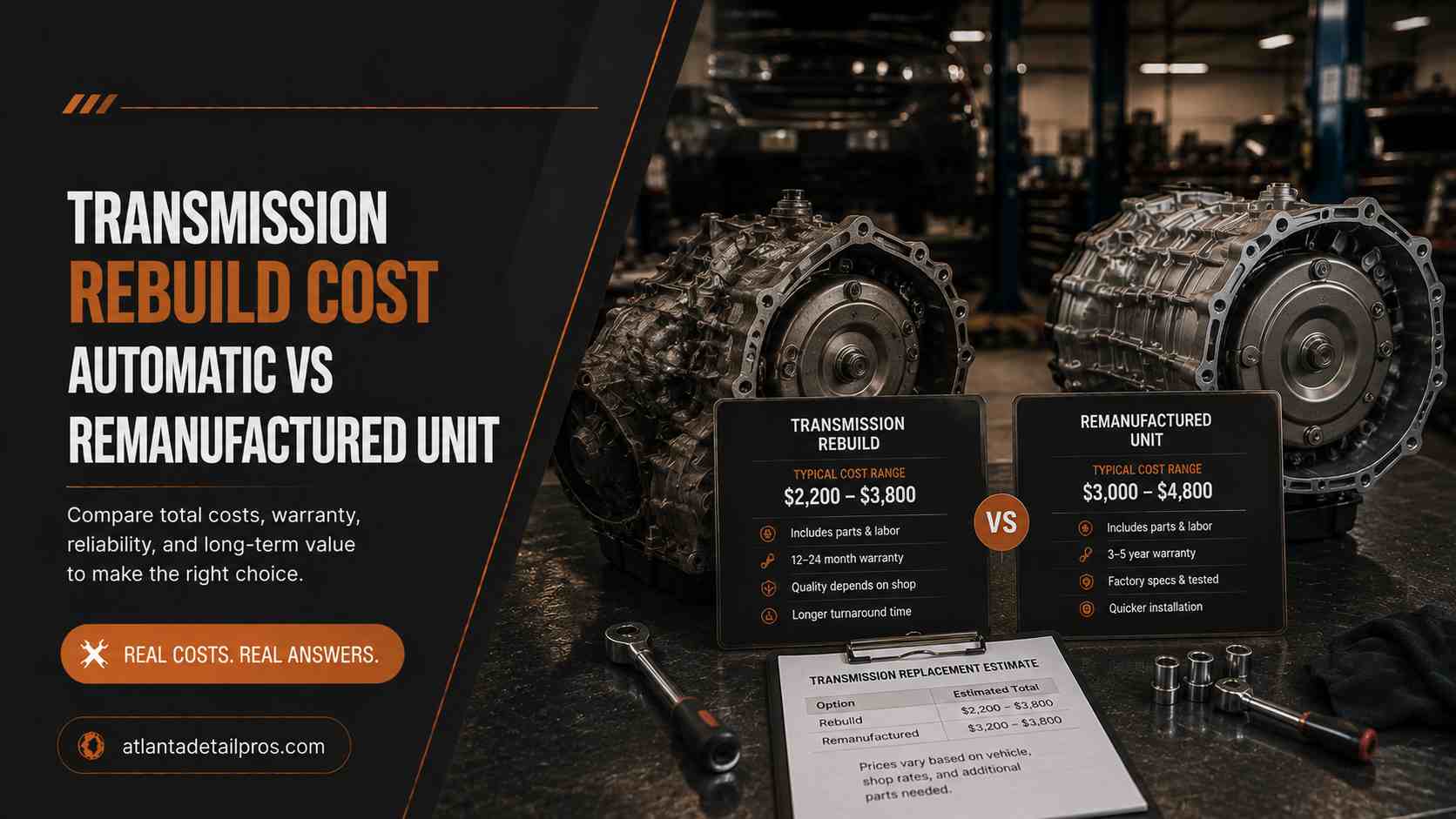
A local transmission rebuild costs $1,500 to $3,500 for most automatic transmissions, while installing a remanufactured transmission (a factory-rebuilt core-exchange unit) costs $2,000 to $4,500 including labor, with the right choice between the two depending on the specific transmission’s condition, the shop’s rebuild capabilities, and how long you intend to keep the vehicle.
These ranges cover the majority of domestic and Japanese automatic transmissions in passenger vehicles and light trucks: heavy-duty diesel transmissions, dual-clutch units, and CVTs occupy a separate cost tier that pushes both ranges significantly higher.
The terminology in this repair category causes more consumer confusion than almost any other major repair. A rebuild performed in a local shop is not the same product as a remanufactured transmission, and neither of these is the same as a transmission repair (which addresses a specific failed component without a full overhaul). Understanding what each option actually involves is the most important step before authorizing any transmission work over $500.
What a Local Rebuild Actually Involves
A local transmission rebuild means the transmission is removed from the vehicle, disassembled completely, and rebuilt in the shop using replacement components for the worn or failed parts. The quality of a local rebuild depends entirely on the skill and thoroughness of the rebuilding technician, the quality of the parts used, and whether the hard parts (valve body, drums, shafts) are within tolerance or need replacement.
A thorough local rebuild replaces all friction clutch discs, steels, bands, seals, o-rings, and the filter. The valve body is inspected and either reconditioned or replaced. Soft parts (seals, frictions, bands) are replaced as a matter of course. Hard parts (shafts, bearings, drums, planets) are measured and replaced only if they are outside tolerance. The torque converter is either rebuilt or replaced.
The advantage of a local rebuild is that the shop can examine the actual condition of your specific transmission internally and address only what needs to be addressed rather than blanket-replacing every component. The disadvantage is that the quality is entirely dependent on the skill of the individual technician performing the work, which varies significantly between shops.
What a Remanufactured Transmission Actually Involves
A remanufactured transmission is a core-exchange unit rebuilt in a dedicated facility to a standardized specification. Your transmission is removed and sent out (or a pre-built unit is delivered first and your core is returned as a credit). The remanufactured unit has been disassembled, cleaned, inspected, and rebuilt with new friction materials, seals, and updated components that incorporate all service bulletin improvements for that unit.
The advantage of a remanufactured unit is consistency: the build is performed on a production line with torque specifications, quality control checkpoints, and test procedures that a local shop cannot economically replicate. The remanufactured unit from a reputable supplier such as Jasper, ATSG-certified rebuilders, or OEM remanufacturing programs typically comes with a 3-year or 100,000-mile nationwide warranty that follows the vehicle, not just the shop.
The disadvantage is that you are paying for a complete build regardless of whether your specific transmission needed all of it, and the installation labor is the same whether the unit being installed is rebuilt locally or shipped from a remanufacturing facility.
Cost Comparison by Repair Option
Understanding the complete cost of each option requires separating the transmission work from the installation labor, since the labor to remove and reinstall the transmission is the same regardless of which repair path you choose.
Repair Option | Transmission Cost | Removal and Reinstall Labor | Typical Total |
|---|---|---|---|
Local rebuild (standard platforms) | $800 to $2,000 | $400 to $800 | $1,500 to $3,500 |
Local rebuild (complex VW, BMW, ZF units) | $1,200 to $2,800 | $500 to $1,000 | $2,000 to $4,500 |
Remanufactured unit (standard platforms) | $1,200 to $2,800 | $400 to $800 | $2,000 to $4,500 |
Remanufactured unit (complex units) | $1,800 to $3,500 | $500 to $1,000 | $2,800 to $5,500 |
Used transmission (salvage yard) | $300 to $900 | $400 to $800 | $900 to $2,000 |
New OEM transmission | $3,000 to $6,000 | $400 to $800 | $4,000 to $7,500 |
Cost by Transmission Type and Platform
The transmission itself determines a significant portion of the rebuild cost because complexity, parts availability, and the time required to correctly rebuild the unit vary considerably.
Transmission | Vehicle Applications | Local Rebuild Cost | Reman Unit Cost (Installed) |
|---|---|---|---|
GM 4L60E | Silverado, Sierra, Tahoe, Camaro (pre-2007) | $1,200 to $2,200 | $2,000 to $3,500 |
GM 4L80E | Heavy-duty GM trucks, Hummer H1 | $1,400 to $2,500 | $2,200 to $3,800 |
Ford 4R70W and 4R75W | F-150, Mustang, Explorer | $1,200 to $2,000 | $1,900 to $3,200 |
Ford 6R80 | F-150 (2011 to present), Mustang GT500 | $1,600 to $2,800 | $2,500 to $4,200 |
Chrysler 45RFE and 68RFE | Ram 1500 and 2500 | $1,400 to $2,600 | $2,200 to $4,000 |
Toyota A750E and A761E | 4Runner, Tacoma, Tundra | $1,500 to $2,500 | $2,300 to $3,800 |
Honda BDGA and SLXA | Accord, CR-V, Pilot | $1,300 to $2,200 | $2,100 to $3,500 |
ZF 8HP (BMW, RAM, Chrysler) | BMW 5 Series, Ram 1500, Jeep | $2,000 to $3,500 | $3,000 to $5,500 |
Local Rebuild vs Remanufactured: Which Is Better
The choice between a local rebuild and a remanufactured unit is not a question of which option is universally superior. It is a question of which option is better for your specific vehicle, mileage, and the shop making the recommendation.
When a Local Rebuild Makes More Sense
A local rebuild from a shop that specializes in your specific transmission platform and can show you a documented track record of rebuilds on that unit type can produce an equal or superior outcome to a remanufactured unit at a lower cost. Common, widely-built transmissions like the GM 4L60E and Ford 4R70W are rebuilt locally by experienced shops thousands of times per year, and a shop with this volume knows the failure patterns, the correct updated components, and the proper procedures from direct experience.
A local rebuild also allows the shop to address only the components that have actually failed rather than blanket-replacing everything on a transmission that failed from a single localized cause. This targeted approach can reduce the cost significantly on transmissions where one worn component (a band servo, a specific clutch pack) caused the failure without widespread internal damage.
When a Remanufactured Unit Makes More Sense
A remanufactured unit makes more sense when the transmission is a complex modern unit (ZF 8HP, Aisin 6-speed with electronic control, any dual-clutch automatic) where the specialized tooling and software required for a correct local rebuild are not commonly available. It also makes sense when the local shop has limited documented experience with your specific unit and when the remanufactured unit’s warranty (typically 3 years or 100,000 miles nationwide) has meaningful value given how long you plan to keep the vehicle.
“My shop quoted a local rebuild on the 6R80 in my F-150 at $2,100. A remanufactured unit through a different shop was $2,800 installed with a 3-year, 100,000-mile warranty that travels with the vehicle. I chose the reman because I plan to keep the truck for another 80,000 miles and the warranty covered me if there was any issue at all. The extra $700 bought a lot of peace of mind.” : Fiona Stafford, 2013 Ford F-150 3.5L EcoBoost owner
The Used Transmission Option
A used transmission from a salvage yard is the lowest-cost option but carries the highest risk. A salvage transmission comes from a vehicle that was wrecked, flooded, or otherwise totaled. Its service history is unknown, its internal condition is unverifiable without a full disassembly, and the warranty (if any) is typically 30 to 90 days and limited to the salvage yard.
A used transmission is a reasonable choice only on older, lower-value vehicles where the cost of a rebuild or remanufactured unit approaches the vehicle’s market value and the owner has acceptable risk tolerance for a repeat failure. For vehicles that are depended on for daily transportation, a rebuilt or remanufactured unit is the appropriate minimum standard.
What a Complete Transmission Job Should Include
Regardless of whether a local rebuild or remanufactured unit is chosen, the complete installation should include fresh transmission fluid (the correct specification for your unit), a new filter, a new pan gasket, an inspection of all cooler lines and fittings with replacement of any that are corroded, and a road test with a shift quality verification before vehicle delivery.
The torque converter should be replaced or professionally rebuilt as part of any transmission overhaul. A transmission rebuilt with the original torque converter frequently develops shudder or recurrent failure within 12 to 24 months because the converter contains fluid and clutch material from the failed transmission that contaminates the new build.
FAQ
How long does a transmission rebuild take?
A local rebuild typically takes 3 to 5 business days: 1 day for removal and disassembly, 1 to 2 days for rebuilding and sourcing any hard parts, and 1 day for reinstallation and road testing. A remanufactured unit installation takes 1 to 2 days if the unit is in stock and delivered next day.
Does a rebuilt transmission come with a warranty?
A local rebuild should come with a minimum 12-month or 12,000-mile parts and labor warranty from the shop. A remanufactured unit from a reputable supplier typically carries a 3-year or 100,000-mile nationwide warranty that is honored at any participating installer. Always get the warranty terms in writing before authorizing the repair.
Is it worth rebuilding a transmission on a high-mileage vehicle?
It depends on the vehicle’s overall condition and the cost of the repair relative to the vehicle’s value. A transmission rebuild on a vehicle that is otherwise sound and has 150,000 to 200,000 miles on it is often worth completing. A transmission rebuild on a vehicle where the engine, suspension, or body has significant deferred maintenance may not be the best use of $2,000 to $3,500.
Can a transmission be repaired without a full rebuild?
Yes. A transmission that has failed from a single, identifiable component (a broken band, a failed shift solenoid, a cracked filter) can sometimes be repaired without a full rebuild. A transmission shop that disassembles the unit and finds a localized failure should present the option of a targeted repair versus a full overhaul with the respective cost and risk of each.
What is the difference between a transmission flush and a fluid change?
A fluid change drains the pan and replaces the filter, exchanging approximately 40 to 50 percent of the total fluid volume. A flush exchanges nearly 100 percent of the fluid using a machine that pumps new fluid through the torque converter and cooler circuit simultaneously. Neither is a substitute for a rebuild on a transmission that is failing: they are maintenance procedures for transmissions that are still functioning correctly.
Bottom Line
A local rebuild costs $1,500 to $3,500 and a remanufactured unit costs $2,000 to $4,500 installed, with the right choice depending on the shop’s documented experience with your specific unit and the warranty value you need.
For common domestic transmissions (4L60E, 4R70W, 68RFE) with an experienced local shop, a local rebuild at a lower price point is a legitimate and often superior choice. For complex modern units (ZF 8HP, Ford 6R80, any dual-clutch) where specialized tooling and software are required, a remanufactured unit with a long-term nationwide warranty is the more reliable investment.
Get itemized quotes from at least two shops, confirm that the torque converter replacement is included, and ask for the warranty terms in writing. The transmission is the second most expensive drivetrain component after the engine: it deserves the same level of scrutiny as any other major repair decision.