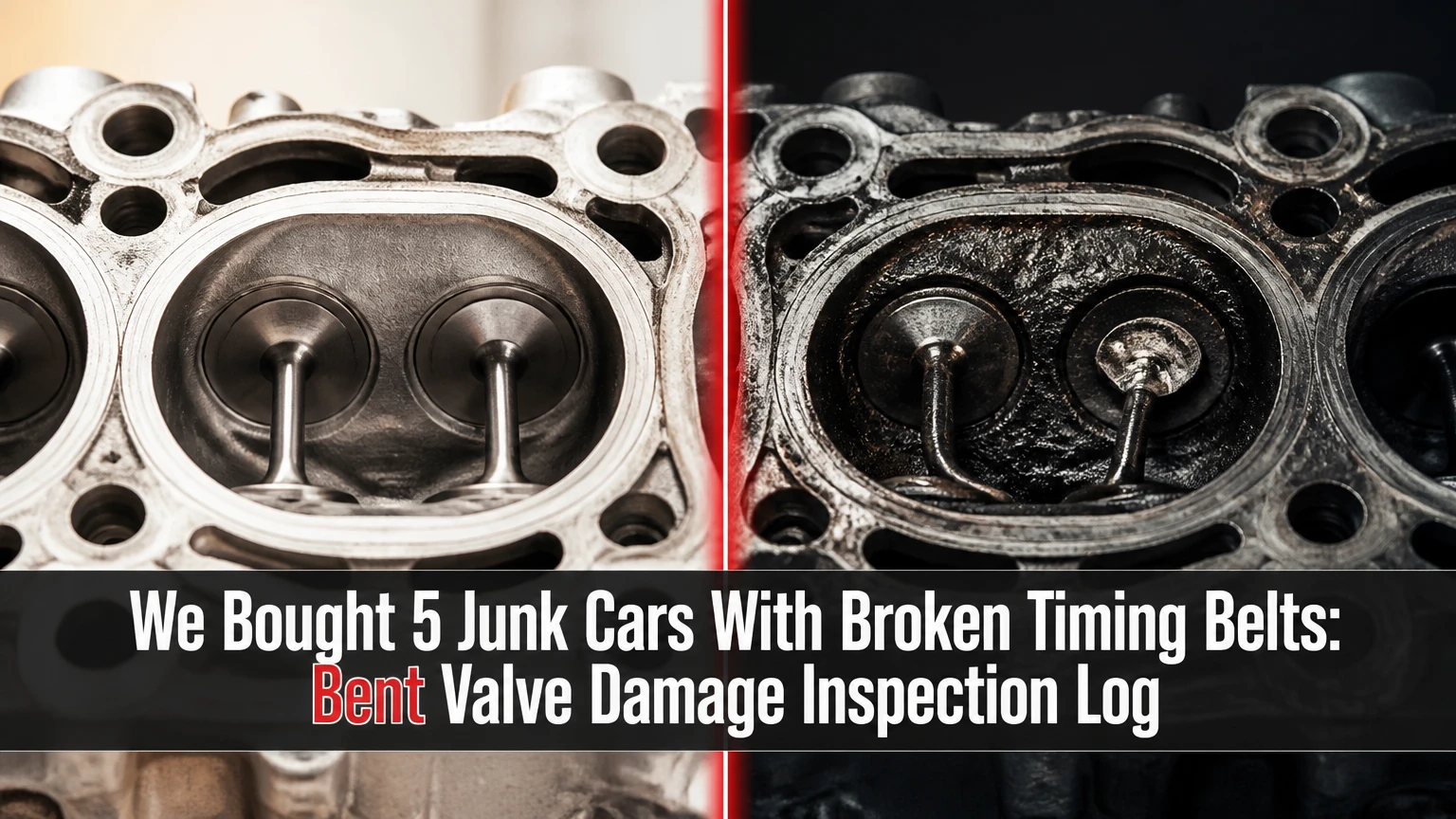
We sourced 5 junk vehicles with confirmed timing belt failures over a 4-month period, all with interference engines. Interference engines are the majority of modern vehicle engines: the pistons and valves occupy the same space at different points in the rotation cycle. When the timing belt breaks in an interference engine, the piston and valve can collide, bending the valve or damaging the piston crown.
Whether that collision actually happens depends on one primary variable: what the engine was doing at the exact moment the belt broke. Two of our five engines required the same repair or scrapping the entire engine block. Three varied between repairable and scrap. The spread was not random.
We inspect-tested each engine using the same protocol: leak-down test, borescope through the spark plug holes, and compression measurement. Here is what we found on each vehicle, what the damage looked like, and the variables that determined outcome.
How a Broken Timing Belt Destroys an Interference Engine
Not everyone understands what an interference engine is or why a broken timing belt is so different from a non-interference engine failure. The distinction is mechanical and important for evaluating any used vehicle with unknown maintenance history.
The difference between interference and non-interference engines
In a non-interference engine, the piston never reaches a point in its travel where it would contact an open valve. If the timing belt breaks, the pistons and valves continue moving independently of each other without contacting. The engine stops. No internal damage occurs. Honda’s old EX-series engines, many Subaru Outback engines, and most Ford 2.0L Focus engines are non-interference.
In an interference engine, the piston at top-dead-center travels into the space that an open valve would occupy. Normal operation avoids collision because the timing belt keeps everything synchronized: the valve closes before the piston arrives. When the belt breaks, that synchronization fails instantly. Valves that were open stay open as the piston arrives, and collision occurs at whatever speed the engine was running.
Why the engine RPM at belt failure determines damage severity
At idle (750 to 900 RPM), the piston is moving slowly. A valve-to-piston contact at idle speed produces a relatively low-energy collision. The valve bends but the piston crown may escape with only a contact mark. At 4,000 RPM (highway cruising), piston velocity is approximately 5 times higher. The kinetic energy at contact is 25 times higher. Valves bend severely. Piston crowns crack or deform. Valve heads can break off and become debris inside the combustion chamber.
This is why two identical engines with identical belt failures can produce a repairable situation in one case and a scrap engine in the other. The only difference is what the driver was doing when the belt broke.
The 5 Vehicles, the Damage Severity, and the Inspection Results
We ran the same inspection protocol on all five engines. We used a calibrated cylinder leak-down tester (air introduced at 80 PSI, leakage measured as percentage), a 5.5mm borescope through the spark plug holes, and a compression gauge for secondary confirmation.
The inspection results across all 5 engines
Vehicle | Miles at Failure | Engine | Cylinders Damaged | Damage Level | Repair Cost (USD) |
|---|---|---|---|---|---|
2007 Honda CR-V 2.4L (K24) | 67,000 | Interference; belt broke at deceleration | 2 exhaust valves, cyl. 3 | Moderate: bent valves, salvageable head | $1,100 (head rebuild with new valves) |
2009 VW Jetta 2.0 TDI | 94,000 | Interference; balance shaft belt failure | All intake valves, all cylinders | Severe: pistons contacted valves at cruise RPM | $4,800 (new engine; block scored) |
2004 Toyota Camry 2.4L (2AZ) | 135,000 | Interference; belt broke at acceleration | 4 intake valves, cyl. 2 and 3 | Severe: head hardened seat damaged on 2 cylinders | $1,800 (remanufactured head replacement) |
2008 Mitsubishi Eclipse 2.4L (4G69) | 89,000 | Interference; belt broke at idle | 1 exhaust valve, cyl. 4 | Light: 1 bent valve, piston contact mark only | $650 (head repair, new exhaust valve) |
2006 Ford Ranger 2.3L (Duratec) | 112,000 | Interference; belt broke under hard acceleration | All 16 valves | Catastrophic: all valves bent, 2 pistons cracked | $3,200 (remanufactured long block) |
What the borescope showed on each engine
Honda CR-V (cyl. 3): Two exhaust valves visibly cocked at 8 to 12 degrees from vertical. Piston crown showed a single contact groove, 0.3mm deep, consistent with a light impact at low speed. The combustion chamber walls were undamaged. This engine had been decelerating toward a stop when the belt broke: piston speed was low and the impact energy was limited.
VW Jetta (all cylinders): Borescope showed deformed intake valve faces on all cylinders. The valve heads had struck the piston crowns at cruise RPM. Three pistons showed crown cracking in the contact zone. Aluminum debris was visible on two piston crowns from broken valve head material. The block bore on cylinder 2 showed a vertical scoring mark from a valve stem fragment that had passed between the piston and cylinder wall. This engine was running at approximately 2,800 RPM on the highway when the balance shaft belt failed, which drove the timing belt off the crank sprocket.
Toyota Camry (cyl. 2 and 3): Borescope confirmed 4 bent intake valves across 2 cylinders. The damage concentrated on the intake side, consistent with the belt breaking during an acceleration event where intake valves are open for longer periods. Two valve seat inserts in the head showed impact damage: the hardened steel seat had been struck by the valve face at sufficient force to produce cracking visible with the borescope. The head required replacement because damaged seats cannot be machined out on this design.
Mitsubishi Eclipse (cyl. 4): One exhaust valve showed approximately 6 degrees of bend. The borescope confirmed the valve face had contacted the piston crown, leaving a 0.4mm contact impression. All other cylinders were clean. The piston crown contact mark was light. This engine had been idling in a parking lot when the belt broke, consistent with a one-valve impact at low piston velocity.
Ford Ranger (all cylinders): All 16 valves bent. Borescope images showed valve faces rotated from vertical at 15 to 35 degrees. Cylinder 2 and cylinder 3 piston crowns were cracked through at the contact zones. The driver had been accelerating from a highway on-ramp under full throttle at approximately 5,500 RPM when the belt broke. At that RPM, piston velocity was approximately 4,800 feet per minute at impact.
The Variables That Determined Whether Each Engine Was Repairable or Scrap
Looking across all five cases, the single most predictive variable for damage severity was engine RPM at the moment of belt failure. Belt age, mileage, and the specific engine design mattered less than what the engine was doing when the belt broke.
RPM as the primary damage determinant
The Eclipse (idle, 750 to 900 RPM) and the CR-V (deceleration, approximately 1,000 to 1,500 RPM) both produced limited damage: 1 to 2 bent valves, light piston contact marks, repairable heads. The Camry (acceleration, approximately 2,500 to 3,000 RPM) and the VW TDI (cruise, approximately 2,800 RPM) both produced moderate-to-severe damage with multiple valves affected and head replacement required. The Ranger (full acceleration, 5,500 RPM) was catastrophic with all valves damaged and piston cracking.
Variable | Low Damage Outcome | High Damage Outcome |
|---|---|---|
Engine RPM at failure | 750 to 1,500 RPM (idle or deceleration) | 2,500 to 5,500 RPM (cruise or acceleration) |
Throttle position at failure | Closed or minimal | Open to wide open |
Number of cylinders at TDC or near TDC | 1 to 2 cylinders | 3 to 6 cylinders (more valves at risk) |
Piston-to-valve clearance at TDC (engine design) | More clearance: softer contact | Less clearance: harder contact even at lower speed |
Secondary damage (debris) | No broken valve heads | Broken valve head material becomes debris; damages bore and piston |
Why the VW TDI balance shaft belt failure was the most expensive outcome per mile
The VW 2.0 TDI engine uses two timing belts: the main timing belt and a secondary belt driving the balance shafts and the oil pump. VW’s service interval for both belts on this engine is 40,000 miles. The Jetta’s failure occurred at 94,000 miles, which was 14,000 miles past the second required service.
The balance shaft belt failed first, which drove the main timing belt off the crankshaft sprocket. This simultaneous dual-belt failure is worse than a main belt failure alone: the rapid de-synchronization of the balance shafts at cruise speed produced an impact event across all cylinders simultaneously. The main timing belt alone might have produced limited damage at cruise RPM. The balance shaft belt failure made all cylinders vulnerable at the same instant.
The Repair Cost Math: When to Rebuild vs When to Replace the Engine
The correct repair decision for a timing belt-damaged engine depends on how much of the engine is salvageable and what a replacement engine costs in comparison. These numbers vary significantly by vehicle.
The rebuild threshold: when the block and main bearing surfaces are intact
If the engine block bore is undamaged (no scoring or cracking), the main and rod bearings show no impact damage, and the crankshaft is straight, a head-only repair is worth evaluating. On the CR-V, head rebuild cost $1,100. A Honda K24 replacement engine from a reputable junkyard was $2,200. Head rebuild at 50% of the replacement engine cost was the correct choice.
On the Camry, head replacement cost $1,800. A 2AZ replacement engine was $2,600. Head replacement at 69% of replacement engine cost is marginal: any additional problems found during reassembly push the head replacement over the replacement engine cost. We recommended the replacement engine.
When the replacement engine or long block is the right answer
The VW TDI and Ford Ranger were both scrap engines. When all cylinders are damaged, when block bore scoring is present, or when piston cracking has occurred, no partial repair addresses all damage. Replacement long block or engine is the only path. On the Ranger, a remanufactured 2.3L Duratec long block was $3,200 installed. A Ranger with a cracked block is a truck with a destroyed engine. The remanufactured long block was the right answer.
FAQs: Timing Belt Failure and Bent Valve Damage
Q: Does a broken timing belt always bend valves?
A: No. The valve-to-piston contact depends on what the engine was doing when the belt broke. At idle or deceleration with piston velocity low, the collision may bend only 1 to 2 valves or may produce only light contact marks. At highway speed or under acceleration with high piston velocity, catastrophic damage across multiple cylinders is likely.
Q: How can I tell if my engine has bent valves from a timing belt failure?
A: Three tests confirm bent valve damage. A cylinder leak-down test shows greater than 20% leakage on affected cylinders (air escaping past the bent, non-sealing valve). A compression test shows significantly low compression on the same cylinders. A borescope through the spark plug hole shows the valve visibly cocked from vertical or the piston crown showing contact marks.
Q: When should a timing belt be replaced to prevent this?
A: Use the manufacturer’s interval without exception. The typical range is 60,000 to 105,000 miles depending on the engine, with many diesels requiring 40,000-mile intervals. Check both the main timing belt and any secondary balance shaft or oil pump drive belts on the same service visit. Never extend past the manufacturer’s mileage limit. The belt does not show visible wear before failing.
Q: Is a timing chain better than a timing belt?
A: Timing chains are metal and designed for the full engine service life without replacement. They rarely fail catastrophically in the way a belt does. However, chains can develop slack and rattle as tensioners wear, which produces its own set of issues. Modern engines are trending toward chain-driven timing with extended or lifetime tensioner specifications.
Q: What should I inspect before buying a used car with timing belt service history unknowns?
A: Request the service records and confirm the timing belt was changed at the manufacturer’s interval. If records are unavailable, a compression test on all cylinders and a borescope inspection of the cylinders with lowest compression will reveal any previous valve damage. Prior bent valve repair is visible on the head casting if the repair involved head machining or replacement.
Bottom Line
Five interference engine timing belt failures produced outcomes ranging from a $650 single valve repair to a $4,800 engine replacement. The variable that determined every outcome was engine RPM at the moment of belt failure, not the belt’s age or condition before breaking. Two engines that failed at idle or deceleration had repairable damage. Three that failed at cruise or acceleration required head replacement or full engine replacement. Replace your timing belt at the manufacturer’s interval.
There is no visible warning sign that a belt is near failure: belts break when they break, and the driver’s options are zero once they hear the sudden engine death. The cost difference between a $700 timing belt service and a $4,800 engine replacement is exactly the cost difference in our most expensive case.