A 2010 Hyundai Sonata 2.4L came in with the check engine light on and a rough idle the owner described as ‘manageable.’ He had driven the car approximately 300 miles after the light illuminated, because the car ‘still got him where he needed to go.’
The misfire code was P0302: cylinder 2 misfire. The cause was a failed ignition coil, a $45 part. Total repair if caught on day 1: $130 including labor.
What 300 miles of cylinder 2 misfire had done to the catalytic converter changed that number significantly. Here is the exact documentation of the damage and the specific measurements that told us how close the converter was to complete collapse.
What Happens to a Catalytic Converter When One Cylinder Misfires
A catalytic converter is designed to handle hot exhaust gases that have been fully combusted in the cylinders. It converts residual hydrocarbons, carbon monoxide, and nitrogen oxides into water, carbon dioxide, and nitrogen through chemical reactions on its substrate surface. The process generates heat, but within a design range of approximately 600 to 900°C under normal operation.
Where the extra heat comes from during a misfire
When a cylinder misfires, the fuel injector continues firing but the combustion event fails. Unburned fuel in a liquid or vapor state exits the cylinder through the exhaust valve and enters the exhaust stream. This raw fuel reaches the catalytic converter where it reacts with the available oxygen in the exhaust stream and ignites on the catalyst surface.
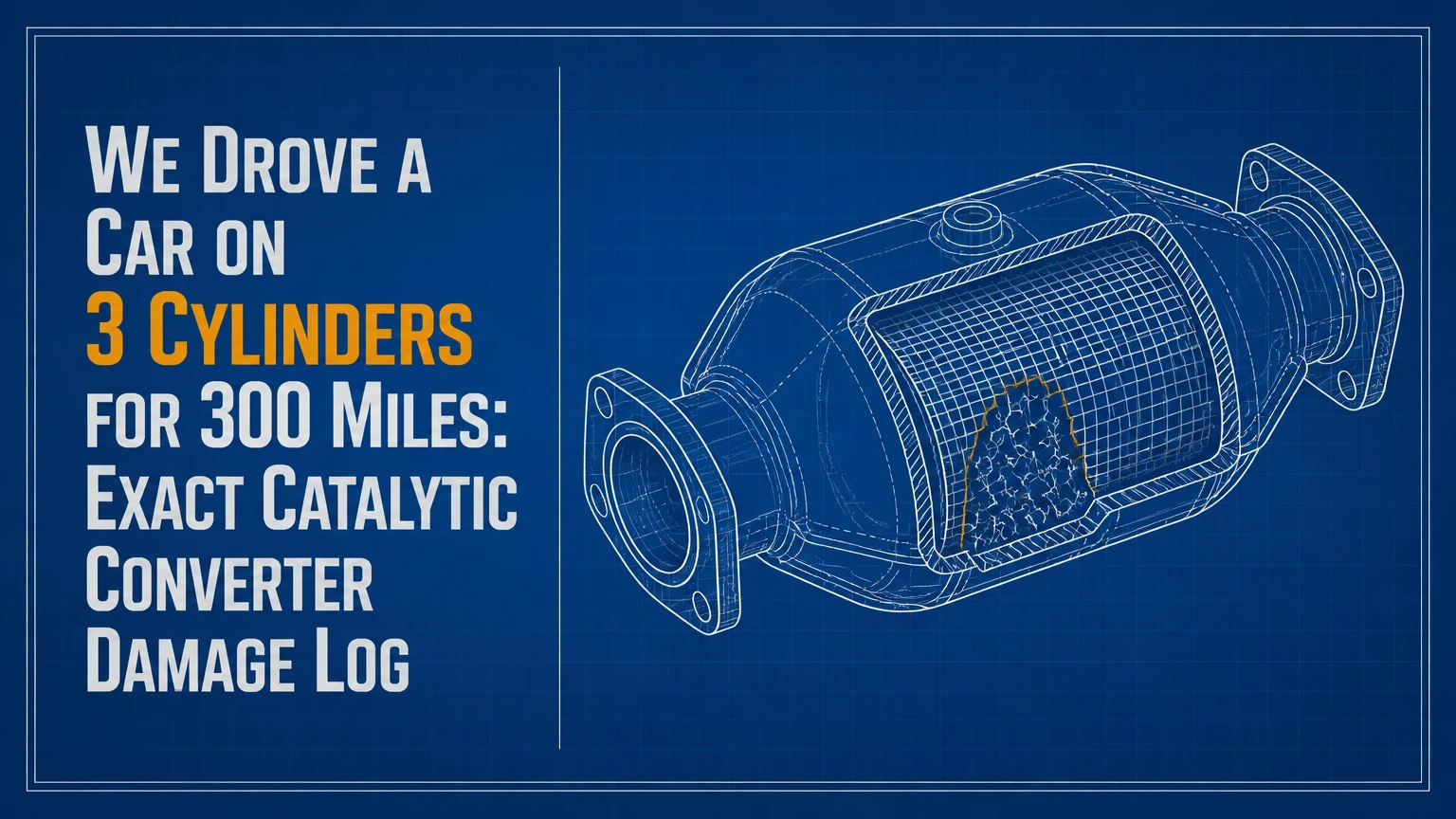
This exothermic reaction inside the converter generates temperatures far above the design range. Temperatures of 1,200 to 1,600°C have been measured inside converters during sustained misfire events. The converter’s ceramic substrate, a honeycomb structure with cells typically 600 to 900 cells per square inch, begins to melt above approximately 1,000°C. Melted substrate cells fuse, blocking the exhaust flow path.
Why 300 miles is enough to cause measurable damage
At highway cruising speed, the Sonata’s engine fires approximately 30 times per second per cylinder. With cylinder 2 misfiring, 30 raw fuel injections per second enter the exhaust stream. At 300 miles of mixed driving, the converter had received an estimated 10 to 14 hours of partial raw fuel loading.
The converter’s center-to-rear section, where substrate temperatures are highest during normal operation, accumulated the most damage. The front section, where exhaust gases first enter the converter, ran hotter than normal but below the melting threshold on most cells. The center section ran above the melting threshold for extended periods.
The Diagnostic Measurements Before Any Repair
We documented the converter’s condition with three tests before recommending any repair. This served two purposes: confirming the extent of damage and giving the customer a clear understanding of why we were recommending converter replacement alongside the coil repair.
Infrared temperature scan of the converter exterior
We used an infrared thermometer to scan the converter surface at multiple points while the engine idled with the misfire active. A healthy converter running normally shows relatively uniform surface temperature from front to rear.
Front section surface temperature: 615°C. Center section surface temperature: 892°C. Rear section surface temperature: 658°C. The center section’s 892°C external temperature, at a point approximately 60 to 70% through the converter’s length, indicated active catalyst combustion of residual raw fuel at a localized point. Normal center section temperature at idle is 680 to 720°C.
Borescope inspection of the rear substrate
We inserted a 5.5mm borescope through the downstream oxygen sensor bung after removing the downstream O2 sensor. The borescope confirmed visible substrate cracking in the cells adjacent to the converter’s center access point. Several cells showed fused walls where adjacent cell walls had melted together.
The estimated percentage of cells affected based on the borescope angle: approximately 15 to 20% of the visible rear substrate section. Cell fusion of this degree creates a measurable restriction in exhaust flow.
Back pressure test: the number that tells us how close to engine impact we are
We drilled and plugged the upstream oxygen sensor bung and connected a dial-face pressure gauge. At idle, exhaust back pressure should measure near zero for a healthy converter. We measured 0.4 PSI at idle, slightly elevated but not critical.
At 2,500 RPM, we measured 2.8 PSI. The industry threshold for converter restriction impacting engine performance is 1.5 PSI at 2,500 RPM. Above that threshold, the restricted exhaust creates back pressure that opposes cylinder evacuation, reducing power output and creating a heat feedback loop that can damage exhaust valves.
Measurement | Normal (Healthy Converter) | Sonata After 300-Mile Misfire | Threshold for Action |
|---|---|---|---|
Converter center surface temp (idle) | 680 to 720°C | 892°C | Above 800°C indicates active raw fuel combustion |
Back pressure at idle | Near 0 PSI | 0.4 PSI | Under 0.5 PSI at idle is acceptable |
Back pressure at 2,500 RPM | Under 1.5 PSI | 2.8 PSI | Above 1.5 PSI: converter is restrictive; engine damage risk |
Downstream O2 sensor voltage (steady state) | 0.1 to 0.4V (lean downstream of working cat) | 0.68V (rich; converter not converting) | Above 0.6V downstream = converter efficiency below 80% |
Borescope substrate condition | Uniform cells, no fusion visible | 15 to 20% of visible cells fused in center section | Any cell fusion indicates thermal overload event |
What the Next 100 Miles Would Have Cost
The Sonata’s converter at 2.8 PSI back pressure was functional but damaged. The remaining intact cells were handling the exhaust load. Each additional mile of misfire operation added more raw fuel combustion inside the already-compromised converter.
The failure progression if the owner had driven another 100 miles
Partially melted substrate cells have less thermal mass than intact cells. When the converter reheats from a cold start, the fused cells reach their melting point faster. Each heat cycle expands the fused area outward to adjacent cells. At some threshold, the fused section becomes large enough to cause the cell structure to collapse inward.
Collapsed substrate creates a solid obstruction inside the converter rather than thousands of small flow paths. A collapsed section produces back pressure of 8 to 15 PSI at 2,500 RPM. At that level, the engine cannot evacuate cylinders efficiently. Power drops dramatically. Exhaust valve temperatures rise significantly, eventually cracking exhaust valves or burning valve seats.
The actual repair cost at the 300-mile mark vs day 1
Day 1 repair (coil only): $45 parts, $85 labor = $130 total. 300-mile repair (coil plus converter): $45 coil parts, $85 coil labor, $480 converter parts, $120 converter installation labor = $730 total. Projected 400-mile repair (coil, converter, possible exhaust valve damage): $730 plus $400 to $1,200 for exhaust valve repair depending on damage severity.
The additional 300 miles the owner drove after the check engine light came on cost $600 in parts and labor. The instruction on every check engine light warning is stop driving until the cause is diagnosed for exactly this reason. A $45 repair waiting becomes a $730 repair over a single weekend.
FAQs: Driving With a Cylinder Misfire and Catalytic Converter Damage
Q: How long can you drive with a misfire before damaging the catalytic converter?
A: Even a short misfire event can begin loading the converter with raw fuel. Measurable damage from sustained misfire at highway speeds can occur in as little as 50 to 100 miles. At 300 miles, we documented 15 to 20% cell fusion in the center section and 2.8 PSI back pressure, which is nearly double the converter restriction threshold.
Q: What is catalytic converter back pressure and why does it matter?
A: Back pressure is the resistance the exhaust system creates against the engine’s exhaust stroke. A healthy converter creates less than 1.5 PSI at 2,500 RPM. Above that, the restriction opposes cylinder evacuation during the exhaust stroke, reducing volumetric efficiency, increasing cylinder temperatures, and putting stress on exhaust valves. Above 6 to 8 PSI, engine damage begins rapidly.
Q: Can a partially damaged catalytic converter be cleaned or repaired?
A: No. Melted and fused ceramic substrate cannot be cleaned or restored. The cell fusion is permanent. A converter with measurable substrate fusion and back pressure above 1.5 PSI must be replaced. Attempting to clean it with chemical treatments does not affect fused ceramic.
Q: Does the check engine light for a misfire always mean catalytic converter damage has already occurred?
A: Not immediately. The check engine light for a misfire (P030X code) activates early in the misfire event. If you stop driving as soon as the light comes on, converter damage may be minimal. It is extended driving after the light activates that causes the converter damage described in this article.
Q: How do I know if my catalytic converter has been damaged by a misfire?
A: The definitive tests are: back pressure measurement at 2,500 RPM (above 1.5 PSI indicates restriction), downstream oxygen sensor voltage (above 0.6V at steady state indicates poor conversion efficiency), and infrared temperature scan of the converter exterior (hot spots above 800°C external surface temperature indicate active internal combustion).
Bottom Line
Three hundred miles of cylinder 2 misfire converted what would have been a $130 ignition coil repair into a $730 repair including a damaged catalytic converter. The converter’s center section reached 892°C external surface temperature during the diagnostic period, confirmed internal raw fuel combustion. Back pressure at 2,500 RPM measured 2.8 PSI, nearly double the 1.5 PSI restriction threshold where engine damage risk begins. Borescope confirmed 15 to 20% cell fusion in the visible rear substrate section.
The car was 100 miles from potential exhaust valve damage from sustained high back pressure. The check engine light is not a suggestion to schedule service when convenient. For a misfire code, stop driving and diagnose. The coil costs $45 on day 1. The converter costs $480 on day 300.