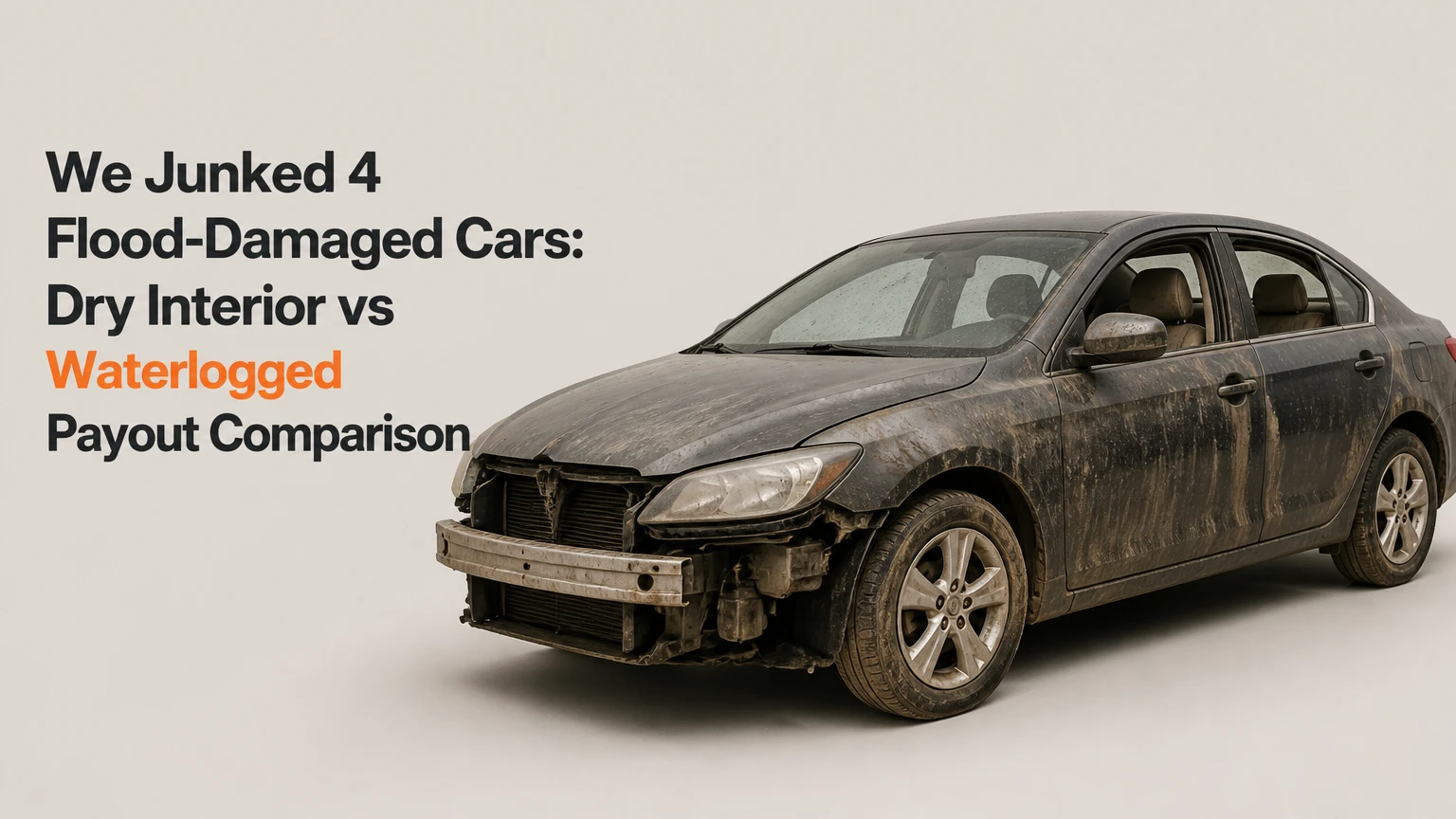
Four flood-damaged cars came in after one storm event in June 2023. All four were insurance total losses. We assumed scrap values would track pre-flood market values. They did not. They tracked the water line. The car with the shallowest flooding brought $2,840. The fully submerged car brought $680. The gap between the driest and most waterlogged payout was $2,160, across vehicles of similar age and weight. Water height inside the cabin moved the number more than make, model, or mileage did.
How Buyers Price Flood Damage
Every yard and salvage buyer we contacted used the same four-point checklist when a flooded car arrived: water height on the interior B-pillars, airbag deployment status, whether onboard electronics still powered on, and whether the drivetrain rotated freely. Each factor has a dollar value, and the deductions compound when multiple factors fail.
Water Height as the Primary Price Driver
The tide line left on interior pillars tells a buyer everything about what got wet. Water below the door sills rarely reaches the seat tracks, the HVAC blower, or the instrument cluster wiring. Water above the seat bottom soaks the ECM, the airbag control module, and the wiring harnesses routed under the carpet. Buyers use a flashlight at the B-pillar before they quote anything.
Why Airbag Status Changes the Number
A car with intact airbags retains value in the salvage market because the bags and SRS module can be pulled and resold. Deployed bags are worthless and the SRS control module is typically non-resalable after deployment. Both cars in our group with deployed airbags received deductions of $300 or more attributed directly to SRS status before any other damage was factored in.
The Four Cars and What Each Brought
Below is each vehicle in order from least to most water damage, with the documented offer and the specific reasons each buyer gave for the number.
Car One: 2019 Toyota Camry LE, $2,840
The Camry had 44,000 miles and took on water to the door sills during a 4-hour flood event. Carpet in the front footwells was damp but not saturated after 72 hours in open air. The airbags were intact, the infotainment screen powered on, and the 2.5L engine started and ran. A regional salvage dealer offered $2,840, citing the high parts pull value of the engine and the intact SRS system.
The buyer noted that the 2.5L 4-cylinder from this generation resells at $1,100 to $1,400 in the used engine market, and that number drove the offer more than the flood condition itself. The water line was low enough that the cabin electrical system was likely rebuildable at auction. Of our four vehicles, the Camry attracted three competing quotes within 24 hours.
Car Two: 2017 Honda CR-V EX, $1,940
The CR-V had 61,000 miles and water reached the bottom of the seat cushions. Seat foam retained visible moisture after 21 days in open air. The airbags remained intact, the infotainment screen powered on intermittently, and the 1.5T engine started but ran rough. The buyer offered $1,940 and itemized a $410 deduction for seat and carpet replacement.
Despite being newer and having a higher pre-flood retail value than the Camry, the CR-V brought $900 less. The buyer attributed $410 of that gap to seat and carpet, and the remainder to the intermittent infotainment behavior, which signaled moisture in the body control module. The engine and front axle assembly kept the offer above $1,500.
Car Three: 2015 Ford F-150 XLT 5.0L, $1,210
The F-150 had 78,000 miles and water reached above the dashboard. Both front airbags deployed, and the ECU showed visible corrosion on removal. The 5.0L Coyote rotated freely and compression tested normally across all 8 cylinders. A yard specializing in truck salvage offered $1,210 with a $680 combined deduction for the deployed airbags and destroyed ECU.
The buyer said the 5.0L was the only component that kept the offer from dropping below $1,000. He quoted the engine alone at $1,800 in the used market at this mileage and said he would part the truck rather than wholesale it. The airbag deduction was firm: deployed SRS components add $400 to $600 in reconditioning costs to any truck in his inventory.
Car Four: 2016 Hyundai Sonata SE, $680
The Sonata had 93,000 miles and sat fully submerged for an estimated 14 hours. The tide line reached the headliner. All airbags deployed, all control modules showed corrosion and no power-on response, and the 2.4L GDI engine locked up from water intrusion. Two buyers declined to offer anything. The third offered $680, pricing it purely as scrap metal at the day’s rate plus the four aluminum wheels.
The buyer said this car had no parts pull value remaining. His $680 broke down as $440 for the steel body at scrap rate, $160 for the four aluminum wheels, and $80 for the battery. He told us this was the worst-outcome flood car he had quoted in six months.
Payout Comparison by Water Level
Vehicle | Miles | Water Height | Airbags | Final Offer | Key Deduction |
|---|---|---|---|---|---|
2019 Toyota Camry LE | 44,000 | Door sill | Intact | $2,840 | None |
2017 Honda CR-V EX | 61,000 | Seat bottom | Intact | $1,940 | $410 seat/carpet |
2015 Ford F-150 XLT 5.0L | 78,000 | Above dash | Deployed | $1,210 | $680 SRS/ECU |
2016 Hyundai Sonata SE | 93,000 | Headliner | Deployed | $680 | All components |
What We Assumed Wrong
We assumed the CR-V would bring more than the Camry based on its higher pre-flood retail value. It brought $900 less. Pre-flood market value carries no weight in the scrap and salvage conversation. Water height and SRS status determine the number. On a flooded vehicle, a lower water line is worth more than a higher trim level, newer model year, or lower mileage.
FAQs
Q: How much less will a flooded car bring compared to a non-flooded car of the same type?
A: Flood cars in this group brought between 12 and 38 percent of their estimated pre-flood private party value, depending on water height. The Camry with the lowest water line retained about 38 percent of its $7,400 private party estimate. The Sonata with the deepest flooding retained about 12 percent of its $5,600 estimate. Water height is the single largest variable in that range.
Q: Do scrap yards pay more for a flooded car than salvage buyers?
A: Scrap yards price purely on weight and current metal rates and will not pay more because the engine or interior is intact. Salvage buyers who pull and resell parts will typically offer significantly more if the flood level left usable components. For the Camry, the salvage offer of $2,840 was $1,190 more than the highest scrap-only quote we received.
Q: Does a flood car need to run for a buyer to pick it up?
A: No. Every buyer we worked with offered flatbed pickup for non-running vehicles at no additional charge. Two of our four cars could not move under their own power at pickup. Running condition matters for the offer amount because it signals engine integrity, but it does not prevent a buyer from taking the vehicle.
Q: How does airbag deployment affect the scrap or salvage offer?
A: Deployed airbags reduce the offer in two ways. The airbag modules lose resale value once triggered, and the SRS control unit is unsaleable after deployment. On the F-150, the buyer itemized $680 in combined deductions for the deployed front bags and the corroded ECU. On the Sonata, the buyer counted the entire cabin as having no parts value.
Q: Can I get competing quotes on a flooded car?
A: Yes, and it matters. For the Camry, we received three offers ranging from $2,100 to $2,840 within 24 hours. Buyers who specialize in pulling and reselling the specific engine family in your vehicle will outbid general scrap yards by a wide margin. Contact at least three buyers before accepting any offer on a flood vehicle.
Q: Should I disclose the flood history to every buyer?
A: Yes. Every buyer in this group asked about flood history before completing the transaction, and most checked the NMVTIS report independently. Misrepresenting flood status on a vehicle sale creates legal liability in most states. Disclosure also protects you if a buyer later claims the car was worse than represented.
BOTTOM LINE
Four flood-damaged cars from a single storm event produced payouts of $2,840, $1,940, $1,210, and $680. The difference between the highest and lowest offer was $2,160 across vehicles of similar age and weight. Water height inside the cabin drove the number more than make, model year, or mileage in every case. A flood car with water below the door sills and intact airbags is worth three to four times more than a fully submerged car with deployed SRS. Contact salvage buyers who pull parts for your engine family first. They will outbid general scrap yards on any flood car with a water line below the dashboard.