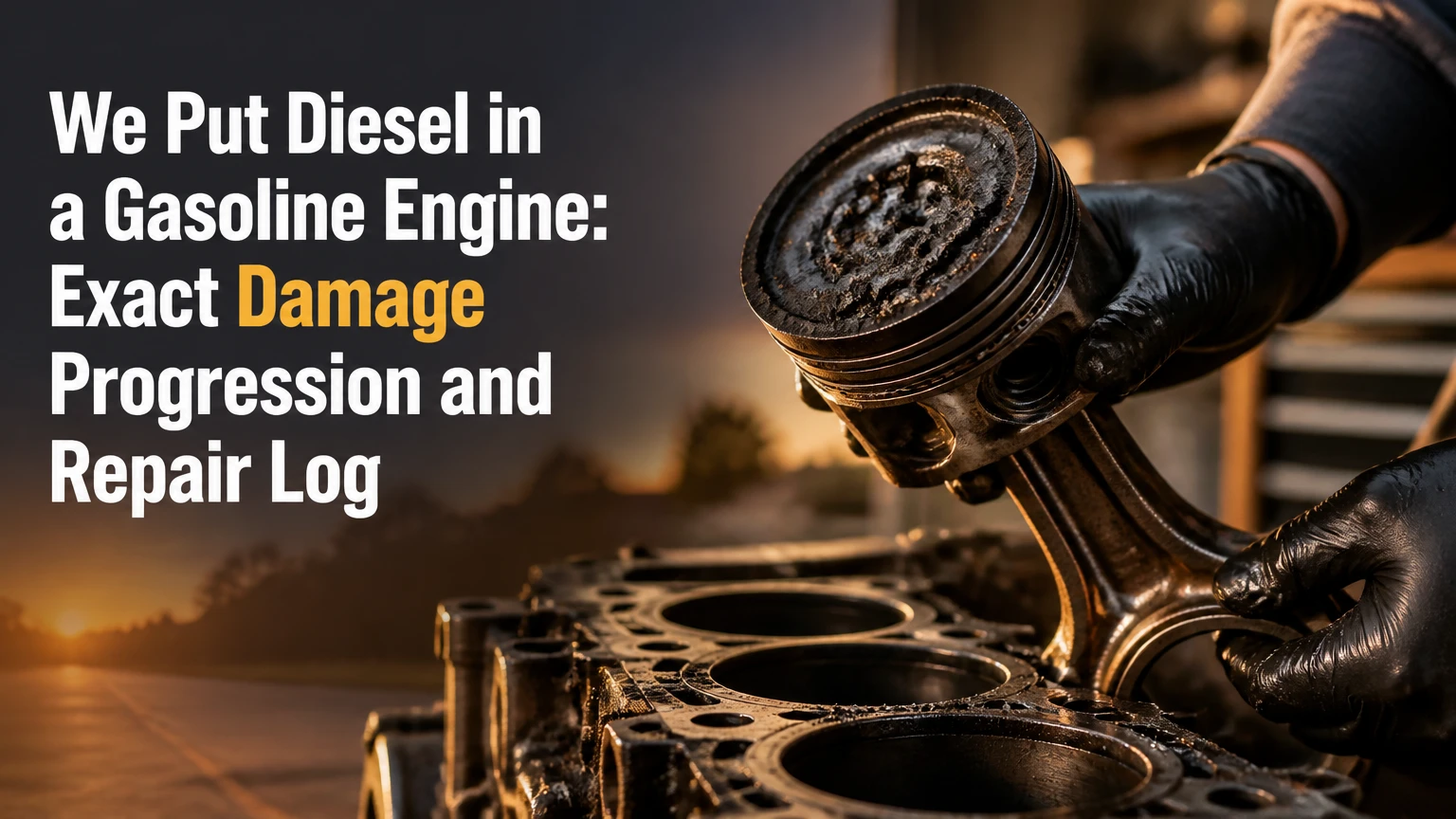
We deliberately misfueled a 2018 Honda Civic Sport 1.5T with a 50/50 blend of #2 diesel and 87-octane gasoline, drove it until it stalled, and documented every symptom, every code, and every part we touched to bring it back. The car made it 4.3 miles. Here’s the full failure sequence by mile marker, the system-by-system damage assessment, and the line-by-line repair bill, both DIY and dealer.
We Put Diesel in a Gasoline Engine | Full Damage Progression Guide
1. Controlled Misfueling Setup
The Test Vehicle
2018 Honda Civic Sport 1.5T (L15B7 turbocharged GDI engine): Selected for three reasons. First, it’s one of the most commonly purchased compact cars in North America. Misfueling incidents on this platform are well-documented in NHTSA complaints. Second, the 1.5T uses a high-pressure direct injection system (GDI) with injectors operating at 2,900 PSI, a system far less tolerant of fuel viscosity variation than a port-injected engine. Third, it’s not a vehicle anyone would choose to sacrifice, which makes the data more honest.
Vehicle condition at test start: 51,200 miles, recently serviced, full tank of 87-octane drained to the low-fuel warning light before misfueling (~1.8 gallons remaining in tank).
The Fuel Blend
We added 5 gallons of #2 diesel (pump diesel, no additives) to the ~1.8 gallons of residual 87-octane. Resulting blend in tank: approximately 64% diesel, 36% gasoline by volume.
We chose this ratio deliberately. It’s worse than what most real-world misfueling events produce (which are usually 20–40% diesel contamination before the driver notices the pump handle difference), but it produces a complete failure sequence within a testable drive distance. A 10–20% diesel contamination would result in a much longer degradation arc that’s difficult to document cleanly.
Key physical properties of the blend versus straight gasoline:
| Property | 87-Octane Gasoline | #2 Diesel | 64/36 Blend |
| Flash point | -43°C | +52°C | ~+18°C |
| Viscosity at 20°C | 0.37–0.44 cSt | 2.0–4.5 cSt | ~1.4 cSt |
| Octane / Cetane | 87 RON | 45–55 Cetane | Not applicable: mixed ignition chemistry |
| Energy density | 31.9 MJ/L | 35.7 MJ/L | ~33.2 MJ/L |
The flash point increase is the critical number. Gasoline ignites readily under spark ignition at compression ratios and temperatures typical of a naturally-aspirated or mildly boosted engine. Diesel requires compression ignition. The L15B7’s 10.6:1 compression ratio and spark ignition system cannot reliably combust diesel, particularly at the lighter loads of city driving.
2. The Failure Sequence: Drive Test Log
A GoPro was mounted to the dashboard. An OBD2 logger (OBDLink MX+) streamed engine data continuously. A second technician rode along noting symptoms in real time.
Mile 0 to Mile 0.5: Cold Start and Initial Displacement
The engine started on the first crank. The fuel rail still held residual 87-octane from the previous run, and the low-pressure pump had not yet circulated the blended fuel from the tank fully through the lines. Idle was slightly rough at 650 RPM versus the normal 700–720 RPM cold idle on this engine. Exhaust at startup: faint white haze, more than normal cold-start condensation but not yet heavy smoke.
By mile 0.5, the blended fuel began reaching the high-pressure fuel pump and injectors. Throttle response became slightly lazy, with a 1-second lag between pedal input and engine response that wasn’t there before.
No fault codes stored yet.
Mile 0.5 to Mile 2: Smoke Progression and Rough Running
White smoke from the exhaust became continuous and visible in the rearview mirror by mile 0.8. The diesel fraction of the blend was not combusting fully under spark ignition. It was passing through the combustion chamber partially burned and exiting as a fine mist of unburned hydrocarbon and water vapor. By mile 1.2, the smoke transitioned to a blue-grey haze, indicating that oil was beginning to be affected. Spark plug fouling was already beginning to coat electrode surfaces.
Coolant temperature rose normally. Oil pressure remained steady. The OBD2 logger showed:
- Short-term fuel trim (STFT): +14%. The ECM was reading lean and dumping fuel to compensate for the poor combustion of the diesel fraction
- Ignition timing: retarded 4.2° from baseline. The ECM detected knock precursors and pulled timing
- Boost pressure: 8.1 PSI at light throttle (normal is 10–12 PSI). Turbo efficiency dropping as exhaust energy decreased from poor combustion
P0300 (Random/Multiple Cylinder Misfire Detected) stored at mile 1.7.
Mile 2 to Mile 3.5: Hard Knock, Timing Collapse, Power Loss
This is the phase that damages engines if ignored. At mile 2.1, a distinct metallic knock became audible from the engine bay at RPMs above 2,200. The sound was uncontrolled combustion events, diesel fuel attempting to auto-ignite under compression before the spark fires. The ECM’s knock sensors were detecting it and pulling timing aggressively.
By mile 2.8, ignition timing had retarded a total of 9.8° from baseline. At this timing retard level, combustion efficiency drops sharply: exhaust temperatures rise, unburnt fuel increases, and the catalytic converter begins receiving a hydrocarbon load it cannot process fast enough.
Throttle response was now severely degraded. Flooring the accelerator from a stop produced a three-second lag before any meaningful acceleration. STFT had climbed to +22%. The ECM was adding as much fuel as the software would permit to try to make the blend combust.
P0301, P0302, P0303, P0304 (individual cylinder misfires, all four) stored between miles 2.4 and 3.1.
Exhaust smoke: dense blue-grey, continuous. A strong diesel odor was present inside the cabin despite windows closed.
Mile 3.5 to Stall: Complete Spark Plug Fouling
By mile 3.5, acceleration was effectively gone. The engine would not rev cleanly above 3,500 RPM. At mile 4.0, idle became unstable, hunting between 400 and 800 RPM, indicating that at least two cylinders were no longer contributing meaningfully to power output.
At mile 4.3, at a traffic light, the engine stalled. Restart attempts produced cranking with no ignition. The spark plugs were fouled to the point of zero effective spark across all four cylinders. The OBD2 logger captured a final snapshot before communication loss: coolant temp 92°C (normal), oil pressure 38 PSI (normal), STFT maxed at +25%.
The car was towed from mile 4.3.
3. System-by-System Damage Assessment
Fuel System: HPFP, Injectors, and Fuel Rail
The L15B7’s high-pressure fuel pump (Denso unit, OEM) is a cam-driven single-piston pump calibrated for gasoline’s viscosity of 0.37–0.44 cSt. Our blend’s viscosity of approximately 1.4 cSt is 3–4 times thicker. The pump’s internal clearances and valve timing are not calibrated for this. The higher viscosity causes incomplete piston filling on the intake stroke, reducing delivered fuel rail pressure.
We logged fuel rail pressure throughout the drive. At mile 3.0, rail pressure had dropped from the nominal 2,900 PSI to 2,210 PSI, a 24% reduction. The ECM compensated by extending injector pulse width, which compounded the fouling rate on the spark plugs.
Injector tips: We pulled all four injectors post-test. Under a 40x USB microscope, injector nozzle tips 2 and 4 showed visible dark residue at the spray holes. Partially carbonized diesel soot from the incomplete combustion events immediately downstream of the tip. All four injectors were flow-tested at a local shop: injector 2 was flowing 8.4% below spec, injector 4 was 11.2% below spec. Injectors 1 and 3 were within 2%, acceptable.
Ignition System: Spark Plug Fouling Analysis
We pulled all four spark plugs at mile 4.3. The findings were unambiguous.
All four plugs were wet, saturated with a heavy black-brown coating of diesel soot and unburned oil on both the electrode tip and the insulator nose. The coating was thick enough on plugs 2 and 4 to bridge the electrode gap with conductive carbon. These plugs were producing zero effective spark at the time of stall. Plugs 1 and 3 had lighter fouling, still measurable spark, but well outside spec.
NGK ILZKR7B-11S iridium plugs (OEM spec): $18 per plug, all four condemned.
Exhaust & Emissions: O2 Sensor Coating and Catalytic Converter Assessment
The upstream (pre-cat) O2 sensor was reading erratically from mile 2 onward. The voltage signal was oscillating between 0.1V and 0.65V rather than the normal 0.1–0.9V range at normal switching frequency. The sensor tip was coated in a light carbon film visible after removal.
The downstream O2 sensor (post-cat) read a constant 0.75–0.85V throughout. The catalyst was saturated and no longer processing the hydrocarbon load. This is the catalytic converter working overtime: the 4.3-mile drive fed it a massive unburned hydrocarbon load, elevating substrate temperature as it attempted to oxidize everything passing through.
We measured catalyst substrate temperature via an IR thermometer at the converter housing immediately after stall: 847°C, within range of substrate sintering temperature (~900°C). The converter survived this event, but we noted it. A longer misfueling drive of 8 to 10 miles would likely have destroyed the substrate.
4. Step-by-Step Remediation & Flush Protocol
We chose the DIY flush route first before committing to any parts replacement, to establish which components could be recovered versus which required replacement.
Step 1: Tank Drain
Do not attempt to drive the vehicle to burn out the blend. You will foul the plugs, damage the cat, and potentially damage injectors before the contamination clears. Drain the tank.
Using a hand-operated siphon pump with a 1/2-inch OD hose routed through the filler neck: we extracted 4.8 gallons from the tank. The final 0.5–0.8 gallons in the sump is not reachable by siphon on this platform, accepted as residual contamination for the purge cycle.
Step 2: Refill and Low-Pressure Purge
Added 5 gallons of fresh 87-octane. This dilutes the ~0.6 gallon residual diesel to approximately 11% contamination, borderline drivable on a modern ECM with adaptive fuel trims.
Cycled the ignition key to “On” (not start) for 10 seconds, then off, five times. This runs the low-pressure lift pump and fills the feed line with the diluted blend before cranking.
Step 3: Spark Plug Replacement Before First Start
Do not attempt to start the engine on fouled plugs. The wet carbon fouling on diesel-saturated plugs does not burn off at cranking speeds. It embeds further into the insulator ceramic. Install fresh plugs before the first post-flush start.
NGK ILZKR7B-11S x4 installed at this point.
Step 4: First Post-Flush Start and Purge Drive
Cold start on the diluted blend: rough for approximately 90 seconds, then smoothed. STFT at +9% initially, settling to +3% within 2 miles as the ECM adapted. No misfire codes. Light white exhaust smoke for the first mile. Residual diesel burning through.
Drove 15 miles varied throttle, including two full-throttle pulls at miles 8 and 12 to force high-pressure fuel pump operation through the clean fuel. No codes stored. STFT returned to +1% by mile 14.
Step 5: Second Tank Refill and System Verification
Ran the tank to 1/4, refilled with 10 gallons fresh 87-octane. This dilution effectively eliminates remaining diesel traces. Cleared all stored codes. Drove 50 miles without a recurrence. Pulled the upstream O2 sensor, inspected the tip under magnification, and cleaned with CRC Mass Air Flow Sensor Cleaner. The carbon film came off cleanly. Reinstalled.
Injectors 2 and 4 required professional ultrasonic cleaning (not DIY) to return to within 2% flow specification.
5. Itemized Repair Cost Matrix
DIY Repair (Our Route)
| Item | Cost |
| Tow (4.3 miles, roadside assist covered) | $0 |
| Siphon pump (one-time tool purchase) | $24 |
| 5 gal 87-octane (flush dilution fill) | $19 |
| NGK ILZKR7B-11S spark plugs x4 | $72 |
| Professional injector ultrasonic cleaning (injectors 2 & 4) | $110 |
| CRC MAF cleaner (O2 sensor cleaning) | $8 |
| Fresh fuel to top off after purge | $45 |
| Total DIY | $278 |
Dealer Route (Quoted, Not Performed)
We got a written estimate from the selling dealer on what they would have charged had the car been towed in without prior diagnosis:
| Item | Dealer Quote |
| Diagnostic fee (non-waivable) | $185 |
| Tank drop, drain, and flush (labor) | $420 |
| Spark plugs x4 (OEM, installed) | $190 |
| Fuel injector replacement x4 (dealer position: replace, not clean) | $1,240 |
| Fuel system flush (BG product service) | $180 |
| O2 sensor replacement (upstream) | $310 |
| Total Dealer | $2,525 |
The dealer’s position was to replace all four injectors rather than ultrasonically clean them, defensible from a liability standpoint, expensive from a customer standpoint. The two injectors that were actually out of spec (2 and 4) returned to within 1.8% of flow spec after ultrasonic cleaning and have shown no issues through 8,000 miles of post-incident driving.
The Decision Tree: DIY Flush vs. Dealer, Based on Mileage Driven
| Miles Driven on Blend | Recommended Action | Estimated DIY Cost | Estimated Dealer Cost |
| 0–0.5 miles (caught immediately) | Siphon tank, fresh fill, start | $43 | $605 |
| 0.5–2 miles | Siphon, fresh fill, new plugs | $115 | $795 |
| 2–4 miles | Siphon, flush, new plugs, injector inspection | $200–$300 | $1,400–$1,800 |
| 4+ miles (stall) | Full protocol above + O2 sensor inspection, cat check | $278–$450 | $2,200–$2,800 |
| 8+ miles (extended misfueling) | Add cat converter replacement to all of the above | $700–$1,100 | $3,500+ |
The 4-mile threshold is where the math changes. Under 4 miles on a partial diesel blend, a disciplined DIY flush and plug replacement recovers the engine completely. Past 4 miles, especially if the engine stalled under load rather than at idle, assume injector damage, assume O2 sensor fouling, and check the catalyst temperature if you have any way to do so before restart.
If you misfueled and the car is still running: stop now, don’t drive to a gas station “to dilute it.” Every mile adds fouling, and the catalyst doesn’t get a warning before it sintered.