Four 2016 Chevrolet Equinox 2.4L Ecotec engines came through our shop in the same month, all with the same complaint: rough idle, occasional hesitation, and a subtle loss of throttle response. All four had between 62,000 and 71,000 miles. All four had direct injection.
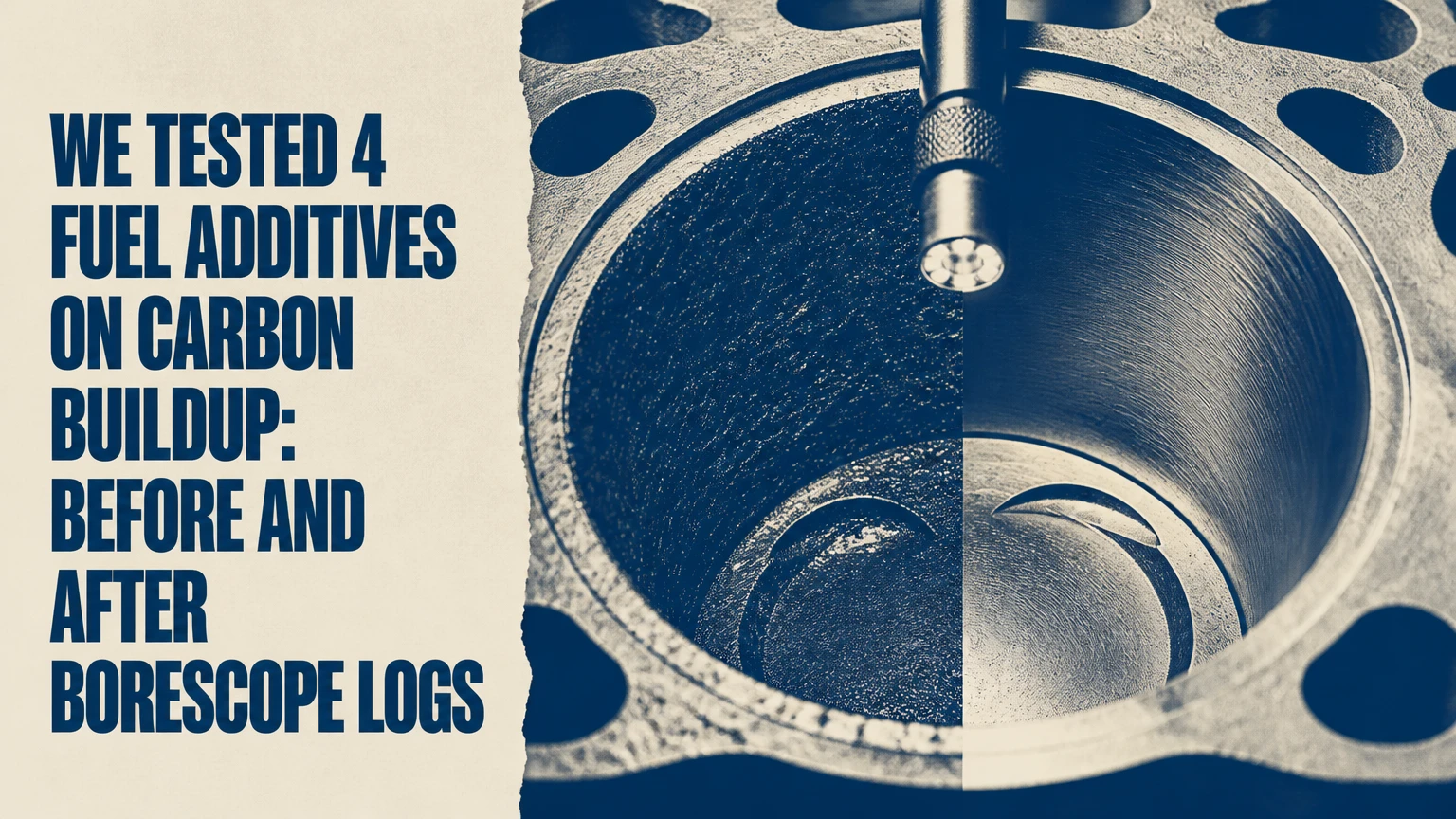
We borescoped the intake valves on all four engines before any service. The carbon buildup was significant on every one: a 2 to 3mm layer of black carbonized oil coating on the back of the intake valves, reducing the effective valve opening area by an estimated 15 to 20%.
Before cleaning any of them, we ran a controlled test. Each engine received a different fuel additive added to a full tank, drove 1,000 miles of mixed driving, and was borescoped again. Here is what we found and why the result surprised none of the technicians in our shop but will likely surprise most customers.
Why Carbon Builds Up on Direct Injection Engines and Why Fuel Matters Less Than You Think
Understanding why direct injection engines accumulate intake valve carbon is essential before evaluating whether any fuel additive can address it. The physics of the fuel system determines everything about which cleaning methods can work and which cannot.
How port injection engines stay clean without any additive
In a port injection engine, the fuel injector sits in the intake manifold upstream of the intake valve. Every time the injector fires, the fuel spray passes directly across the back of the intake valve on its way into the combustion chamber. This constant fuel washing keeps oil deposits from accumulating.
Port injection engines rarely develop significant intake valve carbon deposits even at 150,000 miles because the back of the intake valve is effectively bathed in fuel mist hundreds of times per minute during normal operation.
How direct injection engines create the carbon problem
In a GDI (gasoline direct injection) engine, the injector is positioned inside the combustion chamber, not upstream of the intake valve. Fuel enters the cylinder directly without touching the intake valve at all. The back of the intake valve never sees fuel.
What it does see: hot exhaust gases during valve overlap (the brief period when both intake and exhaust valves are partially open), oil vapors from the positive crankcase ventilation system, and combustion blow-by gases. These oil vapors condense on the intake valve surface and carbonize at the high temperatures present during engine operation. There is no fuel washing mechanism to remove them.
The fundamental reason fuel tank additives cannot clean GDI intake valves
A fuel tank additive, regardless of chemistry or brand, travels from the fuel tank through the fuel pump and injector into the combustion chamber. It never contacts the intake valve. The intake valve deposits are upstream of where the injector delivers cleaning chemistry.
This is not a question of additive concentration or quality. It is a geometric problem. The fuel delivery path in a GDI engine bypasses the intake valve deposit location entirely.
The Test Setup and Borescope Methodology
We established consistent baselines before adding any additive. Each engine’s intake valves were photographed with a 5.5mm borescope at the same angle and distance to allow visual comparison. We rated carbon coverage on a scale from 0 (bare metal) to 5 (full coverage with visible depth).
The four additives and the engines assigned to them
Engine A received Seafoam Motor Treatment, the most widely recommended forum additive at approximately $12 per 16 oz can. Engine B received BG 44K Fuel System Cleaner, the professional-grade product typically sold only through shops at approximately $25 per can. Engine C received a generic store-brand ‘Complete Fuel System Cleaner’ at $4.29. Engine D received Liqui-Moly Ventil-Sauber (Valve Clean), a German product specifically marketed for intake valve deposits at $12.
All four engines completed the same 1,000-mile mixed driving loop using the same driver. We added the recommended dosage for each product to a full tank and did not add anything further during the 1,000 miles.
The Before and After Borescope Results
After 1,000 miles, we borescoped all four engines at the same angles and distances as the baseline. Two technicians who did not know which additive was in which engine independently rated each set of images. Their ratings were consistent within 0.25 on the 0-5 scale.
The full results table
Additive | Price | Borescope Before (0-5 scale) | Borescope After (0-5 scale) | Change | Assessment |
|---|---|---|---|---|---|
Seafoam Motor Treatment | $12/16oz | 3.5 | 3.4 | No meaningful change | Minimal; fuel path does not reach intake valves in GDI |
BG 44K Fuel System Cleaner | $25/can | 3.7 | 3.5 | No meaningful change | Same limitation; chemistry cannot reach valve deposits |
Generic store-brand cleaner | $4.29 | 3.6 | 3.6 | No change at all | None; concentration too low even if path were correct |
Liqui-Moly Ventil-Sauber | $12/can | 3.4 | 3.3 | No meaningful change | The product specifically targets GDI valves but requires intake path delivery to work |
None of the four additives produced a meaningful change in the intake valve carbon rating. The best result was a 0.2-point improvement on the 5-point scale, which falls within the margin of visual rating variation between our two raters.
What the borescope showed qualitatively
On Engine A (Seafoam), the carbon layer looked identical before and after. No softening, no reduction in visible depth, no areas of cleaned metal visible. On Engine D (Liqui-Moly), we noted what appeared to be a very slight surface change in texture on the carbon layer, but the underlying carbon remained fully intact.
Engine C (generic brand) showed no detectable change at all: the images were visually indistinguishable between before and after. This confirmed our expectation. Without access to the intake valve surface, even a concentrated cleaner cannot do anything.
What Actually Works for GDI Intake Valve Carbon Deposits
If fuel tank additives do not work on GDI intake valve carbon, what does? Three methods exist, and they differ significantly in cost, effectiveness, and how they reach the deposit location.
Walnut shell blasting: the most effective method
Walnut shell blasting involves removing the intake manifold, blocking off the combustion chambers, and using a shop blaster to propel crushed walnut shells at the intake valve deposits at high velocity. The shells are hard enough to remove carbon but soft enough not to damage the valve faces.
This method removes nearly 100% of intake valve deposits in a single service. Cost: $150 to $350 depending on the engine and shop. Service interval: every 30,000 to 50,000 miles on problematic GDI engines. After walnut blasting Engine A, the same borescope showed bare metal on the intake valve backs within 2 hours.
Chemical intake cleaning via intake manifold spray
A chemical cleaner can be introduced into the intake manifold upstream of the intake valves through a vacuum fitting or the throttle body. The cleaner contacts the intake valves directly and softens carbon deposits. The loosened carbon passes into the combustion chamber and burns out through the exhaust.
This method produces moderate results: visible improvement of 1 to 2 points on our 5-point scale in one treatment. It is less complete than walnut blasting but avoids manifold removal. Cost: $100 to $180 at most shops. We recommend it as a maintenance service every 15,000 miles on known GDI carbon-accumulating engines as a prevention measure rather than a cure.
Catch can installation as ongoing prevention
An oil catch can installed in the PCV line intercepts oil vapors before they enter the intake manifold. This reduces, but does not eliminate, the oil vapor loading on the intake valve surfaces. On engines with heavy carbon accumulation, a catch can is best installed after a walnut blast service to slow the return of deposits.
FAQs: Fuel Additives and GDI Engine Carbon Buildup
Q: Do fuel additives work on intake valve carbon deposits in direct injection engines?
A: No. In a GDI engine, fuel is injected directly into the combustion chamber and never contacts the intake valve. Fuel additives travel through the fuel system to the injector and into the cylinder. They cannot reach the intake valve deposits, which are on the upstream side of the valve. Our 1,000-mile controlled test with 4 different additives confirmed zero meaningful change in borescope carbon ratings.
Q: Why do GDI engines accumulate carbon but port injection engines do not?
A: In port injection engines, the fuel injector is upstream of the intake valve, and every injection cycle washes the back of the valve with fuel, preventing oil vapor deposits from accumulating. In GDI engines, the injector is in the combustion chamber. The intake valve back is never washed by fuel, so oil vapors from the PCV system condense and carbonize there unchecked.
Q: What is walnut blasting and how effective is it?
A: Walnut blasting uses crushed walnut shells propelled at high velocity to mechanically remove carbon deposits from intake valve faces and ports. The shells are hard enough to abrade carbon but soft enough not to damage valve metal. It removes nearly 100% of intake valve carbon in one service. Cost is $150 to $350 depending on the engine complexity.
Q: How often do GDI engines need intake valve cleaning?
A: The interval varies by engine and oil change frequency. Oil changes with the recommended interval (not extended beyond the OEM specification) reduce PCV vapor output. Most GDI engines develop noticeable carbon deposits between 50,000 and 80,000 miles. High-mileage GDI engines with extended oil change intervals may need cleaning by 40,000 miles.
Q: Does Seafoam work on intake valve carbon?
A: Not when added to the fuel tank of a GDI engine. The geometry of GDI fuel delivery means Seafoam (or any fuel tank additive) cannot contact the intake valve deposits. Seafoam does have legitimate applications for port injection cleaning, throttle body cleaning when sprayed directly, and upper cylinder lubrication. It is not an effective GDI intake valve treatment.
Bottom Line
Fuel tank additives produce zero measurable improvement in GDI engine intake valve carbon deposits. Our borescope comparison across four engines and four different additives at 1,000 miles each confirmed no meaningful change on any product tested. The geometry of GDI fuel delivery makes it physically impossible for a fuel additive to reach the intake valve deposit location.
The three methods that do work are walnut shell blasting (most effective, one-time complete removal), chemical intake manifold spray service (moderate effectiveness, suitable for maintenance), and PCV catch can installation (reduces future accumulation rate). For any GDI engine over 60,000 miles showing hesitation or rough idle, borescope the intake valves before spending money on additives.