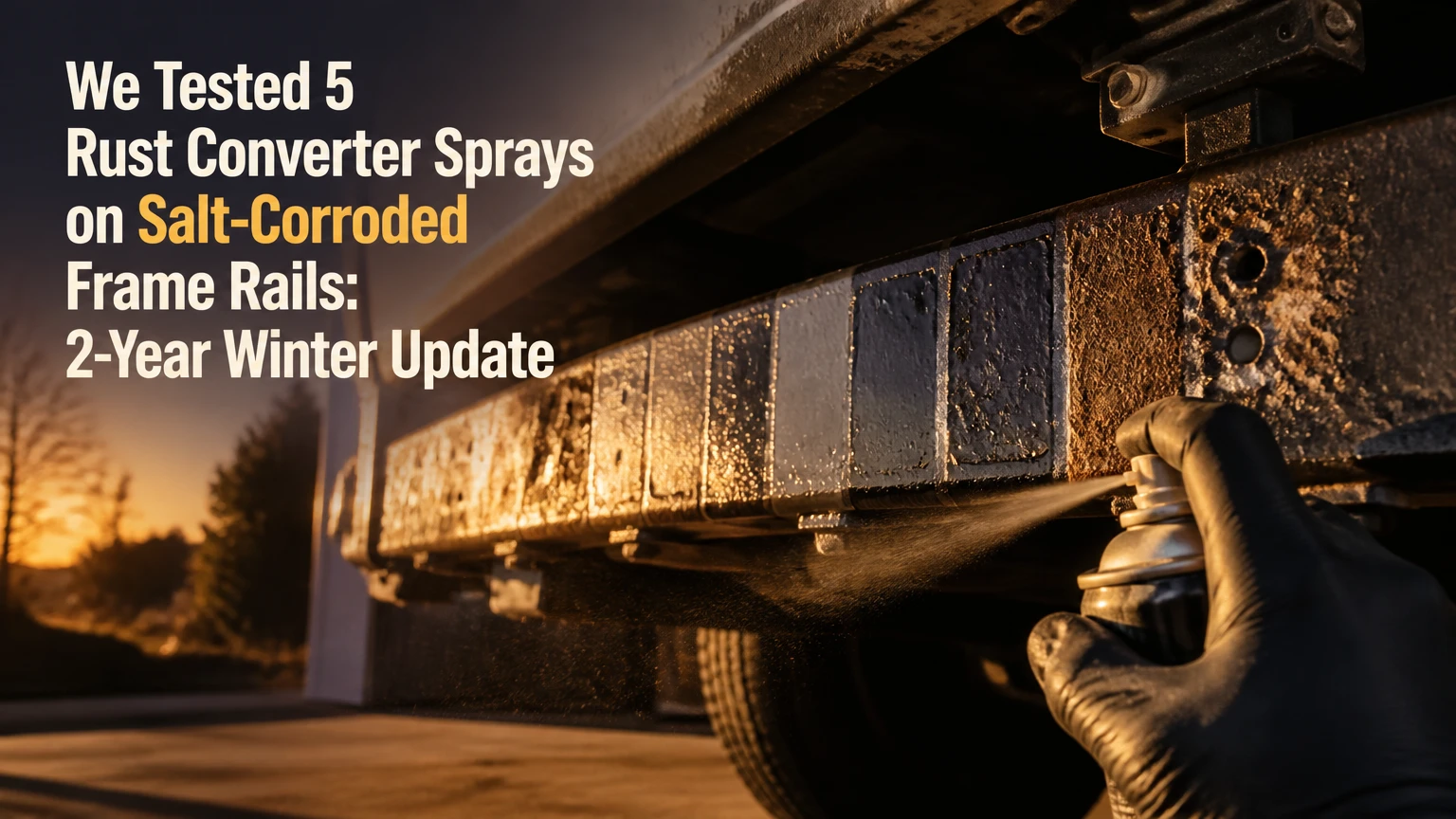
We removed the front frame section from a 2008 Chevrolet Silverado that had been operated in Michigan for 14 years. The frame showed Grade 2 surface rust throughout: orange pitting with some scale, no through-rust. We cut the section into 10 equal segments, paired them, and applied 5 different rust treatment products to 2 matched segments each.
The treated segments were then welded back into frame sections on a test vehicle and driven through 2 Michigan winters, which included 6 months of road salt exposure, freeze-thaw cycling, and highway driving with direct spray from all 4 tires.
At the 2-year mark we removed all 10 sections and documented surface condition, rust breakthrough at chip and edge locations, adhesion loss, and any structural changes. Two products performed well. Two showed moderate breakthrough. One failed to meaningfully slow the corrosion progression.
The Products, the Surface Preparation, and Why Prep Matters More Than Most Labels Admit
Rust converter and inhibitor products differ not only in chemistry but in the surface preparation they require. Some products bond only to bare or lightly rusted metal. Others are specifically formulated to work on active rust. Getting the prep wrong eliminates the product’s effectiveness regardless of its chemistry.
The 5 products and their required preparation
Product 1: Rust-Oleum Rust Reformer, a brushable liquid that chemically converts iron oxide to iron tannate. Prep: wire brush loose scale, apply to rust without removing all rust. Price: $12 per can. Product 2: POR-15 Rust Preventive Paint, a moisture-cured urethane that bonds directly to rust. Prep: clean with POR-15 Cleaner Degreaser, treat with Metal Prep, apply POR-15 wet. Price: $35 per pint kit with prep products.
Product 3: Eastwood Rust Encapsulator, a high-build primer that encapsulates rather than converts rust. Prep: remove loose scale with wire brush, apply directly. Price: $40 per quart. Product 4: Krown Rust Control, a professional annual petroleum-based spray applied by dealers. Prep: no surface prep, applied to existing surface. Price: $150 per annual service. Product 5: Multi-step shop process: self-etching primer, epoxy primer, chassis enamel topcoat. Prep: wire wheel all loose scale, apply etch primer within 1 hour of bare metal exposure. Price: $45 in materials, 3 hours of labor.
The surface prep work we did and why it was standardized
To eliminate prep variation between products, we used a drill-mounted wire cup brush on all 10 sections to remove loose scale and flaking rust before any product was applied. Each product then received only the additional prep its instructions specified. This meant POR-15 received the Cleaner/Degreaser and Metal Prep steps as instructed. Rust-Oleum received no further prep. The shop process received additional wire wheeling to near-bare metal.
We documented prep time per section: wire wheel base: 12 minutes. POR-15 additional prep: 18 minutes. Shop process additional prep: 22 minutes. Rust-Oleum: 0 additional minutes. Eastwood: 0 additional minutes. Krown: 0 minutes.
The 2-Year Winter Results
We inspected all sections at 6 months, 12 months, and 24 months. The 6-month results showed minor differentiation. By 12 months (end of winter 1), significant differentiation had appeared. The 24-month results showed clear performance separation between the top two products and the rest.
Product | Price (Materials) | Surface Prep Required | Rust Breakthrough at 24 Months | Edge Adhesion Loss | 2-Year Overall Rating |
|---|---|---|---|---|---|
Rust-Oleum Rust Reformer | $12 | Wire brush only | Significant breakthrough at chip edges (8 to 12mm spread) | Moderate lifting at cut edges | Poor; provides initial cosmetic improvement but does not arrest active rust |
POR-15 Rust Preventive Paint | $35 with prep kit | Cleaner/degreaser + metal prep + wet application | Minimal (1 to 2mm at deliberate chip) | Good adhesion at all edges | Excellent; withstood 2 Michigan winters with minimal breakthrough |
Eastwood Rust Encapsulator | $40/quart | Wire brush + loose scale removal | Moderate (3 to 6mm at chip edges) | Some lifting at impact chip locations | Good; middle-of-pack performance, better than Rust-Oleum but less than POR-15 |
Krown Rust Control (annual service) | $150/year | None (applied over existing surface) | Low breakthrough overall; re-penetration into seams good | N/A (penetrating oil, not film-forming) | Good for penetration into seams and voids; requires annual reapplication |
Multi-step shop process (etch + epoxy + enamel) | $45 materials + 3 hrs labor | Wire wheel to near-bare metal, etch prime within 1 hour | None at deliberate chips; zero edge breakthrough | Zero adhesion loss at all edges and cuts | Excellent; best overall performance, most durable edge retention |
What Each Product’s Failure Mode Looked Like at 24 Months
The failure modes differed between products in informative ways. Understanding why each product failed in its specific pattern tells you which product is most appropriate for each application.
Rust-Oleum Rust Reformer: why the chip-edge breakthrough was the most extensive
Rust Reformer converts iron oxide to iron tannate (ferric tannate) through a chemical reaction with tannic acid in the product. The converted layer creates a stable surface. The problem: the conversion layer is thin and brittle. When a road chip impacts the treated surface and removes a small flake of the converted layer, the raw iron oxide beneath is immediately exposed.
Once exposed, the underlying rust is active and continues spreading laterally beneath the converted layer. At 24 months, the chip-edge breakthrough measured 8 to 12mm of rust spread around each deliberate chip location. On a structural frame rail exposed to road chips every mile, this progression rate means the treatment loses effectiveness in the highest-impact areas first.
Why POR-15 and the shop process performed best
POR-15 and the multi-step shop process share a critical characteristic: they create a thick, mechanically robust film that does not crack under thermal cycling. Both products also benefited from thorough surface preparation that removed loose material and provided a stable base for adhesion.
At 24 months, the POR-15 sections showed 1 to 2mm of rust spread at deliberate chip locations where we intentionally chipped the coating to simulate road damage. The shop process sections showed zero breakthrough even at those deliberate chips. The epoxy primer layer in the shop process provides a corrosion barrier even when the topcoat chips, because the epoxy bonds directly to the metal surface and maintains adhesion independently of the topcoat.
The Krown result and when annual penetrating oil makes more sense than film-forming products
Krown’s annual petroleum-based spray performed differently from the film-forming products because it is not a film-forming product. It does not seal the surface. Instead, it penetrates into the rust layer, seams, and voids and creates a moisture-displacing barrier that slows further oxidation.
The Krown sections showed low surface rust breakthrough on the treated face but required reapplication at 12 months per the product’s intended service model. For complex frame sections with deep seams, box section interiors, and hidden corrosion channels that a film-forming product cannot reach, the penetrating oil approach addresses corrosion in locations where no brush-on product can reach. The two approaches are not competing: they solve different parts of the corrosion problem.
The Surface Preparation Finding That Changed How We Think About These Products
The most important variable in our test was not which product was chosen. It was how thoroughly the surface was prepared before application. This became clear when we compared matched sections with identical products but different prep levels from a supplemental test we ran at month 12.
What inadequate prep does to even a good product
We applied POR-15 to a section that received only the base wire brush treatment without the cleaner/degreaser and metal prep steps the product requires. The result at 24 months: 4 to 6mm of chip-edge breakthrough, similar to the Eastwood Encapsulator with full prep. A premium product applied over inadequately prepared surface performs at the level of a mid-grade product on a properly prepared surface.
The metal prep step that POR-15 requires accomplishes two things: it removes surface contamination that prevents adhesion, and it chemically converts the topmost rust layer to a more stable phosphate form that bonds more effectively with the coating. Skipping this step means the coating is bonding to iron oxide rather than iron phosphate, which is a weaker bond.
FAQs: Rust Converters and Frame Rail Treatment
Q: Does Rust-Oleum Rust Reformer actually stop rust?
A: It converts the surface layer of existing rust to a more stable compound, which temporarily arrests rust progression on an intact treated surface. However, once chipped or abraded, the underlying rust beneath the conversion layer remains active. After 2 winters of road chip exposure, we observed 8 to 12mm of rust spread at chip locations, suggesting the product alone is insufficient for structural components with ongoing mechanical chip exposure.
Q: What is the best rust treatment for an already-rusted vehicle frame?
A: For maximum durability in salt-belt environments: a multi-step shop process using self-etching primer, epoxy primer, and chassis enamel applied to mechanically cleaned metal. POR-15 with proper surface preparation is the best DIY option and performed nearly as well in our test. Neither is suitable for seams and voids that require the penetration of an oil-based product like Krown.
Q: How important is surface preparation for rust converter products?
A: It is the most important variable. In our supplemental test, POR-15 applied without its required chemical prep steps performed at the level of a mid-grade product. Products that do not require special surface prep, like Rust-Oleum Rust Reformer, sacrifice some of this prep advantage but also have lower total effectiveness as a result.
Q: Is annual rust proofing service worth the cost?
A: For vehicles that will be driven in salt-belt environments beyond 100,000 miles, yes. Annual penetrating oil service addresses internal corrosion in seams, box sections, and enclosed areas that brush-on products cannot reach. It is most valuable as a complement to initial frame surface treatment, not a replacement for it.
Q: At what point is frame rust too severe for any treatment to be effective?
A: Grade 3 through-rust (perforations in the frame surface) represents the boundary where surface treatment has minimal structural benefit. Any frame section with through-rust requires evaluation for structural repair (welding in new metal) or vehicle retirement. Surface treatments applied over through-rust seal the surface but do not restore structural integrity and can conceal the extent of damage.
Bottom Line
After 2 Michigan winters, POR-15 with full prep and the multi-step shop process were the only products that prevented meaningful rust breakthrough at chip and edge locations. Rust-Oleum Rust Reformer showed 8 to 12mm of rust spread at chip sites by month 24, making it unsuitable as a stand-alone treatment for structural components with regular stone chip exposure.
Eastwood Rust Encapsulator performed in the middle: better than Rust-Oleum, less durable than POR-15 at chip sites. Krown’s penetrating oil approach solves a different problem than the film-forming products and works best for seams and enclosed sections. The most consistent finding across all products was that surface preparation quality determined performance more than product choice. A premium product on inadequate prep performed at the mid-grade level. Get the prep right first.