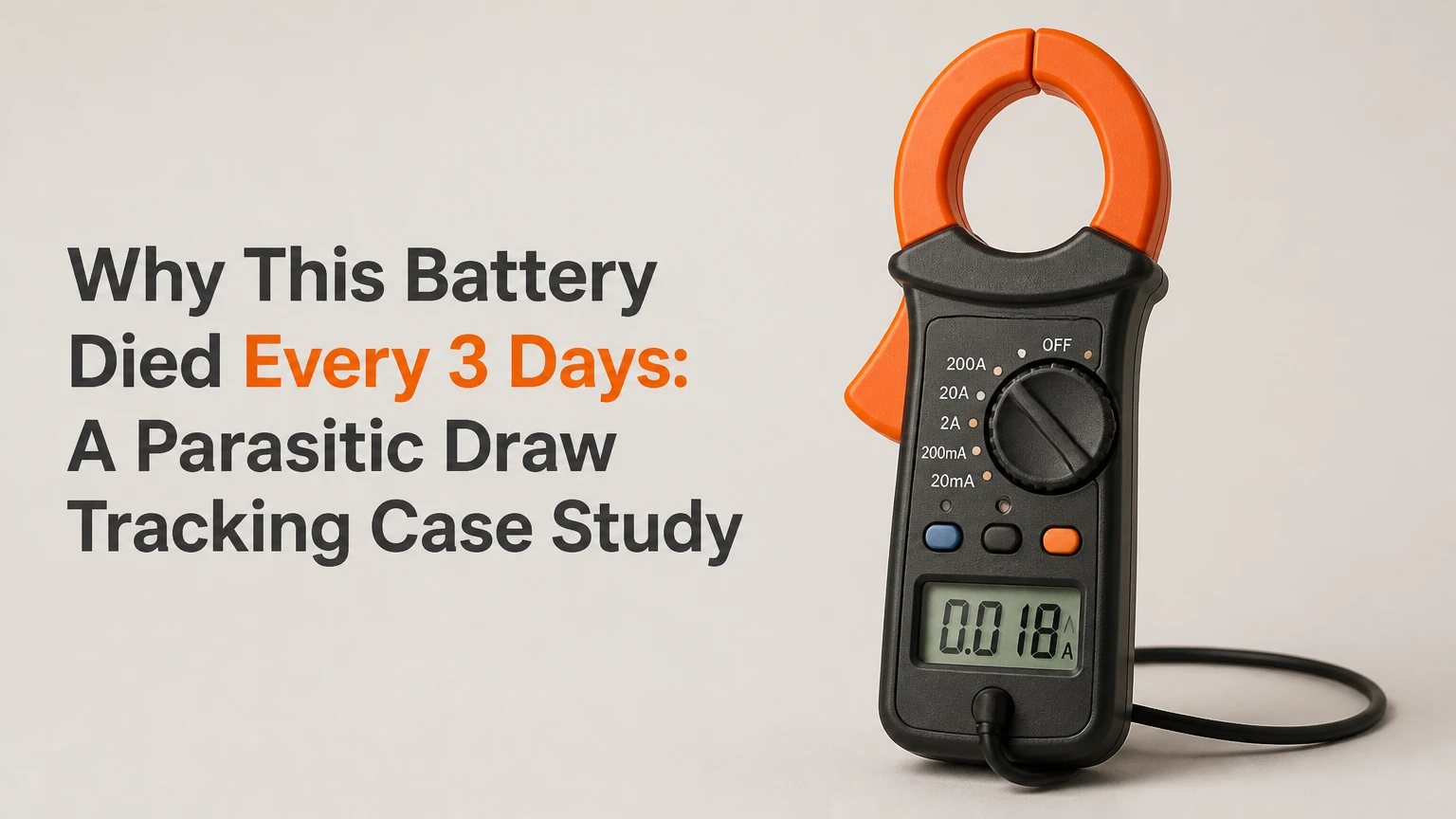
Three batteries in six months. All replaced under warranty. All dead within 72 hours of sitting. The dealer had replaced the batteries and sent the owner home twice. We spent four hours following the current and found two culprits sitting 18 inches apart under the dashboard: an aftermarket dashcam hardwire kit wired directly to a constant-power circuit, and a Body Control Module that had stopped entering deep sleep mode.
Together they were pulling 450 milliamps continuously, around the clock, every minute the car was parked. At that rate, a fully charged 80Ah AGM battery reaches the minimum cranking voltage threshold in approximately 96 hours. The owner parks for long weekends. The math was not in his favor.
The Vehicle and the History
Vehicle: 2020 Jeep Grand Cherokee Limited, 3.6L Pentastar V6, 28,400 miles.
Complaint: New battery purchased at dealer goes dead within 3 days of sitting. Dealer replaced battery twice under warranty, both replacements failed identically. On the third replacement, the dealer told the owner the battery was fine and he should drive the vehicle more frequently.
What the dealer did not check: Parasitic draw. We confirmed this by reviewing the repair orders the owner brought with him. Both warranty replacements documented battery voltage at time of replacement, a confirmation that the new battery held a charge immediately after installation, and a release note. No parasitic draw test was performed at either visit.
A battery that dies repeatedly on a late-model vehicle with moderate mileage is not a battery problem until parasitic draw has been ruled out. Ruling out parasitic draw takes 45 minutes with a basic multimeter.
How We Tracked the Drain: The Sleep Mode Log
Modern vehicles do not go fully quiet the moment you turn off the ignition. Multiple modules stay active for varying periods: the infotainment system shuts down after 30 to 90 seconds, HVAC modules after 2 to 5 minutes, the BCM after 10 to 30 minutes depending on vehicle state. Normal parasitic draw on a fully slept 2020 Grand Cherokee should settle at approximately 30 to 50 milliamps within 45 minutes of ignition off.
We connected a calibrated Fluke 87V in series with the negative battery cable on the 10-amp current range and logged draw at 5-minute intervals over 60 minutes. The vehicle was undisturbed during this period.
Parasitic draw sleep log:
| Time After Ignition Off | Current Draw | Expected Draw | Status |
|---|---|---|---|
| 0 minutes | 2,510 mA | 2,000 to 3,000 mA | Normal (active modules) |
| 5 minutes | 1,840 mA | Dropping | Normal (infotainment shutting down) |
| 10 minutes | 980 mA | Dropping | Normal (HVAC, radio modules sleeping) |
| 20 minutes | 620 mA | Dropping | Normal (most modules sleeping) |
| 30 minutes | 450 mA | Should be at 50 mA or below | Abnormal |
| 45 minutes | 450 mA | Should be at 35 mA | Abnormal |
| 60 minutes | 450 mA | 30 to 50 mA spec | Confirmed parasitic drain |
The system never completed its sleep cycle. Draw stabilized at 450 mA and stayed there indefinitely. Factory spec for this vehicle in full sleep mode is 35 mA. The actual draw was 12.8 times the acceptable background level.
What 450 mA does to a battery over time:
| Time Elapsed (parked) | Estimated Battery Capacity Remaining | Starting Ability |
|---|---|---|
| 0 hours (full charge) | 100% (80 Ah) | Strong |
| 24 hours | 87% | Normal |
| 48 hours | 74% | Normal |
| 72 hours | 61% | Marginal in cold weather |
| 96 hours | 48% | Likely no-start |
| 120 hours | 35% | No-start |
At 96 hours (four days), the battery had dropped below reliable cranking voltage for a 3.6L V6 in temperatures below 50°F. The owner’s “every 3 days” experience aligned precisely with this curve when accounting for the fact that the vehicle often sat from Thursday evening through Monday morning.
Finding the Source: Millivolt Drop Across the Fuse Box
Pulling fuses one by one on a modern CAN-bus vehicle is the wrong approach. Every time a fuse is pulled and replaced, the circuit disruption can briefly wake sleeping modules and reset the sleep cycle, giving false readings. We used a millivolt drop method instead.
With the vehicle in full sleep mode and 450 mA confirmed on the meter, we switched the multimeter to DC millivolts and placed the probes across the front face of each fuse in the interior fuse box, without removing any fuse from its socket. A fuse carrying active current produces a measurable millivolt drop across its terminals proportional to the current flowing through it. A fuse in a circuit with no active load shows less than 1 mV.
Selected fuse box millivolt readings:
| Fuse Number | Circuit Label | mV Drop | Current Flowing |
|---|---|---|---|
| F1 | Airbag backup | 0.4 mV | No |
| F7 | Power windows | 0.6 mV | No |
| F14 | BCM / Accessories | 18.2 mV | Yes, active draw |
| F19 | Instrument cluster | 1.1 mV | No |
| F22 | Radio memory | 2.3 mV | Minor, expected |
| F31 | Dashcam (aftermarket tap) | 14.8 mV | Yes, active draw |
Two fuses showed significant active current flow: F14 (BCM and accessories circuit, 18.2 mV) and F31 (an aftermarket fuse tap, 14.8 mV). Everything else was background noise.
Isolating the Two Culprits
Culprit 1: The dashcam hardwire kit.
The aftermarket dashcam had been professionally installed at a tint and accessory shop 4 months before the battery problems began. The installer had wired the dashcam to the F31 circuit, a constant-power circuit that remains live regardless of ignition state. The dashcam was designed to run in parking mode when the vehicle is off, recording any motion near the vehicle. In parking mode, it drew 185 mA continuously.
This is not an installation error. It is a design mismatch between a parking-mode camera and a vehicle’s battery capacity for extended sitting periods. A dashcam drawing 185 mA on a constant-power circuit with no voltage cutoff will drain any battery given enough time. The dashcam kit should have been wired to a switched ignition circuit for basic operation or through a dedicated battery voltage cutoff relay set to 12.2V.
Culprit 2: The BCM stuck out of sleep.
After disconnecting the dashcam and rerunning the sleep log, total draw settled at 265 mA after 60 minutes. Better, but still well above the 35 mA specification. Fuse F14 still showed active current flow.
A BCM that cannot enter deep sleep mode can be caused by several conditions: an active door or trunk ajar signal keeping the BCM alert, a malfunctioning module on the CAN-bus that the BCM is waiting to communicate with, or a software fault in the BCM itself. We ran a CAN-bus scan and found an active communication fault logged between the BCM and the right rear door module. The right rear door ajar switch had failed and was reporting a continuous “door open” signal, keeping the BCM in an awake state to monitor the door status.
With the door module replaced and the ajar signal resolved, the BCM sleep log completed correctly. Draw at 45 minutes post-ignition off: 31 mA, within specification.
Final draw with both issues resolved: 31 mA (BCM resolved) plus dashcam rewired to a switched circuit with a voltage cutoff relay = 31 mA in sleep mode. Battery has not failed in the 5,000 miles since repair.
The Fuse-Pulling Mistake and Why It Gives False Readings
When most DIYers begin chasing a parasitic draw, they pull fuses until the current reading drops. On a 2005 vehicle with a simple electrical architecture, this sometimes works. On a 2020 Grand Cherokee with a CAN-bus network connecting dozens of modules, pulling and reinstalling fuses wakes sleeping modules repeatedly and resets the sleep cycle from zero each time.
If the sleep cycle resets, the meter reading jumps back to 2,000-plus milliamps and the technician has to wait another 30 to 45 minutes for modules to re-enter sleep before the reading becomes meaningful. In practice, this means repeated fuse pulls never allow the system to reach a stable sleep reading, and the source of the drain never isolates cleanly.
The millivolt drop method across fuse faces does not disturb the circuit at all. It reads passively, like a voltmeter. Use it.
The 0.050 Amp Rule and the Diagnostic Decision Matrix
The threshold between acceptable background memory draw and an active battery-killing parasitic drain is 50 milliamps (0.050 amps) after a minimum of 45 minutes in full sleep mode. Any reading above this number after 45 minutes of undisturbed sleep requires further investigation.
| Steady Draw After 45 Min | Battery Life at Rest | Likely Source | Diagnostic Method |
|---|---|---|---|
| Under 50 mA | 3 to 4 weeks minimum | Normal background memory draw | No action needed |
| 50 to 150 mA | 8 to 12 days | Single accessory or minor module issue | Millivolt fuse scan |
| 150 to 300 mA | 4 to 6 days | Aftermarket accessory or module fault | Millivolt fuse scan + CAN scan |
| 300 to 500 mA | 2 to 4 days | Multiple sources or BCM fault | Millivolt fuse scan + CAN scan |
| Above 500 mA | Under 2 days | Alternator diode fault or major module | Alternator diode test first |
DIY Parasitic Draw Testing: The Safe Method
What you need: A digital multimeter capable of 10A DC measurement, a millivolt DC setting, and patience.
Step 1: Connect the multimeter in the 10A range in series between the negative battery terminal and the negative cable. Do not disconnect anything else. Close all doors and leave undisturbed.
Step 2: Wait 45 to 60 minutes without opening any door, using any button, or interacting with the vehicle in any way. Any interaction resets the sleep cycle.
Step 3: Read the final stabilized current draw. If below 50 mA, the electrical system is healthy. If above 50 mA, proceed to millivolt testing.
Step 4: Switch the multimeter to DC millivolts. Place probes across the front face of each fuse in turn, touching both exposed metal ends without removing the fuse. Record any reading above 5 mV as an active circuit.
Step 5: Identify the circuit label for any active fuse and begin component isolation in that circuit.
Do not start by pulling fuses. Follow the current with the millivolt method before touching anything inside the fuse box.