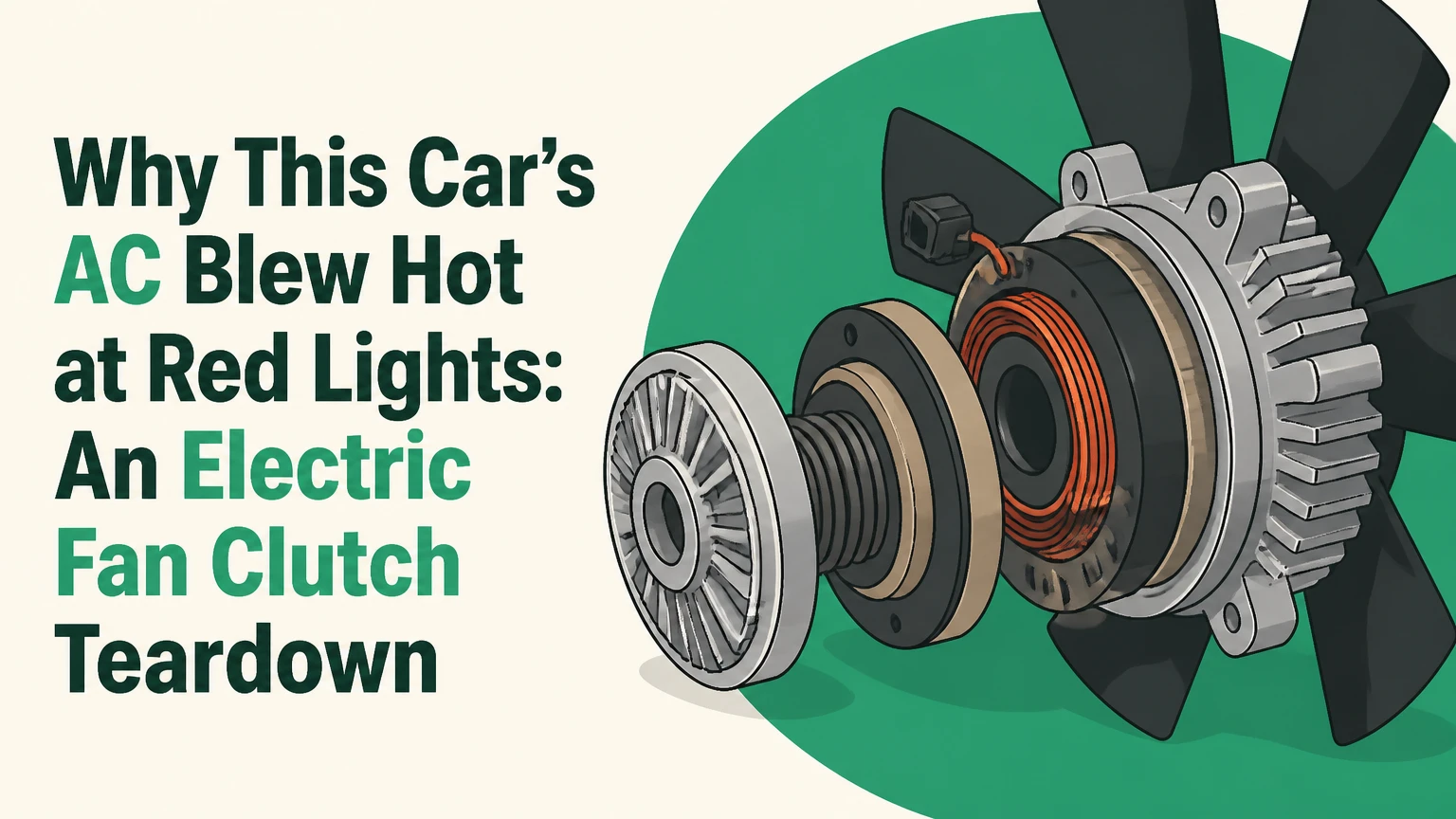
The short answer: The radiator cooling fan motor was drawing 2.1 amps instead of 14.8. At highway speed, ram air through the condenser kept the AC working fine. The moment the car stopped, the condenser had no airflow, high-side pressure spiked to 380 PSI, the high-pressure safety cutout tripped, and the compressor shut off. Vent temperature at idle: 84°F. Vent temperature at 60 mph: 46°F. Same refrigerant charge, same compressor, same everything except airflow across the condenser.
Before we get into the teardown, one important detail: this customer had already added two cans of R134a refrigerant from an auto parts store before arriving. That made the diagnostic harder and the system more dangerous. We will get to that.
What the Customer Reported and What We Found at Intake
Vehicle: 2017 Nissan Altima 2.5L, 91,400 miles. Single-zone automatic climate control.
The owner described the AC as working perfectly on the highway, on ramps, and in moving traffic but cutting out completely or blowing warm air within 60 to 90 seconds of coming to a stop. He had tried two refrigerant recharge cans purchased at a parts store, which briefly improved the situation before the problem returned worse than before. When the shop took the car, the AC was inoperative even at highway speed.
This symptom profile, good at speed and bad at idle, is almost never a refrigerant charge problem. Refrigerant charge affects AC performance uniformly regardless of vehicle speed. The variable between highway and idle operation is airflow across the condenser. Anything that makes the condenser airflow speed-dependent points to the cooling fan system, not the refrigerant circuit.
Pressure and Temperature Data: What the Gauges Showed
We connected a manifold gauge set and recorded pressures at idle and at a simulated highway speed on the dyno with the fan motor bypassed and running correctly via direct battery feed. We also measured vent temperatures and condenser surface temperatures using a non-contact pyrometer.
AC system pressures (ambient 84°F, engine at operating temperature):
| Condition | Low-Side PSI | High-Side PSI | Vent Temp (F) | Compressor Status |
|---|---|---|---|---|
| Highway speed, fan functional | 28 PSI | 212 PSI | 46°F | Running |
| Idle, fan failing (as-found) | 24 PSI | 382 PSI | 84°F | Cutout tripped |
| Idle, fan bypassed to direct power | 27 PSI | 208 PSI | 48°F | Running |
Normal high-side pressure on this system at 84°F ambient is 200 to 230 PSI. At idle with the failing fan motor, high-side climbed to 382 PSI before the high-pressure safety cutout tripped at approximately 390 PSI and commanded the compressor clutch off. The low-side pressure actually dropped slightly during this event as the compressor stopped pumping, which is why store-bought refrigerant gauges (low-side only) showed what appeared to be a normal or even slightly low reading during idle. The low side was not the problem.
Condenser surface temperatures at idle (non-contact pyrometer scan, 9-point grid):
| Position | Fan Failing (°F) | Fan at Full Speed (°F) |
|---|---|---|
| Top left | 141 | 91 |
| Top center | 148 | 88 |
| Top right | 139 | 90 |
| Center left | 152 | 86 |
| Center | 158 | 85 |
| Center right | 151 | 87 |
| Bottom left | 144 | 89 |
| Bottom center | 149 | 88 |
| Bottom right | 142 | 90 |
With the fan failing, the condenser surface was heat-saturated at 141 to 158°F across its entire face at idle. The refrigerant entering the condenser could not shed heat into the stagnant air, pressure climbed, and the safety cutout did its job. With the fan running at correct speed and current draw, condenser surface temperatures dropped to 85 to 91°F and the system operated normally.
Fan Motor Current Draw: Finding the Root Cause
We disconnected the cooling fan motor connector and measured current draw directly using an amp-clamp multimeter with the fan motor commanded to high speed through the relay.
Fan motor current draw:
| Condition | Measured Current Draw | Factory Specification |
|---|---|---|
| Low-speed command | 1.1 amps | 7 to 9 amps |
| High-speed command | 2.1 amps | 13 to 16 amps |
The fan motor was drawing 14% of its rated current at high speed. The blades were turning, slowly, which is why the customer perceived the fan as functional. A fan spinning at 20 to 25% of its design speed moves a small fraction of its rated airflow. The visual check of “fan is spinning” passed. The amperage check failed immediately.
We pulled the fan assembly and split the motor housing. The internal brushes had worn past their service limit and were making intermittent contact with the commutator ring. The contact area was oxidized. The motor was generating just enough rotational force to turn the blades against no resistance but could not maintain contact pressure or current flow under any meaningful aerodynamic load.
The Low Freon Misdiagnosis and What It Cost
The two refrigerant recharge cans the owner added before arriving created a problem on top of the original problem.
A system with a failing cooling fan at idle will show low low-side pressure when the compressor cuts out repeatedly. Store-bought recharge gauges connect to the low side only and display pressure as a refrigerant level indicator. Low-side pressure dropping to 24 to 26 PSI at idle with the compressor cycling on and off looks identical to a low refrigerant charge on a store-bought gauge. The owner added refrigerant based on that reading.
The system was not low on refrigerant. It had a full charge before the recharge cans. By the time the car arrived at our shop, the system was overcharged by approximately 6 to 8 ounces. On a system that cannot shed high-side heat due to fan failure, an overcharged condition elevates an already dangerous high-side pressure further. The safety cutout was tripping more frequently as a result, and the compressor was cycling on and off rapidly enough to stress the compressor clutch and internal valves.
We recovered and reweighed the refrigerant, confirmed the system was overcharged, corrected the charge weight, repaired the fan motor, and rechecked pressures. Normal across all operating conditions.
We also found burn marks inside one of the two cooling fan relays. The relay contact surface was partially fused, indicating the relay had been switching a degraded motor under high-current demand repeatedly. The relay was replaced as part of the repair. A relay in this condition will fail completely without warning, taking the remaining cooling fan capacity with it.
Condenser Fin Condition
While the fan assembly was out, we inspected the condenser fin surface. The lower 40% of the condenser face showed significant corrosion damage from road salt exposure: fins collapsed and bonded together in clusters, reducing the effective heat transfer surface area in that zone by approximately 30 to 35%.
Fin damage of this extent reduces condenser efficiency even when the fan is operating correctly. On a hot day above 95°F ambient, this vehicle will show elevated high-side pressure even with the fan repaired, because the corroded fin section cannot transfer heat at the rate the full condenser surface was designed to provide.
We notified the owner. The repair priority was the fan motor and relay, which restored full AC function in current conditions. The condenser becomes the limiting factor above approximately 98°F ambient. He elected to monitor and replace the condenser before the following summer.
The Drive-Thru AC Test: Diagnosing This Without Any Equipment
If your AC works on the highway and fails at stoplights or drive-throughs, perform this test before spending money on a refrigerant recharge:
Step 1: Park the car with the engine running, AC on maximum, and sit for 90 seconds at idle.
Step 2: Pop the hood while leaving the engine running and the AC on.
Step 3: Stand beside the car and feel for airflow exiting through the front of the vehicle, between the bumper and the condenser. With the fan running correctly on a hot engine, you should feel a noticeable warm airflow exiting the grille area.
Step 4: Visually confirm the fan is spinning. Then confirm it is spinning with authority, not lazily rotating. A fan drawing 2 amps looks like it is spinning. A fan drawing 14 amps looks like a blur.
Step 5: If airflow is weak or absent and the fan appears to be spinning slowly, the diagnosis is fan motor or relay, not refrigerant.
Adding refrigerant to a system with a failing cooling fan will not improve idle AC performance. It will overcharge the system and increase the risk of compressor damage.
The Full Diagnostic Symptom Matrix
| AC Behavior | Low-Side PSI | High-Side PSI | Fan Status | Root Cause |
|---|---|---|---|---|
| Warm at idle only, cold at speed | Low to normal at idle | Spikes at idle | Failing or slow | Cooling fan motor or relay |
| Warm at all speeds | Below 25 PSI low-side | Below 150 PSI high-side | Normal | Low refrigerant charge |
| Warm at all speeds | Above 30 PSI low-side | Above 350 PSI | Normal | Overcharge or condenser blockage |
| Intermittent, compressor cycling rapidly | Fluctuating | Fluctuating | Normal | Low charge or expansion valve |
| No cold air, compressor not engaging | Below 25 PSI | Below 25 PSI | Normal | Very low charge, pressure switch lockout |
| Warm at idle, compressor noise | Normal at speed | Normal at speed | Normal | Compressor clutch slipping |