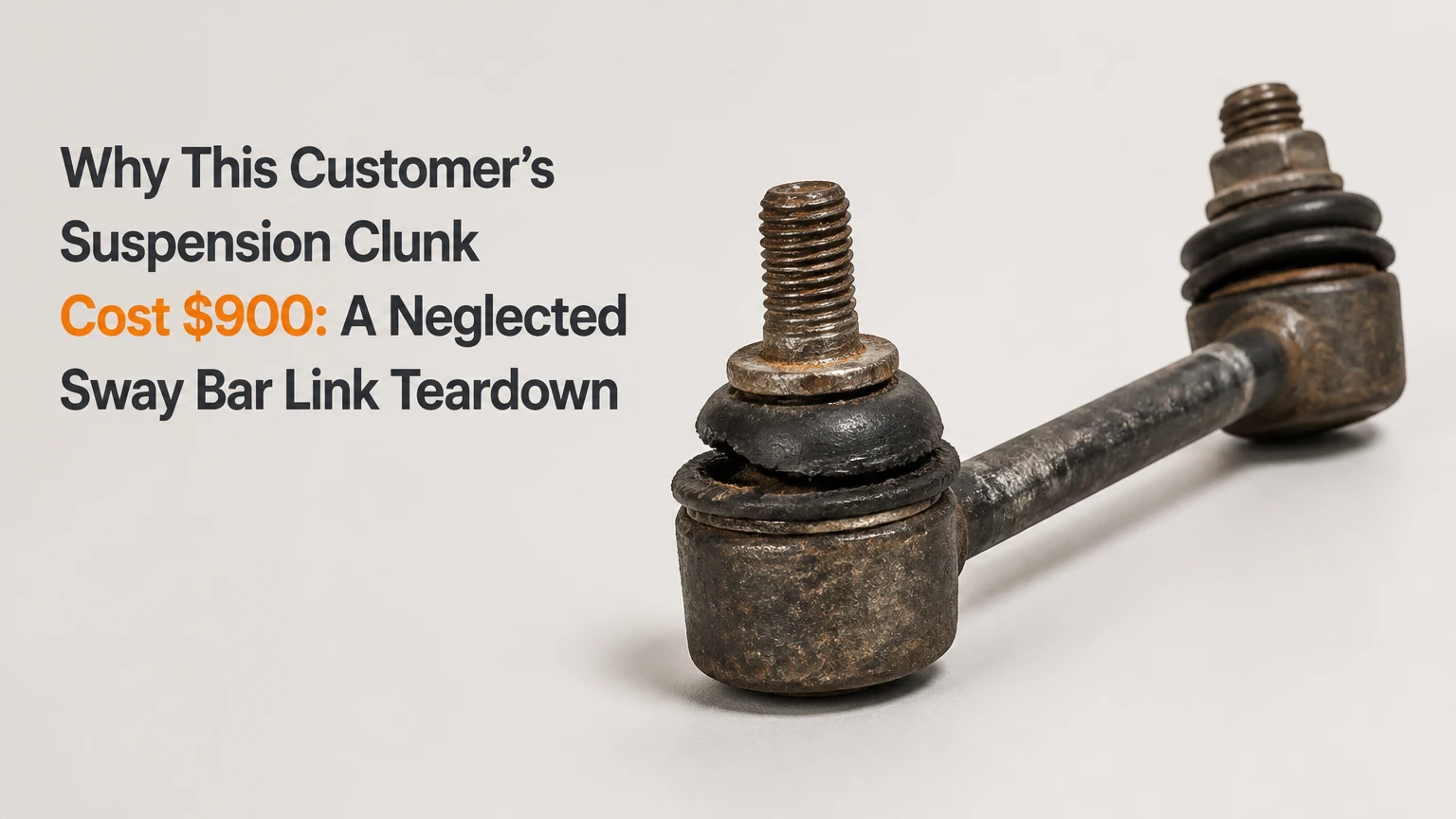
A customer brought in a 2015 Toyota Camry with a front suspension clunk that had ‘gotten a lot worse’ over the past 8 months. He had received a quote 8 months earlier from another shop: $280 for front sway bar links, both sides. He decided it was not urgent.
Eight months later, the car was making a knock-and-thud combination over road irregularities, not just a light clunk. The steering felt vague on lane changes, and there was a new noise from the right front on smooth road turns.
After teardown, the repair came to $900. Here is exactly which components failed due to the delay, the mechanism that connected each failure to the original ignored sway bar link, and what the teardown of the worn link itself showed.
What a Sway Bar Link Does and Why Its Failure Mode Is Insidious
The sway bar link is a short connecting rod between the sway bar (stabilizer bar) and the control arm or strut. It transfers lateral load between left and right corners of the axle through the sway bar, which resists body roll during cornering. Sway bar links are maintenance items: they contain ball joints that wear over miles and require periodic replacement.
The specific failure mode of a sway bar link ball joint
A sway bar link ball joint consists of a stud pressed into a plastic bearing cup, retained by a spring-loaded socket cap. The designed movement range is typically plus or minus 25 to 30 degrees of angular travel with essentially zero axial play. When the bearing cup wears, the stud develops axial play: up-and-down movement within the socket.
The initial clunk a driver hears is the stud traveling to the end of its play and impacting the socket cap or the socket housing. With 0.5mm of axial play, the clunk is light and intermittent, mainly over sharp bumps. With 5mm or more of play, the stud bangs the housing consistently over any surface irregularity.
Why the link’s failure begins damaging adjacent components
A sway bar link that has significant axial play no longer accurately transfers lateral load. Instead of the sway bar and link working together as a rigid connection, the link begins functioning as a loose pivot. The sway bar end, which should be held at a fixed geometry relative to the control arm, now moves through the link’s play range before any load transfers.
This movement creates two problems simultaneously. First, it causes the sway bar end to rotate and translate against the link mounting hole on the sway bar. This metal-on-metal contact (stud of link bearing against sway bar hole edge) begins to groove the softer sway bar material. Second, the lateral load that the sway bar should be carrying begins transferring through other suspension components, primarily the strut, which was not designed to carry that lateral load component.
The Teardown: What Eight Months of Ignored Clunk Did to Five Components
We tore down the right front suspension corner completely and documented the condition of every component the failed sway bar link had contact with, either directly or through load transfer.
The sway bar link itself
The right front sway bar link showed 6.8mm of axial play at the upper ball joint. Designed play: 0.0mm. The rubber boot was torn and had been gone for approximately 4 to 6 months based on the corrosion pattern on the exposed ball stud. The stud itself showed micro-pitting from operating without lubricant.
At the lower ball joint: 4.2mm of play. The lower ball joint showed less wear because it had retained its boot, but the worn upper joint meant the link was operating at extreme angles and loads that accelerated lower wear as well.
The sway bar end: the first secondary failure
Where the sway bar link attaches to the sway bar end, we found a groove worn into the sway bar bore. The sway bar link stud had been rotating and translating within the sway bar’s link hole for 8 months. The stainless steel link stud, harder than the sway bar, had machined a 0.9mm deep groove around the inside of the sway bar hole.
That groove meant the sway bar hole was now oval rather than round. A new link stud in that hole would have significant radial play immediately. The sway bar required replacement.
The control arm bushing: the second secondary failure
The inner control arm bushing on the right front showed accelerated rubber degradation on the outboard face. This face had been receiving irregular lateral load pulses from the sway bar’s ineffective load management. The rubber compound had work-hardened and developed surface cracking.
Bushing end play measured 2.1mm. Specification is under 0.5mm. The bushing was past its service limit and required replacement.
The strut mount bearing: the third secondary failure
The right front strut mount bearing showed early failure at the thrust race. The bearing showed micro-pitting across approximately 30% of the race surface. On turns at low speed, the pitted bearing produced a gritty, intermittent noise from under the hood.
The strut mount bearing had been absorbing lateral loads it was not designed to carry because the sway bar link was not efficiently transferring those loads through the sway bar. Strut mount bearings carry primarily vertical and rotational loads. Sustained lateral loads overload the thrust race.
Component | Condition at 8 Months Prior (Estimated) | Condition at Repair | Failure Cause | Repair Cost (USD) |
|---|---|---|---|---|
Sway bar links (both sides) | Worn, 0.5 to 1mm play, first clunk audible | 6.8mm upper play, boot torn, stud pitted | Normal end-of-service wear, appropriate replacement time was 8 months ago | $140 (would have been the total repair) |
Sway bar (right end) | Intact, no groove | 0.9mm groove around link hole, hole now oval | Metal-on-metal contact from link stud rotating in worn bore over 8 months | $220 |
Right front control arm bushing | Acceptable, minor wear | End play 2.1mm (spec: under 0.5mm), surface cracking | Irregular lateral load from sway bar inefficiency for 8 months | $185 |
Right front strut mount bearing | Acceptable | 30% of thrust race surface pitted, audible on turns | Sustained lateral load overloading thrust race not designed for it | $165 |
Labor (all items) | $140 estimate | $190 for additional components and time | Secondary failure diagnostics and removal/reinstall sequence complexity | $190 |
TOTAL | $140 | $900 |
The Specific Measurement That Showed Us How Fast the Damage Had Progressed
We could not directly measure the condition of these components 8 months earlier. But we could estimate the progression rate from the wear patterns and current measurements.
How we estimated the damage timeline from the wear evidence
The sway bar groove depth of 0.9mm in 8 months implies an average groove cut rate of approximately 0.11mm per month. At that rate, the link stud would have been producing measurable groove contact within the first 2 to 3 months of accelerated play. The control arm bushing cracking was more recent: the crack pattern showed characteristics of 3 to 4 months of sustained irregular load rather than 8.
This suggests the damage accelerated in the later months as each component failure increased the load on the others. The initial 0.5mm of link play produced modest sway bar contact. As that play reached 3mm and then 6mm, the sway bar contact intensity increased, groove depth accelerated, and the lateral load misdirection to the strut increased.
The point at which additional delay would have added more components
The strut mount bearing’s thrust race pitting was at approximately 30% coverage. At 60% coverage, the bearing typically produces a consistent grating on turns that requires power steering fluid replacement diagnosis and sometimes fluid replacement. At 100% race pitting, the bearing can seize and require strut assembly replacement at $350 to $500 additional.
Two to three more months of driving in this condition likely would have added the full strut assembly to the repair list, bringing the total to $1,250 to $1,400 from the original $140.
What the Customer Said and What We Showed Him
We kept all removed components and presented the teardown to the customer before writing the invoice. The grooved sway bar end, the cracked bushing, and the pitted strut mount bearing told the story more effectively than any explanation could.
The conversation about how to evaluate a suspension quote
The customer asked us to explain why the original shop quoted $280 for the links when it cost $140 in our repair. We explained that the $280 likely included both links and both side labor at a higher labor rate, and that the quote was accurate 8 months ago. The $140 in our total is roughly equivalent labor time.
What changed was not the link quote. What changed was the four components that could not have been quoted 8 months ago because they had not yet been damaged. The repair estimate from 8 months prior was not wrong. It became insufficient the moment the driver chose to defer it.
FAQs: Suspension Clunk, Sway Bar Links, and Repair Deferral
Q: How long can you drive with a worn sway bar link before it causes further damage?
A: Based on our teardown data, measurable secondary damage began within 2 to 3 months of the link exceeding 1mm of axial play. By 8 months, the damage had extended to 3 additional components. The progression is not linear: it accelerates as each component failure increases load on the adjacent parts. There is no safe deferral period once a sway bar link is producing a consistent clunk.
Q: What is a sway bar link and how much does it typically cost to replace?
A: A sway bar link is a short rod connecting the stabilizer bar to the control arm or strut. It contains ball joints that wear over time. Replacement cost for one link is $25 to $65 in parts and $50 to $80 in labor at most shops. Both sides are typically replaced at the same time for $140 to $280 all-in. It is one of the more affordable suspension repairs on the service schedule.
Q: How do I know if my sway bar links are worn?
A: Common symptoms: a light clunking noise from the front suspension over bumps that is more pronounced at low speeds or on irregular surfaces. The noise is typically more prominent when turning into the affected side. A technician can confirm by grasping the link and checking for axial play: more than 0.5mm is the replacement threshold for most vehicles.
Q: Can a worn sway bar link damage the sway bar itself?
A: Yes, as documented in this case. When the link develops significant axial play, the link stud rotates and translates against the sway bar mounting hole rather than sitting fixed within it. The hardened stud machines a groove into the softer sway bar material over time. A sway bar with a groove at the link hole requires replacement rather than the simpler link replacement alone.
Q: Is a sway bar link clunk an immediate safety concern?
A: In its early stage, a sway bar link clunk is not an acute safety emergency: the vehicle remains controllable. But the sway bar’s function of limiting body roll during cornering is reduced as the link deteriorates. At 6mm or more of axial play, the link provides minimal lateral load transfer during aggressive cornering, which can contribute to handling instability in emergency maneuvers. Additionally, as this case demonstrates, delayed replacement leads to cascading component damage.
Bottom Line
A $140 sway bar link repair deferred for 8 months became a $900 repair across 4 components. The mechanism was simple and predictable: the worn link’s axial play allowed metal-on-metal contact with the sway bar, lateral load misdirection to the strut mount bearing, and irregular load pulses to the control arm bushing. Each component failure increased the load on the others.
The groove depth data from the sway bar and the pitting progression in the strut mount bearing both suggested the damage rate was accelerating in the final 3 months before the repair. Deferred suspension repairs do not stay static. The initial $140 repair remains the same $140 repair. Every additional month of delay adds to the list of components that have since absorbed the load the original worn part was no longer carrying correctly.