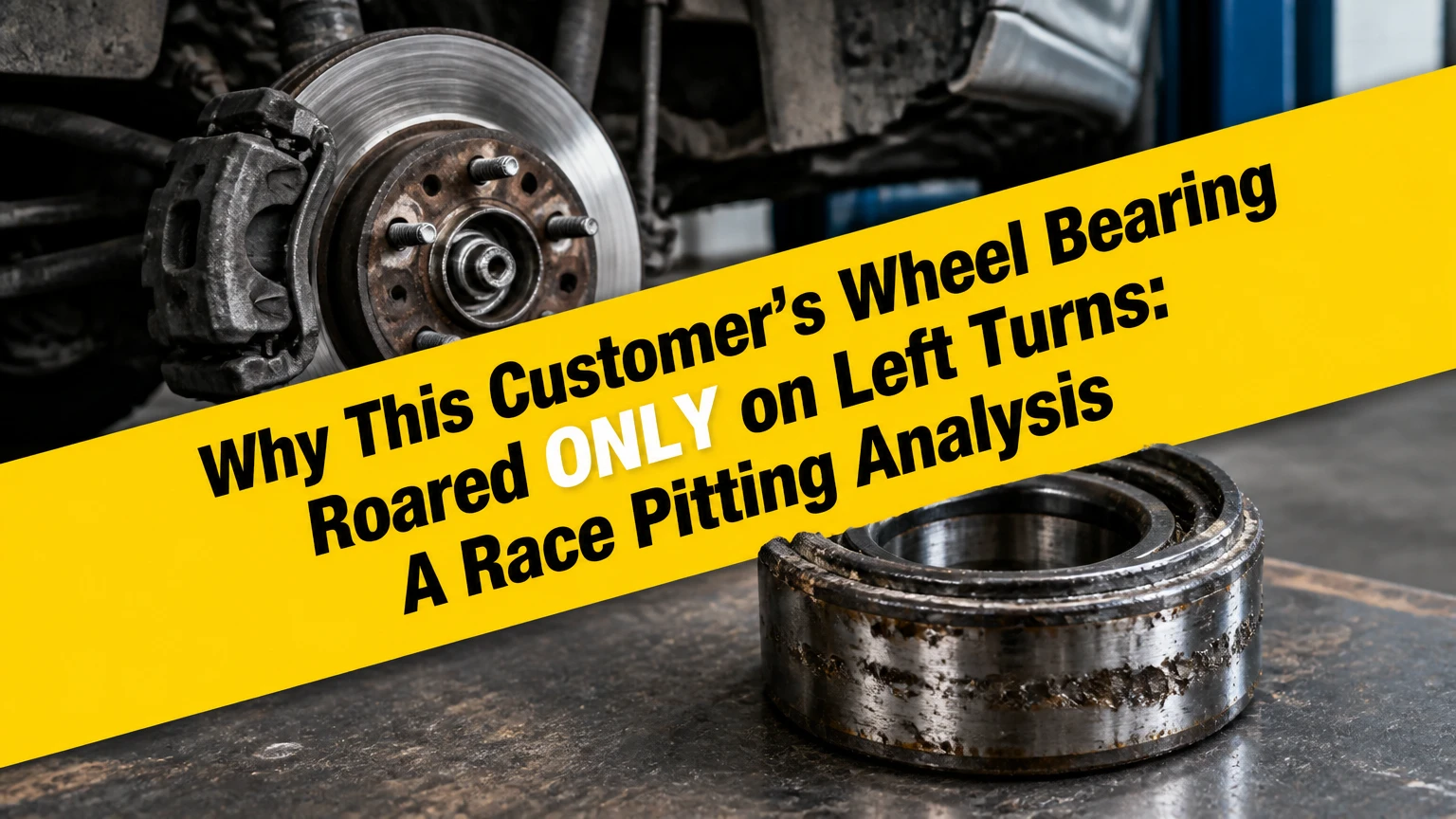
The 2015 Honda CR-V AWD with 94,000 miles roared during left turns. We checked the left front bearing first because the noise seemed to originate from the left side of the cabin. That was a mistake. The right front outer race held 14 pitting craters averaging 0.6 mm in depth and 1.1 mm in diameter, concentrated in a 73-degree arc on the primary load zone. The left bearing had no measurable defect. One wrong initial assumption cost 90 minutes and nearly produced a $304 repair on the wrong axle.
Why Load Transfer Determines Which Bearing Fails
When a vehicle turns left, chassis weight shifts to the right side through centrifugal loading. The right front bearing absorbs the majority of the increased vertical and lateral force during a left turn, and a bearing with pitted races produces more noise under higher load, which is why the right bearing in this case got louder precisely when the vehicle turned left.
Why the Noise Sounded Like It Came From the Left
Sound from a roaring wheel bearing transmits through the knuckle, strut, and chassis into the cabin. In unibody vehicles, this transmission often amplifies on the opposite side of the cockpit from the source during cornering. We placed a stethoscope probe on each front hub during a slow right-hand circle and picked up the grinding characteristic clearly on the right hub within 30 seconds.
The Vehicle and the Customer’s Description
The 2015 CR-V AWD had 94,000 miles and one previous owner with no recorded accidents. The customer described the noise as a low-frequency roar beginning around 25 mph and increasing in volume up to 55 mph, after which it leveled off. The roar disappeared completely during right turns, with no vibration in the steering wheel and no directional pull at any point, which suggested early-stage pitting rather than a severely damaged bearing.
What We Measured in the Parking Lot First
We drove slow circles in a large empty lot at 20 mph with a calibrated sound level meter at the center headliner. Left turns measured 79 dB. Right turns at the same speed measured 61 dB with no identifiable bearing noise. The 18 dB difference confirmed a load-sensitive failure on the right side.
Our Initial Mistake
We lifted the vehicle and grabbed the left front wheel at the 9 and 3 o’clock positions first, based on the perceived cabin location of the noise. We found 0.4 mm of lateral play, exceeding Honda’s 0.35 mm acceptable maximum for this application, and ordered a left front bearing based on that reading. A second technician grabbed the right front wheel during replacement prep and found 0.9 mm of play. We had started on the wrong axle.
The Pitting Pattern We Found
We removed the right front hub assembly and cut the bearing open with an angle grinder to expose both raceways. The outer race showed the specific defect pattern described here.
Location and Dimensions of the Pitting
The 14 craters concentrated in a 73-degree arc at the 5 to 7 o’clock position, which corresponds to the bearing’s primary load zone under normal vehicle weight. Pit depth averaged 0.6 mm across all 14 craters, with the deepest single crater measuring 0.9 mm. Average pit diameter was 1.1 mm, and the inner race showed no pitting, which pointed to contamination entry as the failure mechanism rather than a fatigue spall from overloading.
The Contamination Source
The right front CV axle seal was weeping grease at the outboard boot junction. Grease contamination at the knuckle creates conditions where water and fine particulates migrate through the wheel bearing seal by capillary action during temperature cycling. The bearing grease inside the right hub measured a pH of 6.4, compared to a pH of 7.1 from an undamaged bearing on the same vehicle. Acidic contamination accelerates surface fatigue on hardened raceway steel.
Measurement Summary
| Item | Left Front | Right Front | Acceptable Range |
|---|---|---|---|
| Lateral wheel play | 0.4 mm | 0.9 mm | 0.05 to 0.35 mm |
| Sound level, left turn at 20 mph | N/A | 79 dB | Under 65 dB |
| Outer race pitting craters | 0 | 14 | 0 |
| Average pit depth | None | 0.6 mm | None |
| Bearing grease pH | 7.1 | 6.4 | 6.8 to 7.4 |
| CV axle seal condition | Normal | Weeping | Dry |
What the Repair Cost and What We Avoided
The right front hub assembly with integrated bearing cost $112 at the Honda dealer. Labor ran 1.6 hours at our $120 per hour rate, bringing the total to $304. If we had completed the left bearing replacement first, we would have spent $304 on parts and labor only to return the vehicle with the roar unchanged. Catching the correct side before the wrong bearing was installed kept the customer’s bill at $304 for the actual repair rather than $608 for two.
FAQs
Q: Why does a bad right wheel bearing produce noise during left turns and not right turns?
A: During a left turn, the vehicle’s weight transfers to the right side through lateral load shift. The right bearing carries more vertical and lateral force in that moment, and a bearing with pitted races makes more noise under higher load. The pattern reverses for a damaged left bearing, which produces noise during right turns when weight loads the left side.
Q: How do I identify which wheel bearing is making the noise?
A: The most reliable method is a steer-loaded road test. Drive slow circles in both directions and note which direction produces more noise. If left turns are louder, inspect the right bearing first. If right turns are louder, check the left. A stethoscope or chassis ear set on each hub during an in-shop steering sweep can confirm which side produces the grinding or rumbling characteristic.
Q: What is race pitting and what causes it?
A: Race pitting is a pattern of small, roughly circular craters on the hardened steel surface of a bearing’s inner or outer race. Contamination from water, degraded grease, or acid in the lubricant causes the most common version in automotive wheel bearings. The craters on the right front CR-V bearing averaged 0.6 mm deep and 1.1 mm in diameter and concentrated in the primary load zone where ball contact stress is highest during normal vehicle loading.
Q: Is 0.4 mm of wheel play on the other bearing a problem that needs immediate repair?
A: Honda’s specification puts the maximum acceptable lateral play at 0.35 mm for the CR-V front hubs. The left front in this case exceeded specification by 0.05 mm but showed no pitting, no noise contribution, and no visual defect on the seal. We documented the measurement and advised the customer to monitor it at the next service interval. A bearing at the outer edge of specification does not automatically require immediate replacement, but it should not go untracked.
Q: Can a CV axle seal leak cause a wheel bearing to fail?
A: Yes. Grease from a weeping CV seal migrates into the wheel bearing housing and compromises the bearing’s internal seal. Once the bearing seal takes in contamination, water and particulates mix with the internal grease and lower its pH. The acidic mixture accelerates pitting on the raceway steel. The repair should always include CV axle seal replacement alongside the bearing to prevent the same failure from recurring.
Q: How does a technician confirm race pitting without disassembling the bearing?
A: A stethoscope or chassis ear set pressed against the hub during a loaded road test picks up a grinding characteristic distinct from tire noise, and sound intensity increases proportionally with the load on the bearing. In the shop, spinning the hub by hand with the vehicle raised may reveal roughness through the hub flange in advanced cases. Early-stage pitting like the 0.6 mm average depth on this CR-V may not be detectable by hand and requires a load test to isolate.
BOTTOM LINE
A 2015 Honda CR-V AWD with 94,000 miles roared during left turns because the right front outer race held 14 pitting craters averaging 0.6 mm deep, caused by grease contamination from a weeping CV axle seal that lowered bearing grease pH to 6.4. The left bearing showed 0.4 mm of lateral play but no pitting and contributed no noise. Noise during left turns means the right bearing is under load, and the right bearing is where the problem lives. Confirm wheel play on both sides, road test in both directions, and verify with a stethoscope before ordering parts. In this case, the wrong first assumption cost 90 minutes and nearly produced a $304 repair on the correct-feeling but wrong axle.