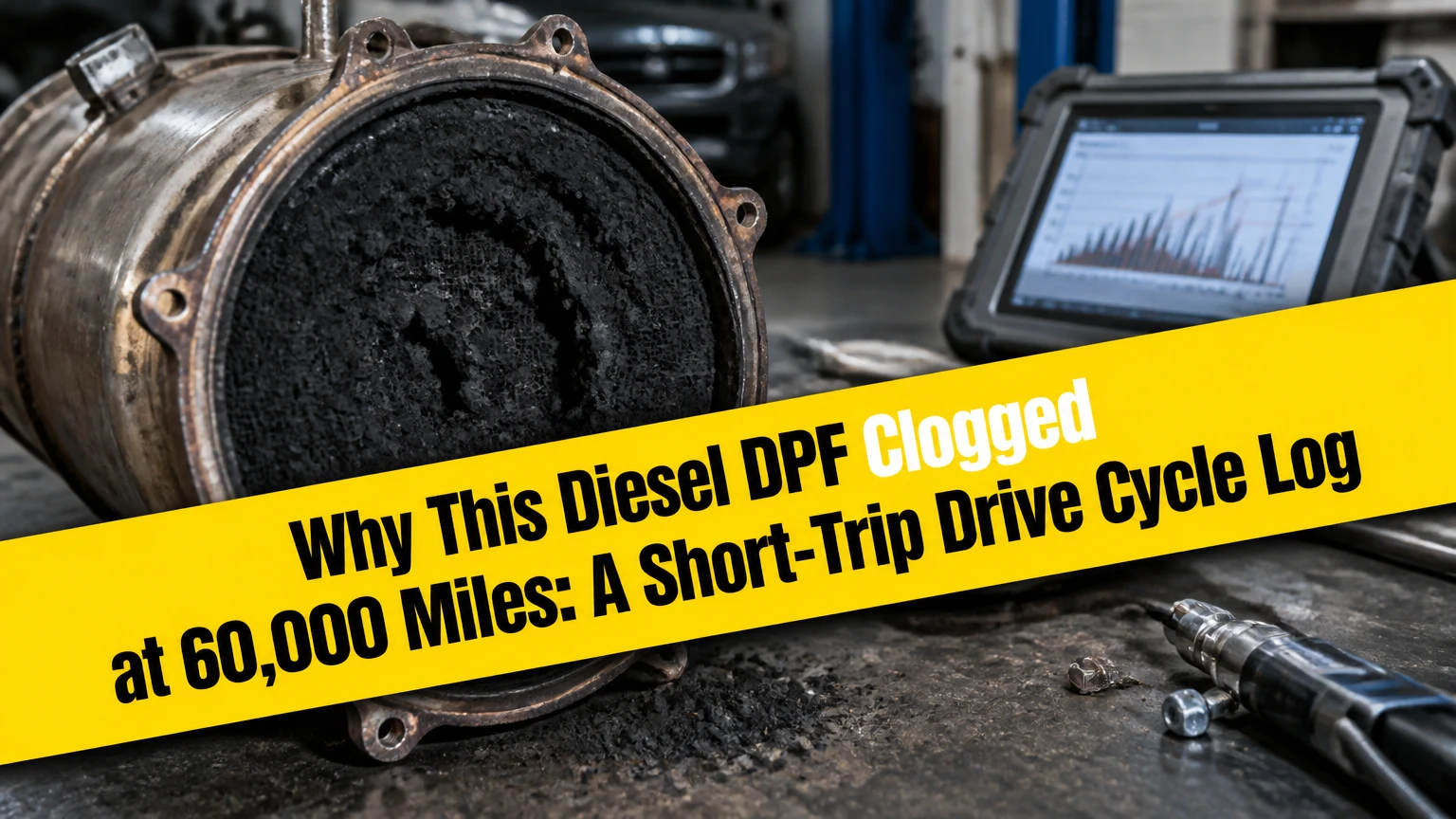
“It’s only got 60,000 miles. These things should last 150,000.” The owner of this 2019 Ram 2500 6.7L Cummins was standing in the shop holding a dealer quote for $4,800 to replace the DPF. He was right that 60,000 miles is early. He was wrong that mileage is what determines DPF life.
We pulled the drive cycle log from the ECM. In 60,000 miles of ownership, this truck had made 42 active regeneration attempts. Thirty-eight of those attempts were incomplete. The ECM had tried to run a parked forced regeneration, the exhaust heating cycle that burns the accumulated soot out of the filter, 38 times. Thirty-eight times, the engine was shut off before the cycle could complete.
The soot that should have been burned off stayed in the filter. It accumulated. By the time the truck reached our shop, the DPF differential pressure sensor was reading 3.5 PSI at idle. The specification for a healthy filter is under 0.5 PSI. The filter was clogged to the point where a forced regen was no longer safe to attempt.
This truck had never traveled more than 8 miles in a single trip in its entire ownership history.
The Owner and the Usage Pattern
Vehicle: 2019 Ram 2500 Tradesman, 6.7L Cummins I6, 60,400 miles. Purchased new, used exclusively for local business errands in a metro area. The owner ran it as a glorified cargo vehicle: short hops to supply houses, hardware stores, job sites all within a 5-mile radius of his shop. Never towed. Never loaded beyond half ton. The diesel engine was chosen because he’d heard diesels last longer. He was not wrong about that, but only if the diesel is operated in a way that lets its emissions system function.
The core problem: A 6.7L Cummins diesel engine in a DPF-equipped Ram needs exhaust gas temperatures above 1,100°F sustained for a minimum of 20 to 30 minutes to passively regenerate the DPF. Passive regeneration means the exhaust is hot enough from normal engine operation to oxidize the accumulated soot in the filter without any active intervention from the ECM. It happens automatically during highway driving and heavy towing where exhaust temperatures naturally reach or exceed this threshold.
On a 5-mile city trip, we logged exhaust gas temperatures at the DPF inlet. The maximum EGT reached during a typical trip was 680°F, recorded briefly during one hard acceleration event. Cruising EGT in city traffic: 420 to 520°F. The passive regeneration threshold of 1,100°F was never reached in 60,000 miles of normal operation.
Soot Load and Differential Pressure Data
We connected a Ram-capable scan tool and pulled live DPF parameters.
| Parameter | This Vehicle | Normal Spec |
|---|---|---|
| DPF soot mass (calculated) | 68 grams | Under 35 grams (active regen triggers at 45g) |
| DPF differential pressure at idle | 3.5 PSI | Under 0.5 PSI |
| DPF differential pressure at 2,500 RPM | 9.2 PSI | Under 1.5 PSI |
| Estimated DPF flow restriction | 89% | Under 25% |
| Ash load (irreversible accumulation) | 22 grams | Under 45 grams (full service life) |
At 68 grams of soot mass and 3.5 PSI differential pressure at idle, this DPF was generating enough exhaust backpressure to reduce engine power and significantly increase fuel consumption. The ECM had been logging derating events for the past 8,000 miles as it attempted to protect the engine from the restriction.
The Regeneration Attempt Log
We pulled the full ECM drive cycle history, which retains a running log of regeneration events. The data covered the vehicle’s full ownership period.
| Regen Type | Attempts | Completed | Incomplete |
|---|---|---|---|
| Passive (automatic at high EGT) | 0 | 0 | 0 (EGT never reached threshold) |
| Active (ECM-initiated, engine running) | 42 | 4 | 38 |
| Parked forced (technician-initiated) | 0 | 0 | 0 |
The 38 incomplete active regeneration attempts each followed the same pattern: the ECM detected high soot load, initiated a regen cycle by introducing post-injection fuel to raise EGT, and the owner shut the engine off before the cycle completed because the truck was at its destination. Most of the incomplete cycles were aborted between 4 and 11 minutes into what should have been a 20 to 30 minute process.
Four completed active regenerations occurred during four instances where the truck had been left idling for extended periods while the owner worked at a job site. All four were completed without the owner’s knowledge or involvement.
Fuel Dilution: The Consequence Nobody Mentions
Each active regeneration attempt injects additional fuel into the cylinders during the exhaust stroke to heat the exhaust stream. This post-injection fuel does not contribute to combustion. It passes through the cylinder, some of it condensing on the cylinder walls, and flows past the piston rings into the crankcase, where it dilutes the engine oil.
A completed regen cycle introduces a small, manageable amount of fuel into the oil over its 20 to 30 minute duration. An incomplete regen cycle that is aborted mid-process, repeated 38 times, introduces fuel with each attempt and allows it to accumulate in the oil without the dilution being corrected by the higher-temperature completion phase of the cycle.
We sent an oil sample to Blackstone Laboratories. The report confirmed fuel dilution at 7.5% by volume in the crankcase oil. Acceptable fuel dilution in diesel engine oil is under 1.5%. At 7.5%, the oil’s viscosity had dropped to the point where its film strength under high-load bearing conditions was compromised. The bearing surfaces and cam lobes on this engine had been running in sub-specification oil for an unknown but significant period.
We changed the oil before doing anything else and recommended the owner track fuel dilution with every sample going forward.
Why Forced Regen Was Not Safe to Attempt at 68 Grams
A forced regeneration from a scan tool initiates an active regen cycle at maximum intensity: late injection, EGT targets above 1,200°F at the DPF substrate face. At 68 grams of accumulated soot, an attempt at forced regeneration carries a genuine risk of thermal runaway inside the filter.
When soot oxidizes rapidly, it generates heat. In a healthy filter with under 45 grams of soot, this heat is manageable within the filter’s thermal mass. At 68 grams, the oxidation of that much soot generates enough heat to exceed the filter substrate’s maximum service temperature and potentially crack or melt the ceramic monolith. In severe cases, this produces a filter fire: actual combustion inside the filter housing visible as flame from the exhaust outlet.
The factory maximum soot mass for safe forced regen on this engine is 50 grams. We were 18 grams over that threshold. We sent the filter to a DPF cleaning service for off-vehicle chemical wash, which uses a thermal oven process and chemical injection to remove soot at controlled temperatures below the oxidation threshold. The cleaned DPF was returned within 48 hours and reinstalled.
The DPF Decision Matrix
| Soot Mass | Differential Pressure at Idle | Regen Status | Required Action |
|---|---|---|---|
| Under 35 grams | Under 0.5 PSI | Normal | Monitor, no action |
| 35 to 50 grams | 0.5 to 1.5 PSI | Active regen triggered | Highway drive 30 to 45 minutes minimum |
| 50 to 65 grams | 1.5 to 3.0 PSI | Active regen failing | Forced regen via scan tool, 30-minute stationary cycle |
| Above 65 grams | Above 3.0 PSI | Forced regen unsafe | Off-vehicle chemical cleaning |
| Any level with ash above 45 grams | Any | Any | DPF replacement (ash is permanent) |
The Diesel Owner Survival Protocol for City Driving
A diesel truck used for city driving requires deliberate management that a highway driver never needs to think about.
The highway exercise rule: Every 1,500 miles of city driving, the truck needs a minimum 45-minute continuous highway run at sustained speeds above 65 mph. This raises exhaust gas temperatures into the passive regeneration zone and burns accumulated soot without ECM intervention or engine shutdown risk. This is not optional maintenance. It is the operating requirement for a diesel emissions system in a city-driving application.
The regen completion rule: When the dash displays a “Performing Service” or “Service Required Soon” message in conjunction with the DPF warning, the ECM is signaling that it has initiated or needs to initiate an active regen. The correct response is to find a parking area, leave the engine running at idle, and wait 25 to 35 minutes for the cycle to complete. Shutting off within that window adds one more incomplete cycle to the log and one more fuel dilution event to the crankcase.
The oil analysis rule: City-driven diesel owners should send an oil sample to a lab every other oil change to monitor fuel dilution. This is not a precaution. Given the pattern this truck demonstrated, it is a diagnostic necessity.
The Cummins engine in this truck will outlast the body if operated correctly. At 60,000 miles with 7.5% fuel dilution in the crankcase and a clogged DPF, it was not being operated correctly, and nothing about the maintenance schedule showed it. The oil was being changed on interval. The service records were clean. The truck was simply being used in a way that is fundamentally incompatible with a diesel emissions system designed around sustained highway operation.