The owner could not move his car. He was parked in his driveway, key in hand, looking at an “EPB FAULT” message on the dash and a right rear wheel that would not turn by hand. He had tried pressing the EPB release button. He had tried the emergency release procedure from the owner’s manual. He had called the dealer, who quoted him a three-day wait for a service appointment. He called us instead.
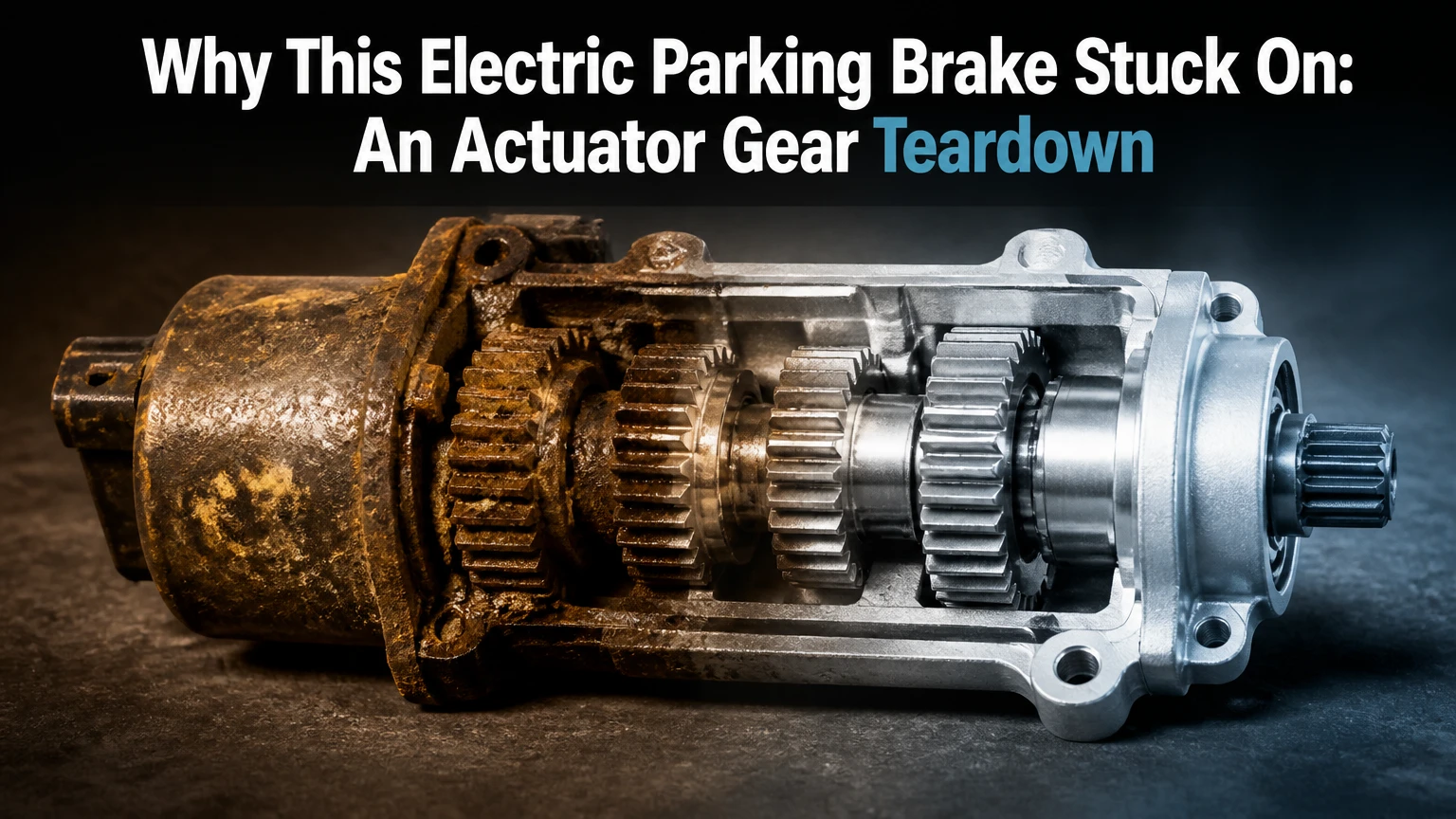
We went to him. The 2017 VW Passat had a cracked actuator housing on the right rear EPB caliper. Road salt brine had entered the crack over the previous winter, migrated into the planetary gear assembly, and frozen the internal gear teeth during a particularly cold night. When the EPB motor attempted to release the brake at startup that morning, it stalled against the frozen gears, tripped its thermal protection circuit at 30 amps, and shut down with the brake pads clamped against the rotor. The ECM logged the overcurrent event and threw the EPB fault.
Before we get to the repair: the owner had attempted to push the piston back with a C-clamp before calling us. This made the situation significantly worse.
The Actuator Teardown: What We Found
We removed the EPB actuator motor from the caliper body using two T40 Torx bolts and extracted the unit for bench inspection before attempting any release procedure.
The plastic outer housing of the actuator had a crack approximately 40mm long running from the cable entry point toward the motor end. The crack width varied from hairline at one end to approximately 0.8mm at its widest point, easily wide enough to admit road brine spray during winter driving.
Inside the housing, the planetary gear set showed corrosion on all three planet gear tooth surfaces and on the ring gear inner surface. The corrosion product was a reddish-brown, slightly crystalline deposit consistent with iron oxide mixed with salt residue. Two of the three planet gears had individual teeth that had welded to the ring gear under the combination of corrosion and the force of the motor attempting to drive a frozen system.
Actuator current draw at time of fault (logged in ECM freeze frame):
| Parameter | Logged Value | Normal EPB Cycle |
|---|---|---|
| Peak motor current | 31.4 amps | 8 to 12 amps |
| Duration above 25 amps | 2.1 seconds | Not applicable |
| Shutdown trigger | Thermal overload trip | Not applicable |
The motor had drawn 31 amps for 2.1 seconds against a frozen gear set before the thermal protection circuit interrupted power. At this current level, the motor armature was dissipating approximately 312 watts of heat in a housing the size of a hockey puck. The motor winding insulation showed heat discoloration when we stripped the motor for inspection, but the winding itself was intact.
The C-Clamp Damage
Before the owner called us, he had placed a C-clamp against the piston face and attempted to push it back into the caliper bore the way you would on a conventional rear disc brake. On a standard rear brake, this works because the piston simply slides in the bore. On an EPB caliper, the piston has a threaded spindle mechanism that extends and retracts the piston via the electric motor through the gear set. The piston does not slide. It threads.
Applying C-clamp force to a threaded piston that is in the fully extended position does not push the piston back. It pushes the piston threads against the spindle threads with several hundred pounds of force. When the owner increased C-clamp pressure trying to overcome what he perceived as piston stiction, he stripped two threads from the spindle inside the caliper bore.
The caliper required replacement as a result. With the actuator motor removed and the spindle accessible, a Triple Square (XZN) bit of the correct size can engage the spindle end directly and manually rotate the piston back into the bore without any force applied to the piston face. This is the correct manual release procedure. It requires the actuator motor to be removed first.
Rotor and Pad Condition After Being Dragged
The owner had attempted to drive the car approximately 40 feet before realizing the brake was fully applied and the wheel was not rolling. The right rear rotor showed heat checking across approximately 60% of the swept face from the locked-pad drag event. The rotor surface temperature had been high enough to create a visible blue-tint discoloration in the metal in the drag zone.
The rear pad on the inside face, which is the EPB-actuated pad, showed a glazed, mirror-smooth surface where it had been sliding against the rotor for 40 feet under clamping force. The glazed area had a slight concave profile where the pad material had been polished away by friction.
Both the rotor and the inside pad required replacement. The outside pad was undamaged.
The Emergency Release Procedure When This Happens to You
If your EPB throws a fault and the wheel is locked, do this in order:
Step 1: Do not attempt to drive the vehicle, even for a short distance. Thirty seconds of locked-pad dragging at 5 mph is enough to overheat the rotor and begin heat checking.
Step 2: Do not use a C-clamp on the piston face. If you push the piston threads against the spindle threads under load, you will strip the spindle and turn a $320 actuator replacement into a $680 caliper replacement.
Step 3: Remove the EPB actuator motor from the caliper. On most VW and Audi EPB applications, this is two T40 or T45 Torx bolts on the rear of the caliper. The motor assembly pulls straight out.
Step 4: Insert a Triple Square bit of the correct size (M8 on most VW applications) into the spindle end that is now exposed. Rotate clockwise to retract the piston (thread the piston back into the bore). Turn until the piston is fully retracted and the brake drag releases.
Step 5: Have the actuator and housing inspected before reinstallation. A cracked housing will fail again within one to two winters.
EPB Failure Comparison
| Failure Mode | Symptom | What You Hear | Repair Cost (Parts and Labor) |
|---|---|---|---|
| Cracked plastic housing, frozen gears | EPB fault, wheel locked, motor stalls | Grinding then silence | $320 to $480 (actuator replacement) |
| Electric motor armature seized | EPB fault, wheel locked, no motor attempt | Silence when EPB commanded | $320 to $480 |
| Wiring harness break | EPB fault, wheel may release manually | EPB fault, no motor sound | $150 to $280 (harness repair) |
| Stripped spindle from C-clamp | EPB releases but piston won’t retract | N/A (already released) | $600 to $900 (caliper replacement) |
| Corroded cable guide | EPB engages but won’t fully release | Scraping at wheel speed | $80 to $120 (cable guide replacement) |
The actuator housing on the VW Passat and most VW Group EPB applications is plastic and is sealed with press-fit seams rather than a gasketed or adhesive seal. Road salt brine, which is significantly more penetrating than pure water, can enter these seams over two to three winters of salt exposure. An actuator that has operated for more than three winters in a salt-belt environment should be inspected annually for housing crack formation, regardless of whether any EPB fault has been logged.