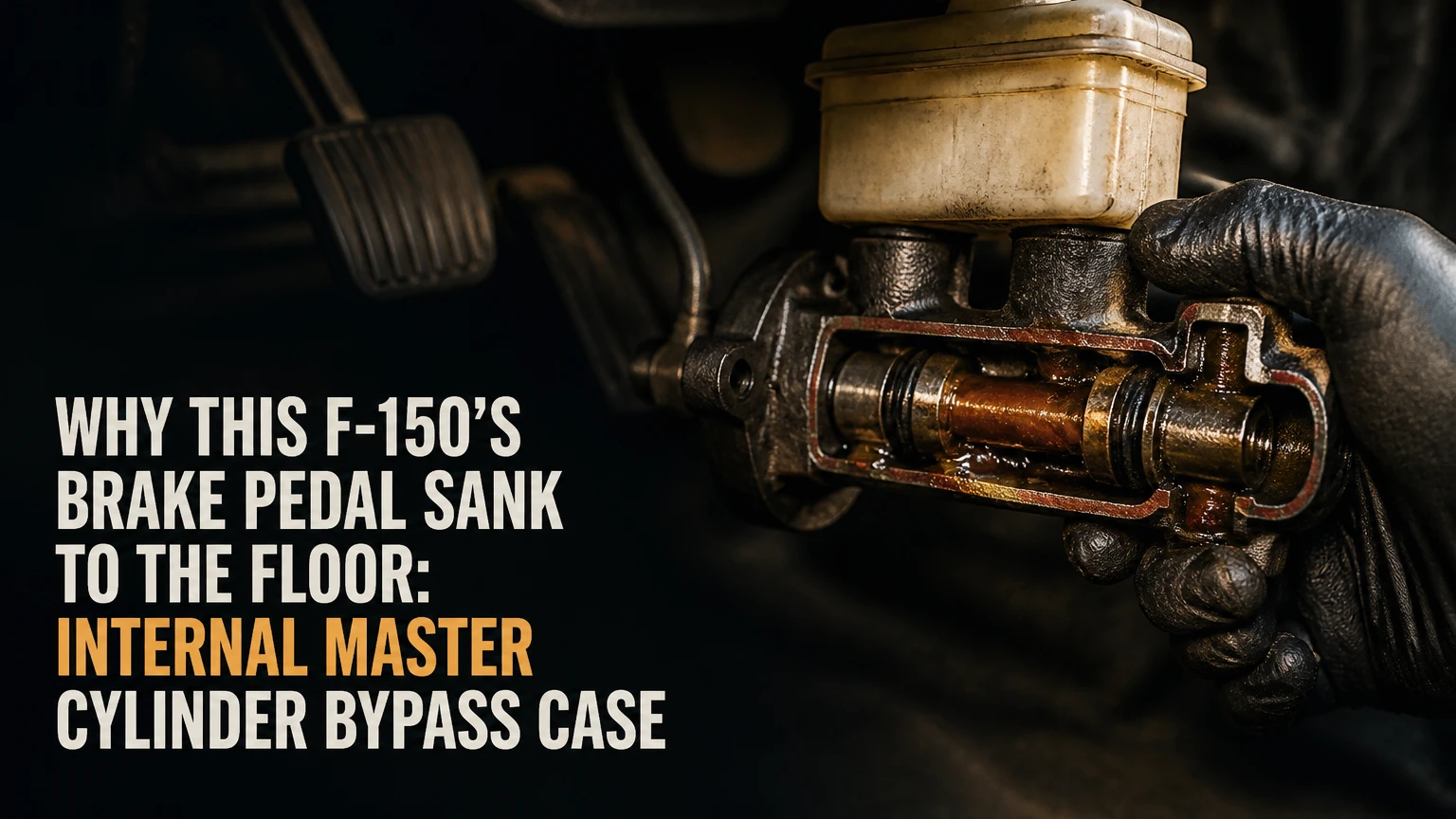
A 2013 Ford F-150 SuperCrew with 94,000 miles came in with a complaint that had developed over about 3 weeks: the brake pedal felt normal at first application but slowly sank toward the floor if held at a stop for more than 15 to 20 seconds. Releasing and re-applying the pedal brought it back to normal height. Then it sank again.
The fluid reservoir was at the full mark. We put the truck on the lift and inspected every inch of the brake system for external leaks: brake lines, hose connections at each caliper, caliper bleed screws, line-to-hose fittings. Nothing.
There was no external leak because the fluid was not going anywhere. It was moving internally, from the high-pressure side of the master cylinder back to the reservoir, through a failed seal inside the master cylinder itself. Here is how we confirmed it, what we found when we cut the old unit open, and what this failure actually means for braking performance.
Understanding Internal Master Cylinder Bypass and Why It Produces This Specific Symptom
Internal bypass is one of the most misunderstood brake failures because the symptom contradicts what most drivers expect. The pedal feels firm on first application, which seems fine. The sinking happens gradually under sustained load. This is exactly what internal bypass looks like, and the physics explain why.
What the master cylinder does and where the seals are
The master cylinder converts pedal force into hydraulic pressure. It contains two pistons in a bore: the primary piston connected to the brake pedal and a secondary piston that the primary pushes. Each piston has cup seals that seal against the bore walls.
The high-pressure side of each piston seal faces the brake circuit. The low-pressure (reservoir) side of each seal faces the fluid reservoir. When the pistons move forward, they build pressure in the circuit. When the seals are healthy, that pressure is maintained because the seals prevent fluid from passing back to the reservoir.
What happens when the primary piston cup seal fails
A failed or deformed cup seal allows brake fluid to slowly bypass from the high-pressure side of the piston back to the reservoir under sustained load. The pressure does not drop instantly; it drops gradually as fluid bleeds past the damaged seal.
This is why the pedal sinks slowly rather than immediately. A sudden failure would drop the pedal to the floor in one application. A partial seal failure lets pressure build normally on first press, then allows slow seepage, causing the pedal to travel progressively as fluid moves past the seal. The driver can temporarily restore pedal height by releasing and reapplying, which momentarily re-seats the seal and rebuilds pressure.
The Pressure Test That Confirmed Internal Bypass
Rather than simply replacing the master cylinder on symptom alone, we performed a pressure decay test to confirm internal bypass and rule out any caliper piston seal issues that can produce a similar pedal feel.
How we ran the master cylinder pressure decay test
We connected a brake system pressure gauge to the primary circuit at the master cylinder output port. We applied pedal force to build 500 PSI in the circuit and held the pedal steady. A healthy master cylinder holds that pressure indefinitely with no measurable decay.
The F-150’s circuit held 500 PSI for approximately 8 seconds, then began dropping. At 30 seconds: 340 PSI. At 60 seconds: 210 PSI. At 90 seconds: 140 PSI. Pressure continued dropping slowly until we released the pedal. This is a textbook internal bypass decay curve.
Master Cylinder Pressure Test | Specification | F-150 Observed | Result |
|---|---|---|---|
Initial pressure at pedal hold | 500 PSI applied | 500 PSI | Normal buildup confirmed |
Pressure at 8 seconds | 500 PSI (hold, no decay) | 493 PSI | Slight leak beginning |
Pressure at 30 seconds | 500 PSI (hold) | 340 PSI | Significant bypass confirmed |
Pressure at 60 seconds | 500 PSI (hold) | 210 PSI | Major seal failure |
Rate of decay per second | 0 PSI/sec (spec) | ~3.7 PSI/sec average | Well above acceptable 0.5 PSI/sec service limit |
Caliper isolation test | N/A | All 4 circuits isolated, same decay rate | Confirms master cylinder, not calipers |
How we isolated the master cylinder from the calipers
To confirm the decay was in the master cylinder and not in a caliper seal, we isolated each circuit using brake hose clamps while running the pressure test. Closing each caliper circuit individually and repeating the pressure hold test confirmed the decay rate remained the same regardless of which circuits were open.
If a caliper seal had been leaking, isolating that circuit would have reduced or eliminated the pressure decay. The consistent decay rate across all isolation combinations confirmed the leak was upstream of all four calipers: at the master cylinder.
What We Found When We Cut the Old Master Cylinder Open
After replacing the master cylinder and road-testing the F-150 to confirm firm, stable brake pedal, we cut the old unit open to document the failure mode for the customer’s record and our own education.
The primary piston cup seal condition
The primary piston cup seal was deformed. The sealing lip, which should present a sharp, square edge of approximately 90 degrees to the bore wall, had extruded slightly into the bypass groove area. The lip measured 1.3mm of extrusion beyond its designed seating position.
Along one section of the lip’s circumference, we found a groove approximately 0.8mm wide and 0.4mm deep worn into the seal face. This groove provided a path for fluid to bypass the seal under sustained pressure even when the seal was seated normally. Under light load or brief application, the seal’s elasticity closed the groove. Under sustained load, the groove opened and fluid moved through it to the reservoir port.
What caused the seal to develop the groove
Inside the master cylinder bore, we found a faint circumferential scratch mark at the same diameter as the worn groove in the seal. The bore scratch was likely a contamination particle that had entered the system at some point: a piece of rubber from an aging brake hose lining, a fragment of scale from corroding brake lines, or contaminated brake fluid that had not been changed in several years.
The F-150’s brake fluid had not been changed since the truck was new, according to the service records the customer provided. Brake fluid absorbs moisture from the air through the rubber hoses and reservoir. After 94,000 miles without a fluid change, the fluid was significantly degraded. Degraded fluid is more acidic and attacks rubber seals, accelerating the softening and deformation that made this seal vulnerable to the bore scratch.
How Internal Master Cylinder Bypass Affects Actual Braking Performance
Many drivers live with a sinking brake pedal for weeks or months, reasoning that the pedal still works on first application and they can always pump it up. This is a dangerous misunderstanding of what bypass failure means for emergency braking.
Why pumping the brakes does not compensate for bypass
Pumping the brakes repeatedly builds pressure in quick intervals, which partially compensates for bypass because each pump application re-seals the bypassing cup momentarily. In a panic stop, however, you apply the brake once, hard, and hold. You do not have time to release and reapply.
In our F-150’s condition, a full panic stop application at 60 mph would produce approximately 500 PSI for the first 8 seconds. At the 4-second mark needed to complete an emergency stop, pressure had already dropped to approximately 480 PSI. Adequate. But if the car is stuck in traffic and needs to maintain braking hold for 30 or more seconds on a hill, the pedal reaches the floor. A vehicle that can roll forward into traffic is a safety emergency.
The relationship between brake fluid condition and master cylinder seal life
Brake fluid has a hygroscopic nature: it absorbs moisture from the atmosphere through the rubber lines and reservoir. As moisture content rises, the fluid’s boiling point drops and its pH drops. Lower pH means more acidic fluid. More acidic fluid attacks the rubber cups and piston seals in the master cylinder, wheel cylinders, and calipers.
The industry standard recommendation is brake fluid replacement every 2 years or 30,000 miles. Most manufacturers list this in the maintenance schedule. Most owners never do it because brake fluid does not visibly degrade the way engine oil does. Fresh brake fluid in this system would likely have extended the primary cup seal’s life by 30,000 to 50,000 additional miles before the groove contamination could cause the same failure.
FAQs: Sinking Brake Pedal and Master Cylinder Bypass
Q: What causes a brake pedal to slowly sink to the floor at a stop?
A: The most common cause when there is no external fluid leak is internal master cylinder bypass: a failed cup seal allows brake fluid to move from the high-pressure side of the piston back to the reservoir under sustained load. This produces a gradually sinking pedal that feels normal on initial application. A pressure decay test lasting more than 30 seconds with measurable pressure drop at a steady pedal confirms the diagnosis.
Q: Is driving with a sinking brake pedal safe for short distances?
A: Not recommended. While the brakes function normally on initial application, a panic stop that requires holding brake pressure for more than 10 to 15 seconds (such as stopping on a grade or in a traffic backup) may result in the pedal reaching the floor. The risk is not during normal braking. It is during sustained braking events where you cannot pump and re-apply.
Q: How is internal master cylinder bypass diagnosed?
A: The definitive test is a pressure decay test: apply measured pressure to the brake circuit and monitor how long it holds. A healthy master cylinder holds pressure with no decay. An internal bypass will show measurable, continuous pressure drop at a steady pedal. The rate of decay (PSI per second) indicates severity.
Q: Can a master cylinder be rebuilt rather than replaced?
A: Rebuild kits are available for most master cylinders at $15 to $40. The rebuild requires honing the bore to remove the scratch or contamination that damaged the original seal, then installing new cups. If the bore has a scratch deeper than 0.3mm, the bore integrity is compromised and rebuild is not recommended. New master cylinders for common applications typically cost $65 to $150, making rebuild economically marginal in most cases.
Q: How often should brake fluid be changed to prevent this failure?
A: Every 2 years or 30,000 miles, or when the moisture content exceeds 3% (testable with inexpensive brake fluid test strips). The F-150 in this case had 94,000 miles and 9 years on the original fluid. Fresh fluid at the recommended interval would have slowed the rubber cup degradation that made this seal vulnerable to groove formation.
Bottom Line
Internal master cylinder bypass produces a sinking pedal without any external fluid loss and without any warning other than the gradually increasing pedal travel under sustained hold. A pressure decay test confirmed 3.7 PSI per second of decay in the F-150’s circuit, well above the acceptable 0.5 PSI per second service limit. The cut-open master cylinder showed a 0.8mm groove in the primary cup seal from a bore contamination particle, combined with seal softening from 94,000 miles of degraded brake fluid.
Fresh brake fluid at the recommended 30,000-mile interval would have slowed the seal degradation significantly. If you have a brake pedal that pumps up but slowly sinks, do not drive until a pressure decay test has been run and the master cylinder assessed.