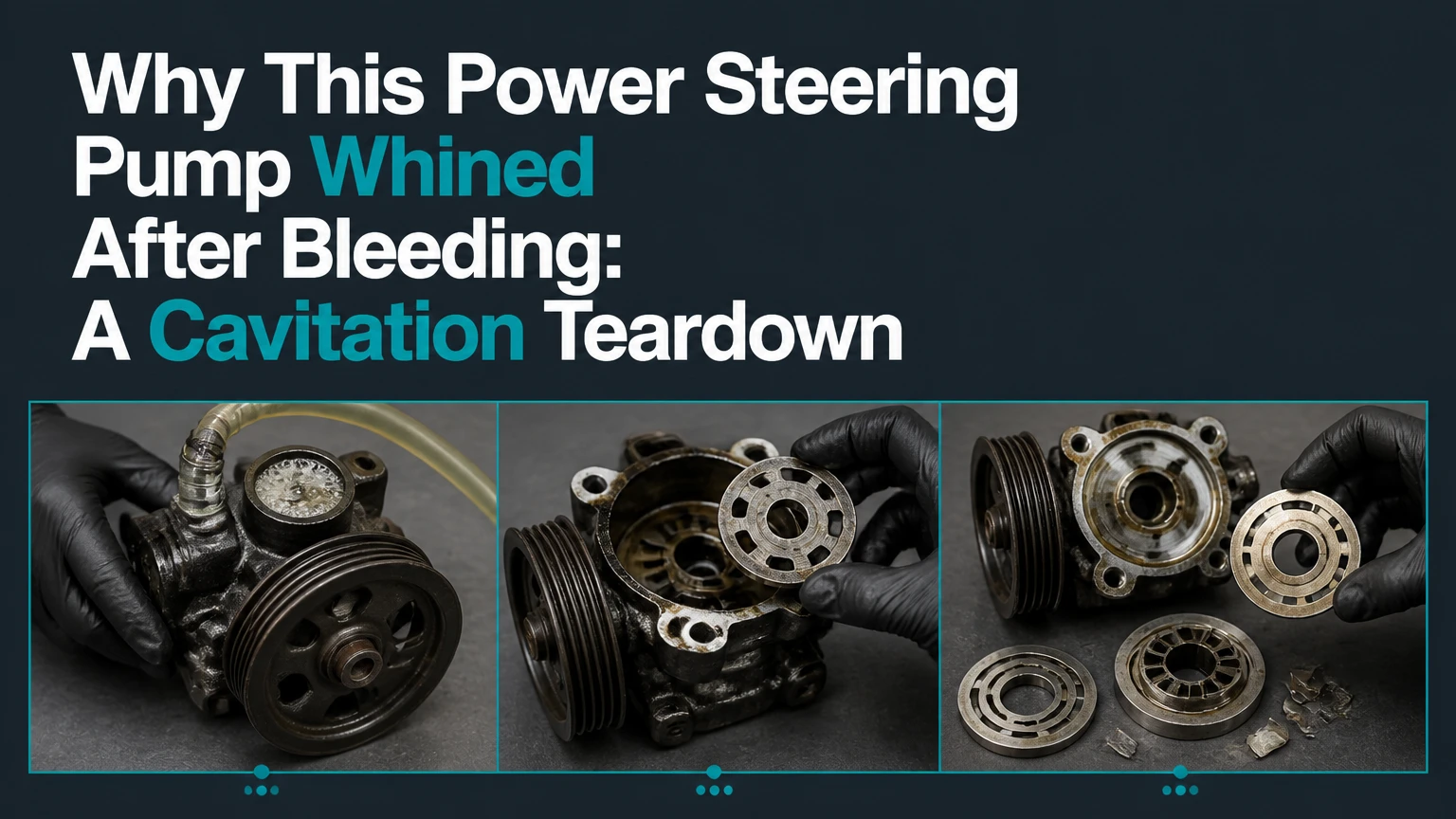
The new pump was destroyed in ten minutes. Not by a bad part, not by a manufacturing defect. We destroyed it ourselves, and we are telling you this because it happens in shops every week and almost nobody talks about it honestly.
The 2004 Honda Accord 2.4L had come in with a classic end-of-life power steering pump: heavy groan on full lock turns, stiff steering at parking speeds, and a reservoir level that had dropped below the minimum mark twice in three months from a slow weep at the pump shaft seal. We installed a remanufactured pump, filled the reservoir with fresh Honda PSF-II fluid, and bled the system using the standard wheels-down lock-to-lock procedure.
The moment we started the engine, the pump screamed. Not a normal break-in whine. A high-pitched, continuous, metallic scream from the pump body. The reservoir fluid had turned foamy within 30 seconds. We shut the engine off and started over. This time we found the real problem: a collapsed suction-side O-ring that had been pulling air into the pump inlet since the moment we started the first bleed procedure. By the time we found it, the new pump had been running in aerated fluid for ten minutes. The pump rotor ring showed cavitation pitting under magnification. We had to install a second new pump.
What Was Happening Inside the Pump
Power steering pump vanes operate by centrifugal force. The rotor spins, the vanes extend outward against the rotor ring under centrifugal action, and the volume between each vane and the ring creates a pumping chamber that pressurizes the power steering fluid as it rotates. The fluid between the vanes is what keeps the vanes from metal-to-metal contact with the ring. It is also the lubricant for the entire rotor assembly.
When air is present in the fluid, two things happen simultaneously. First, the fluid becomes compressible. A hydraulic fluid is essentially incompressible, which is why it transmits force effectively. Aerated fluid with suspended air bubbles is compressible, which is why steering feels vague and heavy when air is in the system. Second, the air bubbles undergo rapid pressure changes as they pass through the pump vanes. A bubble enters the low-pressure suction side of the pump at near-atmospheric pressure, then is rapidly compressed to 900 to 1,200 PSI on the discharge side.
When a bubble collapses under this pressure differential, it generates a microscopic high-velocity fluid jet directed at whatever surface is nearby. In a power steering pump, that surface is the rotor ring. The jet impacts the ring material with enough energy to remove metal from the surface, creating a small pit. This is cavitation pitting. Ten minutes of cavitation at operating RPM can create hundreds of pits across the rotor ring surface, permanently roughening the sealing surface and destroying the pump’s pressure-generating capability.
The Suction-Side O-Ring: A Ten-Year-Old Gasket Causing a Thousand-Dollar Problem
The suction-side hose connects the reservoir to the pump inlet. On this Accord, the hose uses a beaded-end design where the hose end fits over a machined bead on the pump inlet port, sealed by an O-ring that sits in a groove behind the bead.
We removed the suction hose after the first failed bleed attempt and examined the O-ring.
| Measurement | Factory O-Ring Specification | Our O-Ring Condition |
|---|---|---|
| Cross-section diameter | 2.0 mm | 1.1 mm (45% compression set) |
| Material flexibility | Flexible, springs back | Rigid, permanent flat spot on one side |
| Surface condition | Smooth | Circumferential cracking on OD surface |
The O-ring had compressed from 2.0mm to 1.1mm cross-section over its service life and had taken a permanent flat set on the side that contacted the pump inlet boss. When the hose was installed, this flat section did not fully contact the mating surface. The gap was too small to leak fluid outward when the system was under pressure. But on the suction side of the pump, which operates below atmospheric pressure during normal operation, that same gap was large enough to admit air into the inlet stream.
The pump was pulling air from the atmosphere through the collapsed O-ring on every rotation. The air mixed with the fluid in the reservoir and formed the foam we observed within 30 seconds of startup.
Aerated Fluid Analysis
We collected 100 mL of the foamed reservoir fluid during the active whine condition and measured its density at room temperature compared to fresh Honda PSF-II:
| Fluid Sample | Density (g/mL) | Bubble Count (visible per cm3) |
|---|---|---|
| Fresh Honda PSF-II | 0.869 g/mL | 0 |
| Aerated reservoir fluid (active whine) | 0.731 g/mL | 35 to 50 visible bubbles |
The aerated fluid was 16% less dense than fresh fluid, meaning approximately 16% of its volume was air by mass. Steering fluid at 16% air content cannot generate stable hydraulic pressure. The pump was attempting to compress air on every vane rotation instead of transmitting hydraulic force to the steering rack.
The Dry Turn Mistake
The standard power steering bleed procedure commonly taught in service manuals instructs the technician to start the engine and turn the steering wheel lock-to-lock 15 to 20 times with the front wheels on the ground.
Turning the steering lock-to-lock with the wheels on the ground forces the steering rack to work against the full weight and scrub resistance of the tires on the pavement. This resistance creates maximum hydraulic pressure demand from the pump at the point of maximum lock, driving aerated fluid through the entire system under high pressure and forcing air bubbles deeper into the rack cylinder, the hose bends, and the pump body.
The correct bleeding procedure is to raise the front wheels off the ground on jack stands before any lock-to-lock turns. Without tire scrub resistance, the rack moves with minimal hydraulic pressure demand, allowing air to rise to the reservoir naturally rather than being forced through the system under pressure. Air rises in fluid by buoyancy when pressure is low. It gets driven deeper under high pressure.
The Correct Bleeding Protocol Using a Hand Vacuum Pump
After replacing both the O-ring and the cavitation-damaged pump with fresh units, we used a vacuum bleed procedure instead of the lock-to-lock method:
Step 1: Fill the reservoir to the maximum mark with fresh Honda PSF-II. Do not start the engine yet.
Step 2: Connect a hand vacuum pump to the reservoir cap port (or use a reservoir cap vacuum adapter). Apply 15 inches of mercury vacuum and hold for 60 seconds. Air bubbles in the fluid will rise to the surface and be evacuated. The fluid level will drop slightly as air leaves. Refill to maximum mark.
Step 3: Repeat the vacuum pull three times, refilling between each cycle.
Step 4: Raise the front wheels on jack stands.
Step 5: Start the engine. Turn the wheel slowly from lock to lock three times with the engine idling.
Step 6: Shut the engine off. Pull 15 inches of mercury vacuum on the reservoir again for 60 seconds. Top off fluid.
Step 7: Lower the vehicle and do a final slow lock-to-lock confirmation.
Using this procedure, we have not experienced pump whine or foaming during a power steering bleed on any vehicle since adopting it.
Troubleshooting Decision Matrix
| Symptom | Fluid Condition | Root Cause | Corrective Action |
|---|---|---|---|
| Whine immediately after new pump install | Foamy, milky | Suction-side air leak (O-ring or hose) | Find and seal air ingestion point, vacuum bleed |
| Whine on full lock only, clear fluid | Clear, normal | Low fluid level or pump near end of life | Check level, inspect pump |
| Heavy steering, no whine, clear fluid | Clear, normal | Rack and pinion wear or binding | Inspect rack |
| Whine improves then returns | Foamy, then clear | Air still in system from incomplete bleed | Full vacuum bleed procedure |
| Whine with new pump after lock-to-lock bleed | Foamy | Air driven deeper by ground-down bleed procedure | Raise wheels, vacuum bleed, inspect suction O-ring |