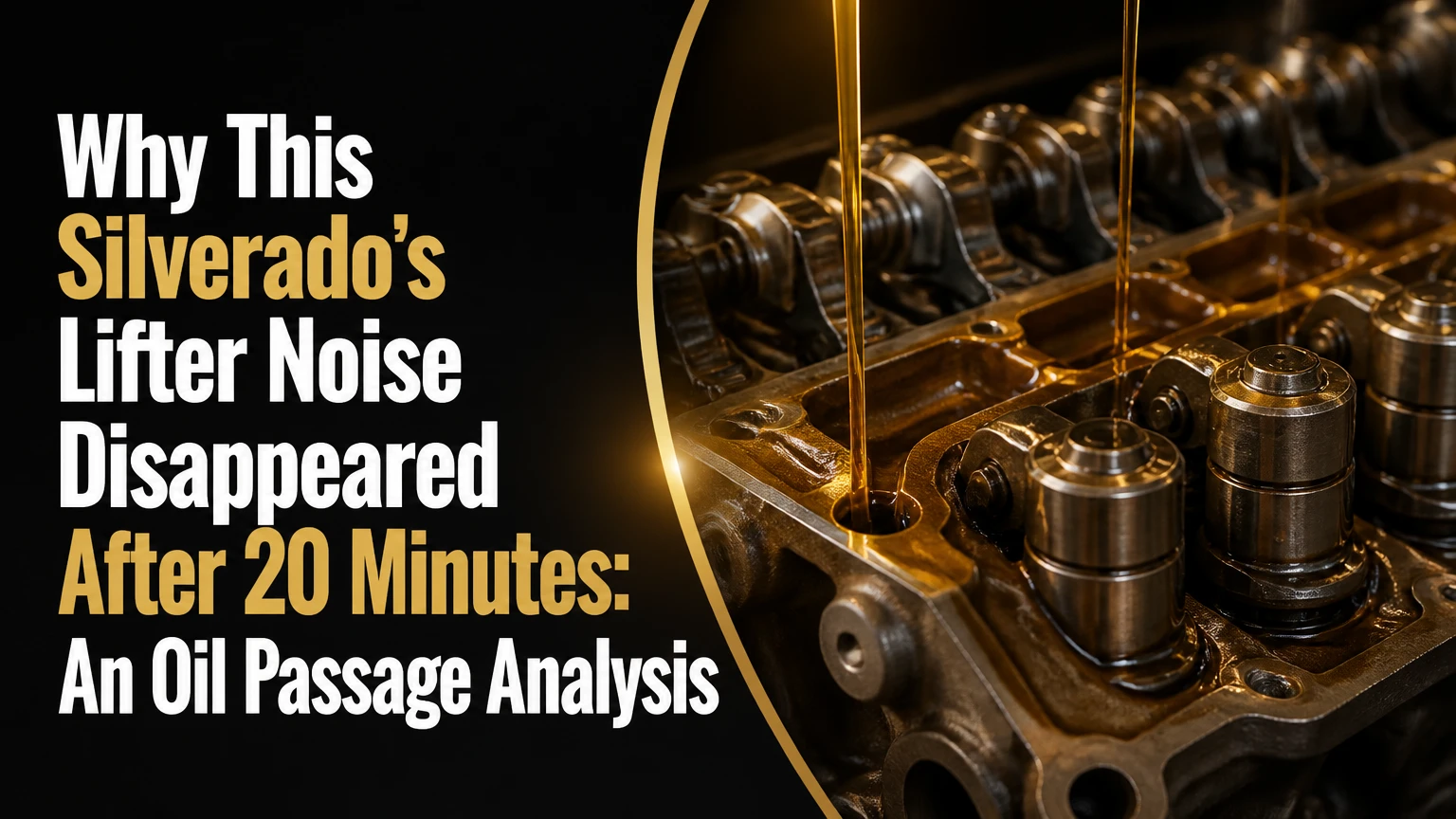
A 2009 Chevrolet Silverado 1500 with the 5.3L V8 arrived with a specific complaint: a tick from the passenger-side valve train that was present at cold start and disappeared completely within 15 to 22 minutes of driving. The customer had heard about AFM lifter collapse problems on LS-family engines and was worried he was looking at a $2,000 repair.
We confirmed the symptom on a test drive. At cold start, a distinct hydraulic lifter tick from the passenger bank. By the time the coolant temperature gauge reached the normal range, the tick was gone. Completely silent. The next morning, the same cycle repeated.
This is not what AFM lifter collapse sounds like. AFM failure is persistent, gets worse under load, and often sets a misfire code. The symptom we heard had a specific timing signature: temperature-dependent resolution. That pointed directly at oil viscosity and passage flow, not at a mechanically failed lifter.
What Distinguishes an Oil Passage Restriction Tick From an AFM Lifter Failure Tick
The LS engine family, which includes the 5.3L, 6.0L, and 6.2L V8 found in Silverados, Tahoes, and Escalades from 2007 to present, has two distinct lifter-related noise categories. Getting the diagnosis right before any disassembly saves thousands of dollars in unnecessary repairs.
What AFM lifter collapse sounds and behaves like
AFM (Active Fuel Management) uses collapsible lifters that can be hydraulically deactivated to put the engine into 4-cylinder mode at light throttle. When an AFM lifter fails, it collapses under load and cannot fully engage. The tick from a failed AFM lifter is present at all operating temperatures, typically increases under throttle load, and is usually accompanied by a misfire code (P0300 series) when the collapsed lifter affects combustion.
An AFM failure also produces a specific data signature on the scan tool: cylinder contribution tests will show a reduced contribution from the cylinder with the failed lifter, and the ECU’s cylinder-specific injector corrections will show compensation for that cylinder’s reduced output.
What oil passage restriction sounds and behaves like
An oil passage restriction tick has one defining characteristic: it resolves with temperature. The tick is present when the oil is cold and thick. It disappears when the oil warms to operating temperature and its viscosity drops. This pattern is impossible with a mechanically failed lifter, which fails at all temperatures. It is perfectly explained by a passage that flows adequately with warm thin oil but inadequately with cold thick oil.
On the scan tool, an oil passage restriction tick shows no cylinder contribution anomaly, no misfire codes, and no AFM deactivation faults. The engine runs perfectly. The sound is the only symptom, and it is transient.
The Oil Passage Analysis: Measuring Varnish Restriction With a Borescope
Diagnosing a specific restricted oil passage without disassembling the engine required indirect measurement. We used a combination of borescope inspection, oil analysis, and flow area calculation to quantify the restriction.
What the borescope showed through the oil fill opening
A 5.5mm borescope inserted through the oil fill opening can see into the valley between the camshafts and onto portions of the lifter bores in an LS engine. We inserted the scope and focused on the general condition of the surfaces accessible from above.
The camshaft valley floor showed light-to-moderate oil varnish: a thin, tan-to-brown coating that was uniform across the surfaces we could see. This is not the heavy black sludge seen on neglected Toyota or Chrysler engines. It is the varnish produced by a functional engine that has been run on conventional oil with moderately extended intervals (7,000 to 9,000 miles based on the service records).
The flow area calculation that explained the 20-minute resolution time
LS engine lifter oil feed passages have a nominal diameter of approximately 3.0mm at the passage feeding each individual lifter from the main oil gallery branch. A 0.8mm varnish layer around the inner circumference of this passage reduces the effective diameter from 3.0mm to 1.4mm. Flow area (pi times radius squared) drops from 7.07mm² to 1.54mm², a reduction of 78%.
That 78% flow area reduction is the mechanism. Cold 5W-30 oil at 20°C has a kinematic viscosity of approximately 65 cSt. The same oil at 90°C operating temperature has a viscosity of approximately 11 cSt. The 6-fold viscosity reduction at operating temperature allows the same oil pressure to push 6 times the flow volume through the restricted passage. Below a critical flow threshold, the lifter cannot fill fully. Above it, the lifter fills and operates normally.
Oil Passage Condition | Nominal Diameter | Effective Diameter After Varnish | Flow Area | Flow Area Reduction |
|---|---|---|---|---|
Clean passage (no varnish) | 3.0mm | 3.0mm | 7.07 mm² | Baseline (0%) |
0.5mm varnish layer | 3.0mm | 2.0mm | 3.14 mm² | 56% reduction |
0.8mm varnish layer (estimated on this engine) | 3.0mm | 1.4mm | 1.54 mm² | 78% reduction |
1.0mm varnish layer (heavy restriction) | 3.0mm | 1.0mm | 0.79 mm² | 89% reduction |
How we confirmed which specific lifter was starving
We used a cylinder contribution test to identify whether one cylinder was affected slightly more than others during the cold tick period. We recorded data at 2 minutes, 10 minutes, and 20 minutes after cold start. At 2 minutes, cylinder 8 (passenger-side, rear) showed a fractionally lower contribution than the other cylinders: 47 RPM drop versus 51 to 54 RPM drop for the others. By 10 minutes, the difference had narrowed. By 20 minutes, all cylinders were within normal variation.
This cylinder-specific cold-period reduction, combined with the temperature-resolution pattern and the varnish observation, confirmed a restricted oil passage feeding the cylinder 8 lifter bore area as the most probable cause.
The Treatment and the 2,000-Mile Resolution Log
Rather than disassembling the engine to clean a passage that might not be accessible without major teardown, we used a targeted oil system approach: an engine flush treatment followed by full synthetic 5W-30 and a 1,000-mile check.
The treatment protocol
We performed an engine flush using the BG 109 EPR product (10-minute hot idle, full drain) followed immediately by fresh Mobil 1 5W-30 full synthetic with a new filter. We also added a bottle of BG 109 supplement to the fresh oil at 50% of normal dose as a continued varnish softening measure for the first 1,000 miles.
Full synthetic 5W-30 was specifically chosen over the conventional 5W-30 the vehicle had been running. At cold temperatures, full synthetic oil flows more freely than conventional oil of the same weight: at 20°C, conventional 5W-30 has a viscosity of approximately 65 cSt while synthetic 5W-30 runs approximately 52 cSt. For a marginally restricted passage, this difference is meaningful during the cold-oil period.
The 2,000-mile tick resolution log
We asked the customer to note the duration of the morning tick at each startup and report back at 500, 1,000, and 2,000 miles. His log, recorded by voice memo each morning: Day 1 after treatment: tick duration approximately 18 minutes (similar to before). Day 7 (400 miles): tick duration approximately 12 minutes. 500 miles: tick duration approximately 8 minutes. 1,000 miles: tick duration approximately 3 minutes. 1,500 miles: tick duration 0 to 1 minute (occasional brief tick at cold start only). 2,000 miles: tick no longer observed.
The progressive reduction over 2,000 miles is consistent with gradual varnish softening and dissolution from the combination of the flush chemistry, the continued BG supplement, and the better cold-flow characteristics of the synthetic oil. The passage cleared incrementally rather than all at once.
How Long-Interval Oil Changes Produce This Specific Failure on LS Engines
The varnish buildup that caused this symptom is preventable. Understanding the specific conditions that produce it on the LS engine family tells us exactly which maintenance habits create the risk and which prevent it.
Why the LS engine’s oil passages are more sensitive to varnish than older V8 designs
The LS engine uses Active Fuel Management passages that are smaller in diameter than standard lifter oil feeds. The AFM lifter hydraulic control passage is approximately 1.8 to 2.2mm in diameter, significantly smaller than the standard lifter feeds. Varnish accumulation that produces only a minor restriction in a 3mm passage creates a critical restriction in a 2mm passage at the same deposit thickness.
The engine in our test had the AFM passages as well as the standard lifter feeds partially varnished. On the standard passages, this produced a 20-minute cold tick. On the AFM passages specifically, it was beginning to produce marginal AFM deactivation: the owner had noticed slightly reduced fuel economy over the previous 6 months, which we attributed to the AFM system not engaging as reliably at low throttle.
The oil change interval that prevents this condition
LS-family 5.3L engines in hard-working truck applications should receive oil changes every 5,000 miles on conventional oil or every 7,500 miles on full synthetic. The GM Oil Life Monitor sometimes allows significantly longer intervals in ideal conditions, but a truck used for towing or operated in dusty environments generates more blow-by contamination per mile than the monitor’s algorithm accounts for.
The Silverado in this case had been following the Oil Life Monitor to intervals of 8,000 to 10,000 miles on conventional oil. That interval is acceptable in a light-duty sedan application. In a pickup used for occasional towing and light-duty work, it was enough to deposit the varnish that caused the issue.
FAQs: Cold-Start Lifter Tick and Oil Passage Restriction
Q: How can I tell if my LS lifter tick is an oil passage restriction or an AFM failure?
A: The defining test is temperature dependence. If the tick resolves completely within 20 minutes of cold start at all temperatures, and the engine has no misfire codes and no cylinder contribution anomaly on the scan tool, the tick is very likely an oil passage restriction. An AFM lifter failure persists at operating temperature, increases under load, and typically produces misfire codes.
Q: Can full synthetic oil reduce cold-start lifter ticking compared to conventional oil?
A: Yes, particularly in the short term. Full synthetic 5W-30 has approximately 20% lower kinematic viscosity at cold temperatures (20°C) compared to conventional 5W-30. For a marginally restricted oil passage, this difference in cold-flow characteristics can shorten or eliminate the starvation period that produces the tick. It does not clean the restriction; it reduces the symptom by improving flow through the existing restriction.
Q: Is it safe to drive a vehicle with a cold-start lifter tick while scheduling repairs?
A: A cold-start tick from oil passage restriction is generally safe for short-term operation as long as the tick completely resolves after warm-up and no misfire codes are present. The risk is that if the restriction worsens, the starvation period extends and begins producing measurable wear on the lifter and cam lobe. We recommend treating the restriction within 1,000 miles of identifying it.
Q: Does engine flush work for oil passage varnish?
A: Yes, for moderate varnish accumulation. Our 2,000-mile log showed progressive tick reduction after BG 109 treatment followed by full synthetic oil. The combination of flush chemistry and better cold-flow oil characteristics cleared the restriction gradually over 2,000 miles of driving.
Q: What oil change interval prevents lifter oil passage varnish on LS V8 engines?
A: 5,000 miles on conventional oil or 7,500 miles on full synthetic for truck applications involving towing, dusty environments, or short-trip driving. The GM Oil Life Monitor may extend these intervals in ideal conditions, but truck applications consistently generate more contamination per mile than the monitor’s baseline assumptions.
Bottom Line
A cold-start lifter tick that resolves within 20 minutes at operating temperature is not AFM lifter collapse. It is an oil passage flow restriction where varnish has reduced the effective passage diameter enough that cold thick oil cannot fill the lifter adequately, but warm thin oil can. On this Silverado, a 0.8mm varnish layer reduced the 3.0mm lifter oil feed passage to an effective diameter of 1.4mm, a 78% flow area reduction.
The temperature-dependent resolution confirmed the mechanism. BG 109 engine flush followed by full synthetic 5W-30 resolved the tick progressively over 2,000 miles as the varnish softened and cleared. The cause was 8,000 to 10,000-mile conventional oil change intervals in a truck application. Five thousand miles on conventional or 7,500 miles on synthetic prevents this condition entirely.