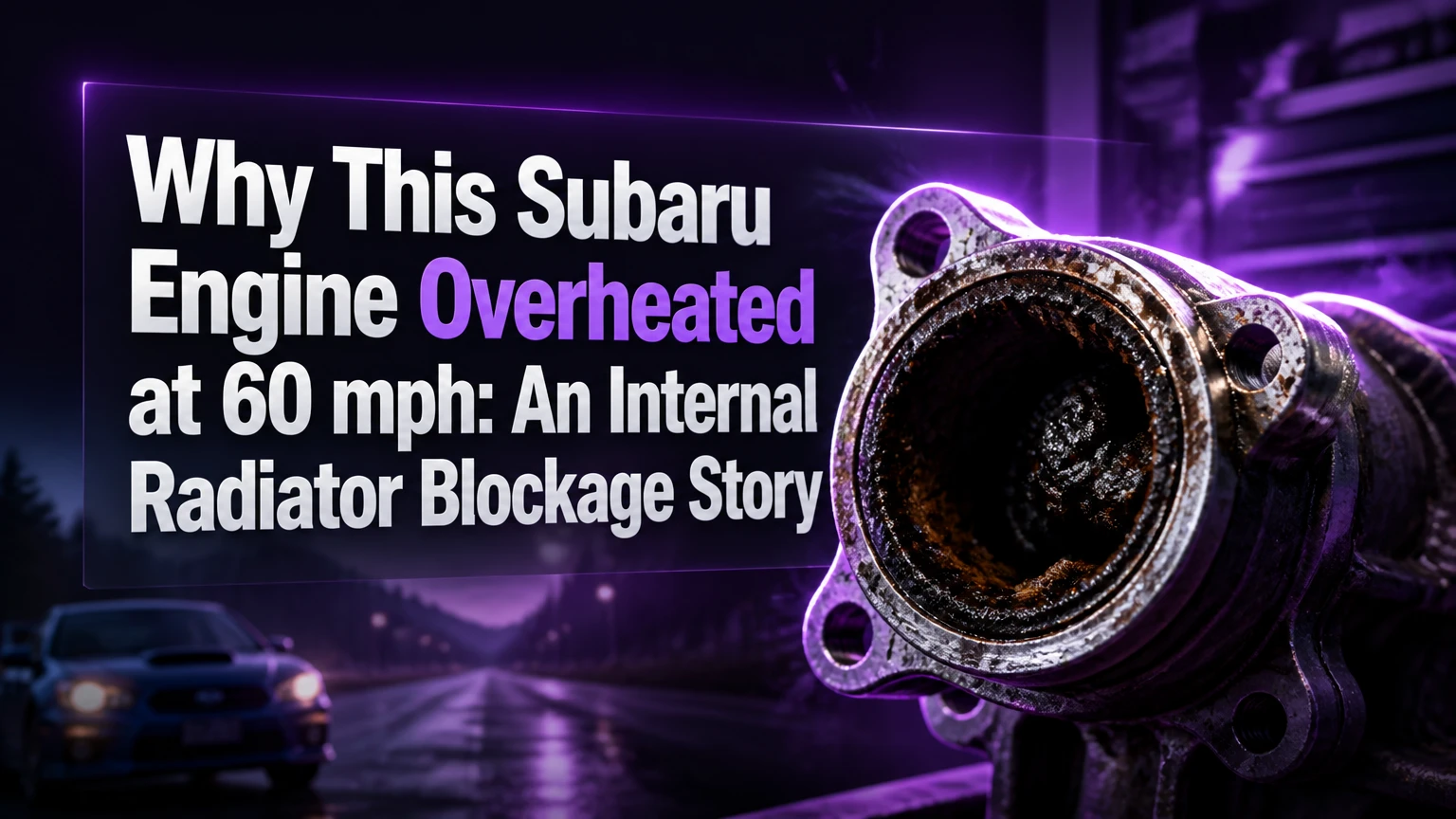
A 2012 Subaru Outback 2.5i came in with an overheating complaint that had stumped two other shops. The engine temperature climbed to near the red zone at sustained highway speeds but stayed completely normal at idle, in traffic, and at speeds below 35 mph.
Both previous shops had replaced the thermostat. Neither had found anything wrong. The new thermostat had not changed the symptom.
The counterintuitive part: at 60 mph, the Outback has maximum airflow across the radiator. More airflow should mean better cooling. Instead, the car overheated specifically because of what happens inside a partially blocked radiator when the water pump flow rate increases at highway RPM. Here is the complete diagnostic story.
The Symptom That Does Not Make Sense: Overheating at 60 mph but Not at Idle
Before touching anything, we spent time understanding why this symptom pattern exists. The answer requires understanding how coolant flows through a radiator under different operating conditions.
Why highway overheating with normal idle temperature is the opposite of what most people expect
At idle, the engine generates relatively little heat because combustion events are infrequent. The cooling system keeps up easily. Even a partially blocked radiator moves enough coolant to handle idle heat load.
At 60 mph, the engine generates significantly more heat because combustion events are more frequent and power output is higher. Simultaneously, the water pump, driven by the crankshaft, rotates faster and pushes more coolant per minute through the system. This is where a partial blockage creates a specific problem that makes cooling worse, not better, at higher flow rates.
The physics of increased flow through a partially blocked system
When the water pump increases flow, coolant encounters the blocked radiator tubes and the pressure drop across the blockage increases. More flow through fewer open tubes means higher velocity through those tubes, which actually reduces the contact time between the coolant and the tube walls. Heat transfer efficiency drops.
Simultaneously, the increased pressure upstream of the blockage forces more coolant through the thermostat bypass circuit, which returns hot coolant to the engine without passing through the radiator at all. The engine effectively starts circulating hot coolant in a shorter loop, bypassing the very radiator it needs to shed heat into.
The Diagnostic Steps We Ran and What Each One Ruled Out
Systematic diagnosis requires ruling out the simple and cheap failures before moving to the complex and expensive ones. We documented each step and what it eliminated.
Step 1: Thermostat test
Two previous shops had already replaced the thermostat. We confirmed the new thermostat was functioning by installing a temperature sensor in the upper radiator hose and watching it on a scan tool during warm-up. The hose remained cool until the engine reached 187°F (86°C), at which point hose temperature climbed rapidly, confirming the thermostat opened correctly. Thermostat eliminated.
Step 2: Water pump test
We pinched the upper radiator hose momentarily during idle with the engine at temperature. Pressure built immediately and released when we unpinched. This confirmed the water pump was moving fluid against resistance. We also removed the pressure cap and checked for coolant movement at idle: strong circulation confirmed. Water pump eliminated.
Step 3: Head gasket combustion gas test
We used a combustion gas block tester (the chemical tester that changes color in the presence of exhaust gases in the coolant). After running at idle for 15 minutes, we tested the coolant. No color change. Clean coolant. Head gasket leak into cooling system eliminated. This was the most important test given the Outback’s known head gasket history.
Step 4: Radiator inlet and outlet temperature differential
We installed dual temperature probes on the upper and lower radiator hoses and drove the vehicle to reproduce the symptom. At idle: upper hose 192°F, lower hose 162°F, a 30°F differential indicating normal heat transfer. At 60 mph with the gauge climbing: upper hose 225°F, lower hose 198°F, a 27°F differential.
Normal differential should be 40 to 55°F at highway speed with higher heat rejection demands. Our highway differential was similar to the idle differential, meaning the radiator was transferring almost no additional heat despite higher engine heat output. The radiator was the problem.
Diagnostic Step | Tool or Method Used | Finding | What It Eliminated |
|---|---|---|---|
Thermostat function | Hose temperature sensor + scan tool | Opens at correct temp, flow confirmed | Thermostat failure |
Water pump function | Hose pinch test, pressure cap removal visual | Strong flow confirmed at idle | Water pump failure |
Head gasket combustion gas | Chemical block tester (blue-to-yellow indicator) | No color change; clean coolant | Head gasket combustion leak |
Radiator temperature differential | Dual thermocouple probes, upper and lower hose | Differential collapsed from 30°F to 27°F at speed | Normal radiator function; radiator is the problem |
Coolant condition visual | Drain and collection into clear container | Brown-orange color, visible sediment particles | Clean coolant (confirmed degradation and scale) |
Radiator flow rate test | Flow meter on lower hose, water pump disconnected, gravity flow | Flow rate 40% below clean-radiator baseline | Normal radiator tube capacity |
What We Found Inside the Radiator After Removing It
We removed the radiator from the Outback after step 6 in the diagnostic sequence confirmed reduced flow. What we found when we back-flushed and then dissected the radiator explained every aspect of the symptom.
The back-flush procedure and what it produced
With the radiator on the bench, we connected a garden hose to the lower outlet and let water flow in reverse through the radiator (back-flush). The first 30 seconds of water coming from the upper inlet was dark brown. The next 60 seconds ran progressively lighter brown. By 3 minutes, the water ran almost clear.
We collected the flush water and let it settle. The sediment at the bottom of the collection bucket was rust particles and a gray mineral scale. The rust was iron oxide from the coolant passages inside the Subaru EJ25 engine block, which used a wet-liner design that allows coolant to contact aluminum and cast iron simultaneously. The scale was calcium and magnesium carbonate from degraded coolant that had lost its corrosion inhibitors.
The tube blockage pattern when we cut the radiator open
After flushing, we cut the radiator’s end tank to expose the tube inlets. Of 32 coolant tubes in the radiator core, we found 9 tubes with significant blockage at the inlet end: 6 tubes blocked 50 to 80% by rust and scale, and 3 tubes blocked 90 to 100%. The blockage pattern was not random. The most blocked tubes were in the lower section of the radiator, where cooled coolant exits. This is where the heaviest sediment settles when the car sits.
Nine of 32 tubes blocked means 28% of cooling capacity lost. At idle, the remaining 23 tubes handled the heat load. At highway speed with 3x the flow demand and the bypass circuit pulling coolant away from the radiator, 23 tubes were insufficient.
What Subaru EJ-series coolant chemistry does to aluminum and iron surfaces
The Subaru EJ25 is a unique engine in how it contacts coolant with dissimilar metals. The aluminum block has cast iron cylinder liners in close contact. Where aluminum and iron meet in a liquid environment, galvanic corrosion occurs: the aluminum acts as an anode and slowly corrodes into the coolant, while the iron liner experiences accelerated oxidation on the outer surface.
Subaru’s own coolant specification (SUBARU Super Coolant, now Genuine OAT) is engineered to suppress this galvanic corrosion with specific inhibitor packages. The Outback in question had a mixture of generic green coolant from the previous owner’s maintenance. Green coolant is formulated for cast iron and copper systems, not for mixed aluminum and iron applications. Using it in a Subaru accelerates the exact corrosion that produced the sediment blocking the radiator.
Why Subarus Are Particularly Vulnerable to This Specific Failure Mode
This overheating pattern is not unique to this customer. It is a predictable failure that appears consistently in Subarus with improper coolant and infrequent coolant changes.
The coolant change interval Subaru recommends and why owners skip it
Subaru recommends coolant replacement at 30,000 miles for the first change and every 30,000 miles thereafter with standard coolant, or every 137,000 miles with Genuine Subaru PDHF OAT coolant. Most owners do not know their Subaru has a specific coolant requirement. Most general service technicians who perform coolant flushes do not check the specification before adding a universal green or pink coolant.
Once the wrong coolant is installed, the galvanic inhibitors that protect the dissimilar-metal cooling surfaces are gone. Corrosion begins immediately. The timescale from wrong coolant installation to symptomatic blockage depends on coolant volume, driving frequency, and how much wrong coolant was mixed in, but 50,000 to 80,000 miles is a common interval for this failure to appear.
The $65 repair that prevents this entire story
A coolant flush and fill with the correct OAT coolant at the recommended interval costs $65 to $95 in service labor and fluid. A new radiator for a 2012 Outback costs $180 to $280 in parts plus 2 hours of installation labor. The correct coolant service is the $65 option. The blocked radiator diagnosis and replacement was the $520 option.
After replacing the radiator and filling with Genuine Subaru OAT coolant, the Outback drove the same 60 mph route with stable temperature. The differential between upper and lower hose temperatures at highway speed was 48°F, confirming the radiator was now transferring heat at the correct rate.
FAQs: Subaru Highway Overheating and Radiator Blockage
Q: Why does a Subaru overheat at highway speed but not at idle?
A: The most common cause is internal radiator blockage from rust and scale sediment. At idle, the blocked radiator has enough capacity for low heat loads. At highway speed, the water pump increases flow, the engine generates more heat, and the increased flow through fewer open tubes actually reduces heat transfer efficiency. The thermostat bypass circuit carries hot coolant back to the engine before it reaches the radiator, creating a spiral of rising temperature.
Q: How do I know if my radiator is internally blocked?
A: Compare the temperature differential between the upper and lower radiator hoses at highway speed. Normal is 40 to 55°F differential. A differential less than 30°F at highway speed with a rising temperature gauge indicates the radiator is not transferring enough heat. Brown or rusty coolant, visible sediment in the overflow bottle, and a radiator that feels cooler in some sections than others under the hood are additional indicators.
Q: Can a blocked radiator be flushed instead of replaced?
A: A chemical flush and pressure flush can remove light sediment from partially blocked tubes. If the blockage is severe (9 of 32 tubes blocked 50% or more), a flush can remove the movable particles but the residue in the tube walls and tube inlets remains. We flushed the Outback’s radiator on the bench before dissecting it. The flush cleared the flow significantly, but tubes that were 90% blocked remained restricted.
Q: What coolant should a Subaru use?
A: Subaru specifies Genuine Subaru PDHF OAT (Organic Acid Technology) coolant for EJ-series and FB-series engines. Standard green (IAT) or universal pink coolants are not compatible with Subaru’s mixed aluminum and iron cooling circuit. Using the wrong coolant accelerates galvanic corrosion between the dissimilar metals and produces the rust and scale sediment that blocks the radiator over time.
Q: How often should coolant be changed in a Subaru?
A: With Genuine Subaru OAT coolant: every 137,000 miles or 11 years per the current service manual. With standard coolant (not recommended): every 30,000 miles. If the vehicle has had non-OAT coolant installed at any point, drain and refill with OAT coolant at the next service and establish a 30,000-mile change interval going forward to prevent further accumulation.
Bottom Line
The 2012 Outback overheated at highway speed because 28% of its radiator tubes were blocked by rust and scale sediment from 11 years of non-OAT coolant use. The counterintuitive highway-specific overheating happened because increased water pump flow at highway RPM reduced heat transfer efficiency in the partially blocked radiator and forced hot coolant through the thermostat bypass circuit rather than through the radiator. The temperature differential diagnostic confirmed the radiator was the problem before we removed anything. A new radiator and OAT coolant fill resolved the symptom completely.
The correct prevention is using Subaru-specified OAT coolant from the first service interval. The wrong coolant in a Subaru’s mixed-metal cooling circuit is a 50,000 to 80,000-mile delayed radiator replacement waiting to happen.