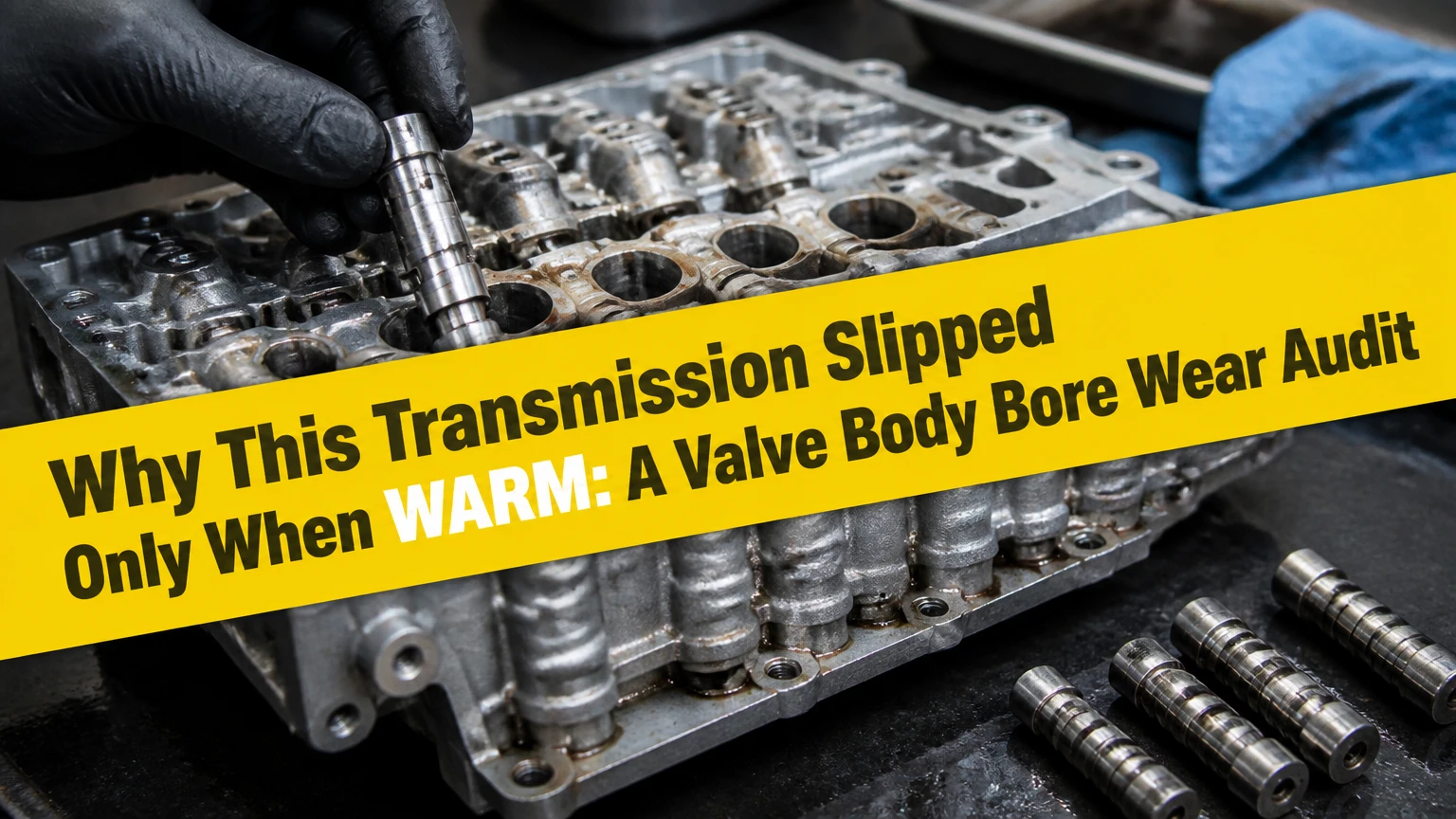
A 2008 Honda Accord with 187,000 miles came in with a specific complaint: the 5-speed automatic slipped in 3rd gear, but only after about 20 minutes of driving. Cold starts were perfect. Neighborhood speeds were fine. The slip started on the way home from work after the transmission had reached full operating temperature.
No fault codes were stored. A road test confirmed the symptom exactly: 3rd gear held perfectly for the first 15 minutes, then began slipping under light throttle load between 40 and 55 mph. Under hard acceleration, it skipped 3rd almost entirely and completed the shift quickly. Under light throttle, it hunted and slipped.
The transmission fluid was clean, the right specification, and at the correct level. This was not a fluid problem. This was a valve body bore problem, and the warm-only pattern was the exact clue that identified it.
The Symptom and Why Warm-Only Slipping Points Directly at the Valve Body
Warm-only slipping in a specific gear is one of the most diagnostically useful symptoms an automatic transmission can produce. It eliminates entire categories of failure before you touch the transmission.
What the valve body does and how it controls clutch pressure
The valve body is a hydraulic control unit that sits at the bottom of the automatic transmission. It contains dozens of passages, solenoid valves, check balls, and regulator valves. When the transmission control module commands a specific gear, it activates solenoid valves in the valve body that route pressurized ATF to specific clutch packs.
Each clutch pack holds a gear ratio engaged by pressing the clutch discs together with hydraulic pressure. Maintain adequate pressure and the clutch holds. Let pressure drop below the clamping threshold and the clutch slips, which is what the customer was experiencing in 3rd gear.
Why warm slipping specifically points at bore clearance rather than a solenoid or clutch pack
A failed solenoid valve fails the same way cold and warm. A worn clutch pack slips the same way cold and warm. The only component in the transmission whose behavior changes dramatically based on oil temperature is the valve body bore-to-spool clearance.
Cold ATF has high viscosity (thick). Warm ATF has low viscosity (thin). A bore that is slightly oversized can seal adequately with cold thick fluid but allows significant leakage when warm thin fluid runs through the same clearance. The fluid finds the path of least resistance: through the worn bore gap rather than to the clutch pack.
How We Measured the Valve Body Bores and What We Found
Valve body bore measurement requires removing the transmission from the vehicle, disassembling the valve body, and measuring each bore with an inside micrometer or bore gauge. This is not a quick job. But the warm-only slipping pattern made the diagnosis specific enough to justify it.
The removal and disassembly process
We drained the ATF, dropped the oil pan, and removed the valve body as a unit. Honda A5B automatic valve bodies separate from the transmission case by removing approximately 20 bolts. We took the valve body to the workbench and photographed every check ball location before opening it.
The valve body splits into upper and lower halves with a separator plate between them. The separator plate has precisely placed holes that direct fluid flow. We photographed the plate hole pattern and matched it to the service manual to confirm it had not been installed incorrectly at a prior service.
The bore measurements that identified the problem
We measured every regulator bore with a calibrated inside micrometer. The 3rd gear pressure regulator bore, which controls hydraulic pressure to the 3rd gear clutch pack, measured 12.041mm.
The service specification for that bore is 12.000mm to 12.018mm. Our measurement was 0.023mm over the maximum service limit. Every other bore in the valve body measured within specification. The 3rd gear regulator bore had worn specifically from 187,000 miles of operation.
Measurement | Specification | Measured (3rd Gear Bore) | Warm Operating Effect | Result |
|---|---|---|---|---|
3rd gear regulator bore diameter | 12.000 to 12.018mm | 12.041mm | Clearance allows ATF to bypass at low viscosity (warm) | Slip in 3rd at operating temperature |
3rd gear clutch pack line pressure (cold) | 9.8 to 11.2 bar (spec) | 9.4 bar (slightly low but holding) | Cold ATF seals the worn bore; near-spec pressure maintained | No slip when cold |
3rd gear clutch pack line pressure (warm, est.) | 9.8 to 11.2 bar (spec) | Estimated 6.5 to 7.0 bar | Warm ATF bypasses worn bore; pressure drops below clamping threshold | Slip under load |
All other regulator bores | Spec range | Within spec on all | N/A | No other symptom |
The Physics of Oil Viscosity and Bore Clearance That Explains Warm Slipping
Understanding why 0.023mm of extra bore clearance causes warm-only slipping requires understanding the relationship between oil viscosity and leakage past a spool valve.
How clearance leakage rates change with temperature
Flow rate through an annular gap (the space between a spool valve and its bore) follows the Hagen-Poiseuille relationship: flow rate is proportional to the pressure differential and the gap geometry, and inversely proportional to viscosity. When viscosity drops by half (as ATF viscosity does from cold to warm operating temperature), the leakage rate through a given clearance approximately doubles.
At cold operating temperature, Honda ATF DW-1 has a viscosity of approximately 38 cSt. At 90°C operating temperature, viscosity drops to approximately 7.5 cSt, a reduction to 20% of cold viscosity. Through the worn 3rd gear bore at 12.041mm, this 5x viscosity drop produced a leakage rate that overwhelmed the pressure regulator’s ability to maintain clutch pack clamping pressure.
Why the skip-3rd-under-hard-acceleration symptom also makes sense
Under hard acceleration, the transmission control module commands a quick 2nd-to-4th skip in some driving situations, bypassing 3rd entirely. The customer noticed this made the car feel ‘almost normal’ under hard throttle. This is because a rapid direct engagement of 4th bypasses the worn regulator circuit momentarily.
Under light throttle, the computer commanded 3rd properly, the pressure tried to build, leaked through the worn bore, and the clutch slipped. This confirmed our diagnosis before we even removed the valve body: the pattern of ‘slips light throttle, feels better hard throttle in same speed range’ is a valve body pressure problem, not a clutch pack friction material problem.
The Repair Options and Why Complete Valve Body Replacement Beat Bore Reconditioning
Once we had the worn bore identified, two repair paths were available. We discussed both with the customer with honest cost and longevity projections for each.
Option 1: Valve body bore reconditioning
A machine shop can bore the worn valve body bore to the next oversize and install a sleeve, restoring the bore to specification. This costs $80 to $180 in machine shop time. The sleeve must be precisely fitted and the valve body reassembled with new solenoids and check balls.
The risk of reconditioning: the machining must be precise to 0.01mm. If a general machine shop without transmission-specific experience is used, the reconditioning can produce a bore that is technically in specification but not perfectly parallel, causing the spool valve to bind. The result can be worse than the original worn bore.
Option 2: Complete remanufactured valve body replacement
A remanufactured valve body for the Honda A5B transmission is available from several suppliers at $180 to $290. It is a drop-in replacement with all bores machined to specification, new solenoids, new check balls, and a new separator plate.
Installation time: 3 hours including fluid drain and refill. Total repair cost: $480 to $600 parts and labor. The customer approved this option. The transmission shifted correctly immediately after the replacement, cold and warm. A 100-mile test drive the following day confirmed no recurrence.
FAQs: Warm-Only Transmission Slipping and Valve Body Wear
Q: Why does my transmission slip only when warm?
A: The most common cause is a worn valve body bore. Automatic transmission fluid has much lower viscosity when warm than when cold. A bore that is slightly oversized can seal adequately with cold thick fluid but allows significant leakage when warm thin fluid runs through. This leakage drops hydraulic pressure to a specific clutch pack below its clamping threshold, causing slipping in the corresponding gear.
Q: Does warm-only slipping mean the clutch pack is worn?
A: Not necessarily. If the clutch pack were worn, it would typically slip consistently regardless of temperature. Warm-only slipping in a specific gear with perfect cold performance is more indicative of valve body bore wear or a temperature-sensitive solenoid valve. Have the valve body bores measured before assuming clutch pack replacement is needed.
Q: Can I drive on a warm-slipping transmission while I schedule a repair?
A: Limited driving to get to the shop is acceptable. Extended commuting with a slipping transmission is not recommended. Every slip event occurs when the clutch is engaging with insufficient pressure, which generates heat within the clutch pack and accelerates friction material wear. A 2-week delay can convert a valve body repair into a full transmission rebuild.
Q: What does a valve body replacement cost?
A: A remanufactured valve body for a common automatic transmission (Honda, Toyota, GM, Ford) typically costs $150 to $350 in parts. Installation labor runs 2 to 4 hours at shop rates. All-in, expect $400 to $700 depending on vehicle and shop. This compares favorably to a full transmission rebuild at $2,200 to $4,500, which is the next cost level if the clutch packs are allowed to wear further.
Q: How long does a valve body typically last?
A: Valve body wear is mileage and fluid quality dependent. A transmission serviced regularly with fresh fluid maintains bore clearances longer because clean fluid carries fewer abrasive particles and maintains its anti-wear additive package. The Honda A5B in our case went 187,000 miles before bore wear produced symptoms. Poor fluid maintenance can accelerate this failure to 80,000 to 120,000 miles.
Bottom Line
A warm-only slip in a specific gear with no fault codes and clean fluid is the classic presentation of valve body bore wear. The worn bore in our Honda A5B measured 12.041mm against a spec maximum of 12.018mm: a 0.023mm oversize. That 0.023mm allowed warm ATF (viscosity at 7.5 cSt) to leak past the 3rd gear pressure regulator at a rate that dropped clutch pack line pressure from spec’s 9.8 to 11.2 bar down to an estimated 6.5 bar, causing the clutch to slip under light throttle load. A remanufactured valve body at $480 installed resolved the complaint immediately. If you are experiencing warm-only slipping in a specific gear with no codes, measure the valve body bores before authorizing any clutch pack work.