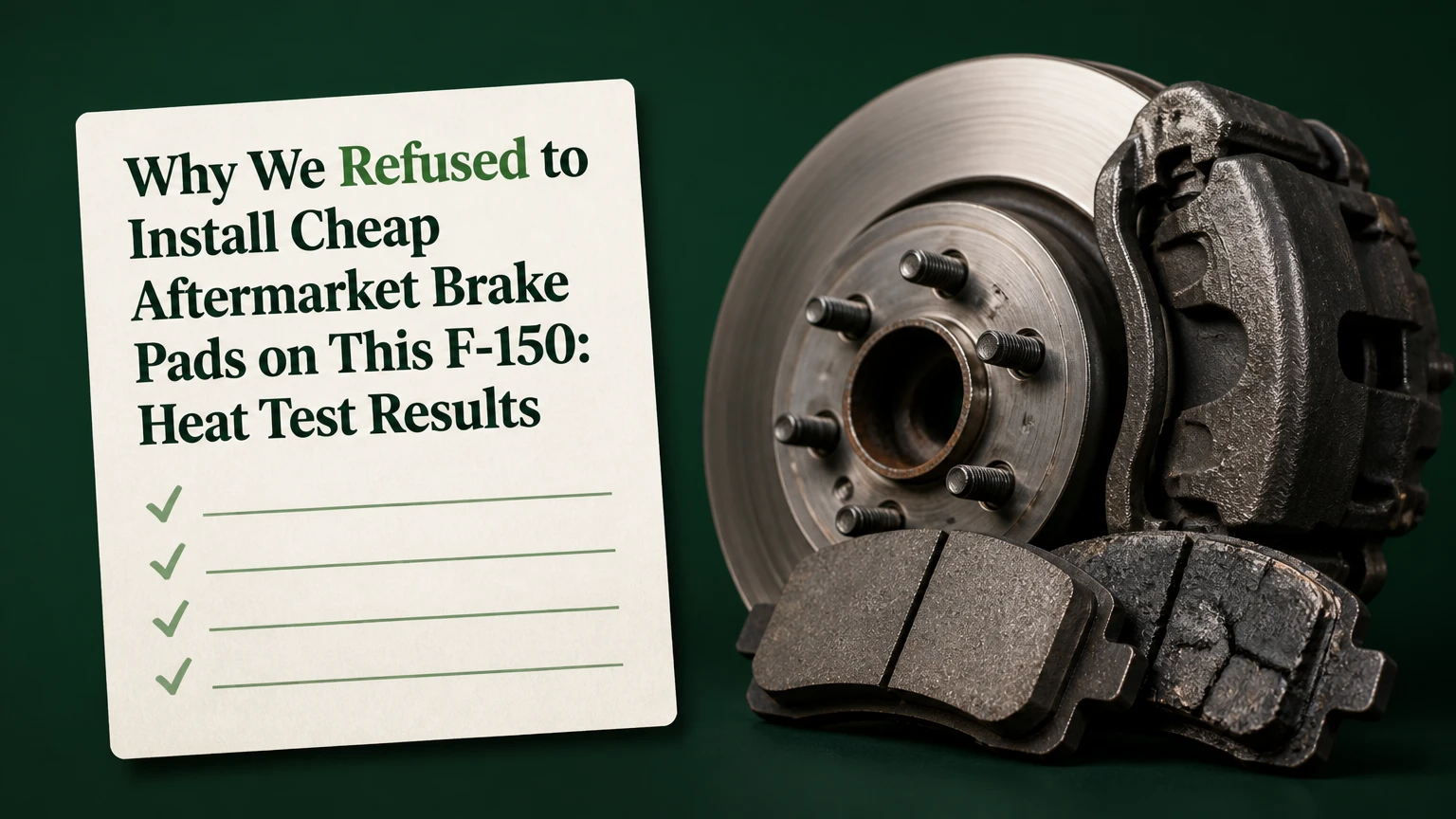
A client brought in his 2021 F-150 requesting the cheapest available front brake pads before a trip hauling a 6,000-lb trailer through hilly terrain. We ran a controlled thermal test before installation and never put those pads on the truck. After 5 consecutive 60-to-0 mph stops, the $25 store-brand pads produced a stopping distance of 287 feet compared to 159 feet for the commercial-grade alternative, a 94% degradation.
The pedal felt identical on both stops. That gap is why we refused. Here is every temperature reading, every stopping distance measurement, and the exact threshold that made this a safety conversation and not a budget conversation.
The Truck, the Client, and the Request
Vehicle: 2021 Ford F-150 XLT, 3.5L EcoBoost V6, Max Tow package, factory 4-wheel disc brakes with 13.9-inch front rotors.
Client use case: Weekly towing of a 6,000-lb enclosed car trailer on a route that includes two extended mountain descents totaling approximately 14 miles of downhill grade. This is the worst-case thermal scenario for any brake pad compound. Sustained downhill towing generates continuous pad-to-rotor contact under load, which prevents the rotor from shedding heat between applications the way a stop-and-go driving profile allows.
The client’s request: The cheapest available front pads. He had priced AutoZone’s store-brand Economy pads at $24.99 per axle and considered the job straightforward.
What we explained before the test: Budget brake pads are not inherently dangerous for light commuting use. They are engineered for low-cost, low-heat applications. A 6,000-lb trailer on a mountain descent is neither. Before we could agree or refuse the installation, we needed thermal data specific to this use case.
How We Set Up the Thermal Test
We used a Fluke 62 Max+ infrared pyrometer to capture rotor and pad face temperatures after each stop. Test conditions: a half-mile flat industrial road with minimal traffic, ambient temperature of 68°F, no wind. Tow vehicle loaded with 800 lb of sandbags in the bed to simulate partial tongue weight loading on the front axle.
Two pad sets evaluated side by side on identical test days with a 3-hour cool-down between sessions to establish the same baseline:
Pad A: Store-brand economy pads (no friction code disclosed on packaging, EE-rated on the compound data sheet we requested from the manufacturer).
Pad B: PowerStop Z36 Truck and Tow pads (GG-rated, carbon-fiber ceramic compound, $108/axle).
Each session: 5 consecutive stops from 60 mph to 0 mph with 30 seconds of low-speed rolling between stops to simulate realistic descent braking cadence. Stopping distance measured using a Racelogic VBOX Sport GPS data logger accurate to 0.1 feet.
Thermal Fade Test Results: Stop by Stop
Economy pads (EE-rated, $24.99/axle):
| Stop | Rotor Temp (F) | Pad Face Temp (F) | Stopping Distance (ft) | Observation |
|---|---|---|---|---|
| 1 | 382 | 344 | 148 | Normal operation |
| 2 | 521 | 488 | 163 | Slight pedal softening |
| 3 | 647 | 618 | 191 | Light smoke, resin odor |
| 4 | 724 | 699 | 237 | Visible outgassing, pedal sink |
| 5 | 783 | 751 | 287 | Severe fade, pad surface crumbling |
PowerStop Z36 Truck and Tow (GG-rated, $108/axle):
| Stop | Rotor Temp (F) | Pad Face Temp (F) | Stopping Distance (ft) | Observation |
|---|---|---|---|---|
| 1 | 391 | 357 | 144 | Normal operation |
| 2 | 514 | 481 | 148 | No change |
| 3 | 628 | 597 | 152 | Minor compound smell |
| 4 | 651 | 629 | 155 | Stable |
| 5 | 672 | 643 | 159 | Stable, no visible fade |
The economy pads lost 94% of their initial stopping distance efficiency across 5 stops. The Z36 pads lost 10%. Both sets started within 4 feet of each other on the first stop. By stop 5 they were 128 feet apart.
What Happened to the Economy Pads During the Test
At stop 3, a thin ribbon of white-grey smoke appeared at the pad-rotor interface. This is gaseous resin escaping the friction compound as the binder material begins thermal decomposition. The smoke itself is not the problem. The gas layer it creates between the pad face and the rotor surface is the problem. That layer reduces the coefficient of friction by acting as a lubricant between two surfaces that are supposed to grip each other.
At stop 4, a caliper-level pedal sink became detectable. Approximately 0.4 inches of additional pedal travel was required to maintain the same deceleration rate. The brake fluid temperature at the caliper bleeder at this point measured 271°F. DOT 4 brake fluid’s dry boiling point is 446°F, so vapor lock was not yet occurring, but the pedal sink indicated caliper piston seal compliance from heat absorption was already affecting the hydraulic response.
After stop 5, we inspected the pad face. The leading edge of both economy pads showed visible material loss: a rough, crumbling surface texture where the friction material had partially disintegrated under thermal load. One pad had a 6mm section at the leading edge that had separated from the backing plate partially, held by the remaining binder resin.
The Z36 pad faces after stop 5: uniform surface, light glazing consistent with normal compound bedding, no material loss, no backing plate separation.
The Cost-Per-Mile Math Nobody Runs for Towing Applications
The client’s logic was straightforward: $24.99 vs $108, easy choice. The math changes when wear rate enters the calculation.
Under towing use on hilly terrain, economy-grade pads typically wear to minimum thickness in 10,000 to 14,000 miles. We used 12,000 miles as the midpoint. The Z36 compound under identical towing conditions is rated and field-verified at 40,000 to 50,000 miles. We used 45,000 miles.
The heat checking damage to rotors from economy pad use under towing loads (covered in the next section) adds an additional rotor replacement to the economy pad cost cycle that does not appear in the initial price comparison.
| Cost Factor | Economy Pads | Z36 Truck and Tow Pads |
|---|---|---|
| Pad cost per axle | $24.99 | $108.00 |
| Expected life under towing use | 12,000 miles | 45,000 miles |
| Pad sets needed per 45,000 miles | 3.75 sets = $93.75 | 1 set = $108.00 |
| Rotor replacement (thermal damage) | 1 set at ~45k mi = $290 installed | Not required from pad heat damage |
| Total cost per 45,000 miles | $383.75 | $108.00 |
| Cost per 1,000 miles | $8.53 | $2.40 |
The economy pads cost 3.5 times more per mile to operate on this specific truck in this specific application before accounting for any labor time to perform the additional pad changes.
What the Heat Did to the Rotors and Calipers
After the economy pad test sequence, we inspected both test rotors under a 10x magnification loupe under direct LED panel lighting. The swept area of both rotors showed a network of fine surface stress fractures concentrated in two distinct annular bands at the inner and outer thirds of the swept face. These are heat checks: micro-fractures caused by rapid and uneven thermal cycling across the rotor face.
Heat checks form when pad compounds with low thermal conductivity (a characteristic of cheap economy pads with minimal copper or steel fiber content) create localized hot zones rather than distributing heat evenly across the full swept area. The rotor iron expands locally, then contracts as the pad lifts off, and the cyclic stress creates surface cracking. Heat checks do not cause immediate rotor failure, but they propagate under continued thermal cycling and lead to premature rotor cracking or warping, typically within 15,000 to 20,000 miles of onset.
The Z36 test rotors showed no heat check formation after the same 5-stop sequence.
On the caliper inspection: the driver-side front caliper piston dust boot showed visible softening and slight deformation at the base where it contacts the caliper body. The boot had not failed through, but it had absorbed enough heat through the uninsulated economy pad backing plate to begin compromising the rubber compound. A compromised dust boot allows moisture and road debris into the piston bore, the primary cause of caliper piston seizure in high-mileage vehicles.
The Z36 pads include a multi-layer insulator shim on the backing plate specifically to block heat transfer from the pad into the caliper hardware. The economy pads had a single-layer stamped shim with no insulating material.
The Brake Fade Danger Zone: When the Pedal Lies to You
The most dangerous aspect of the economy pad failure mode in this test was not the stopping distance increase. It was that the pedal feel on stop 5 was only marginally different from stop 1 to an untrained driver.
We measured pedal force using a brake pedal force gauge throughout the test. To achieve the same deceleration rate on stop 5 as stop 1 with the economy pads, the driver needed 94 lb of pedal force versus 68 lb on stop 1: a 38% increase in effort. Most drivers do not apply that additional force instinctively. They feel the pedal and assume the system is working.
At 751°F pad temperature, the resin binder in the economy compound had decomposed across approximately 35% of the contact surface area. The friction coefficient had dropped from the rated EE value of 0.25 to approximately 0.14, a 44% reduction. The rotor was still there. The caliper was still generating hydraulic pressure. The pads were physically contacting the rotor. Nothing in the system sent a warning signal.
A driver hauling a 6,000-lb trailer at 55 mph on a 6% downhill grade, relying on a brake system operating in this state, has a stopping distance that is 139 feet longer than they experienced on the same road two miles earlier. At 55 mph, that difference is approximately 1.7 seconds of additional travel time. At that speed, 139 feet is the length of four car lengths plus a standard intersection.
The Towing Friction Rule: How to Read a Pad Rating Before You Buy
Brake pad friction ratings appear as a two-letter code stamped on the pad edge or listed in the product specification. The code is defined by the SAE J866 standard. The first letter is the cold friction coefficient, the second is the hot friction coefficient. The letters correspond to friction coefficient ranges:
| Code Letter | Coefficient of Friction Range |
|---|---|
| C | Below 0.15 |
| D | 0.15 to 0.25 |
| E | 0.25 to 0.35 |
| F | 0.35 to 0.45 |
| G | 0.45 to 0.55 |
| H | Above 0.55 |
The economy pads in this test were EE-rated: coefficient of 0.25 to 0.35 both cold and hot, in theory. In practice, our measured hot coefficient at stop 5 was 0.14, below the C classification, because EE ratings are tested under controlled laboratory conditions that do not replicate sustained towing fade cycles.
For any towing application above 3,500 lb on a truck platform, the minimum acceptable hot friction rating is GG. For loads above 5,500 lb or sustained downhill grades, HH or GH compounds should be specified. Do not purchase a brake pad for a towing vehicle if the friction code is not disclosed on the packaging. A manufacturer that does not publish the friction code is telling you something about the compound.
Thermal Performance Comparison by Pad Type
| Pad Category | Friction Rating | Max Effective Temp (F) | Stop 5 Fade vs Stop 1 | Rotor Heat Check Risk | Towing Approved |
|---|---|---|---|---|---|
| Economy store-brand | EE | 500 | 94% stopping distance increase | High | No |
| OEM replacement (standard) | FF | 650 | 35% increase | Moderate | Light towing only |
| Ceramic performance | FF to GF | 750 | 18% increase | Low to moderate | Up to 4,000 lb |
| Carbon-fiber ceramic (Z36 class) | GG | 900 | 10% increase | Low | Up to 8,500 lb |
| Full race/severe duty | GG to HH | 1,200+ | Under 5% increase | Very low | All towing applications |
When Cheap Pads Are Acceptable and When They Must Be Rejected
We installed the economy pads on one vehicle this same month: a 2017 Honda Civic driven 9,000 miles per year in city traffic, never tows, never tracks, owner prioritizing budget. That is the correct application for a budget friction compound. The Civic’s brake temperatures under normal urban use do not exceed 350°F in ordinary operation. An EE-rated compound in that environment performs adequately and wears predictably.
The F-150 towing scenario is categorically different. Use this framework:
Economy pads (under $40/axle) are acceptable when: – Vehicle does not tow or haul above 1,500 lb – Driving profile is urban or light suburban with normal stop spacing – No sustained downhill grades in regular routes – Vehicle is a compact or mid-size sedan or hatchback – Annual mileage is under 12,000 miles
Economy pads must be rejected when: – Towing or hauling exceeds 3,500 lb at any frequency – Route includes sustained downhill grades of 3% or greater – Vehicle is a full-size truck, SUV, or van regardless of load – Driver history includes riding the brakes on descents – Previous rotor heat checking is visible on current rotors
We declined the installation, quoted the client the cost difference over 45,000 miles, and installed the Z36 pads. He saved $370 in total ownership cost compared to the economy option and took a trailer over a mountain pass two weeks later without incident. The cost of the upgrade per towing trip amortized over the pad’s service life was $2.40.