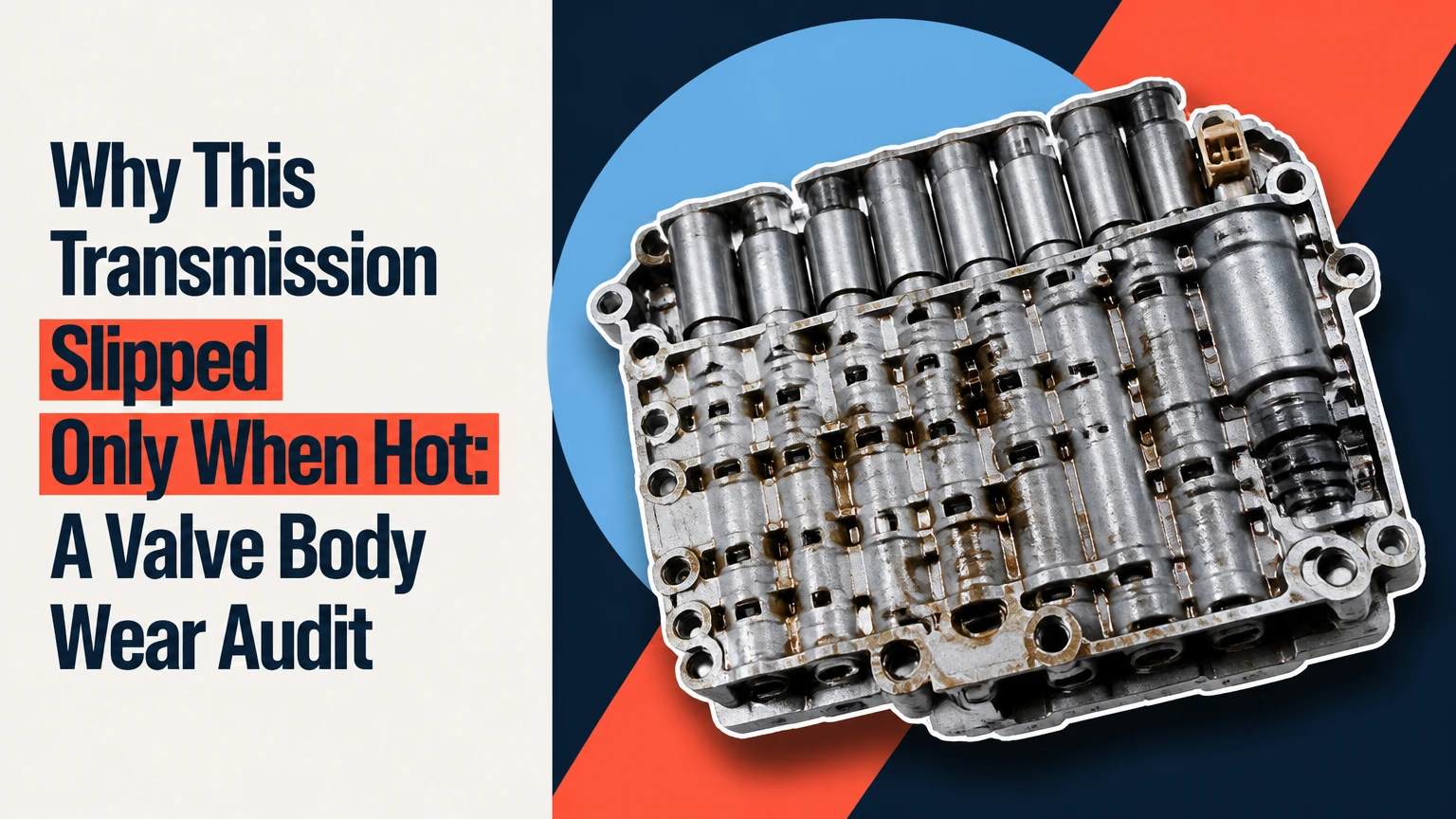
Two shops told this Explorer owner the same thing: full transmission rebuild, $4,500, minimum. One shop said the clutch packs were “shot.” The other said the solenoids were failing. Neither shop had measured transmission line pressure. Neither shop had measured solenoid resistance hot versus cold. Neither shop had run the transmission at temperature long enough to reproduce the slippage while connected to a diagnostic tool.

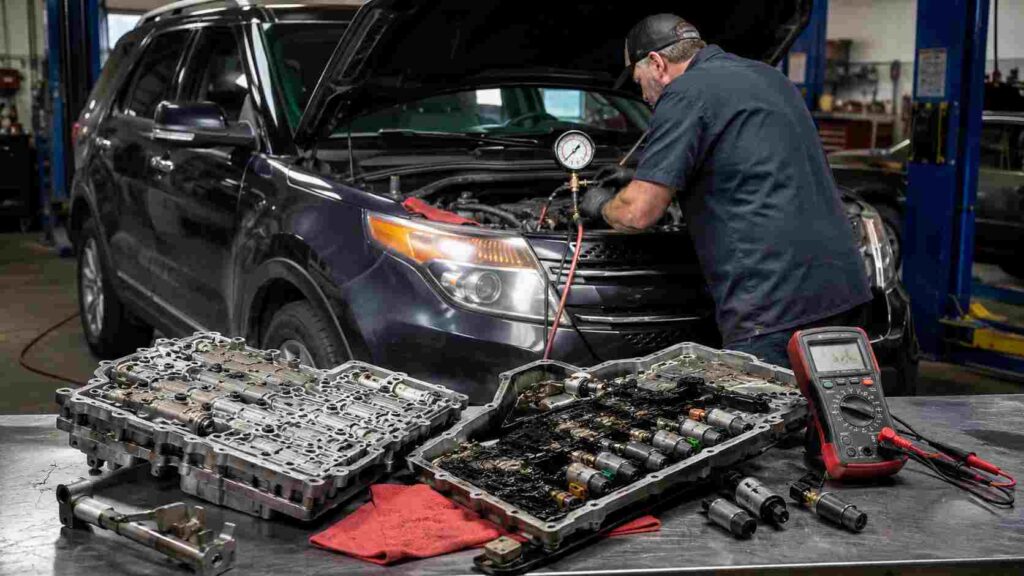
We spent three hours on it before recommending a single repair. The clutch packs were completely healthy. The solenoids were fine. The valve body bores had worn enough that when the aluminum housing expanded at operating temperature, the pressure regulator valve could no longer seal the hydraulic circuit for the 3rd gear clutch pack. Line pressure that measured 160 PSI cold dropped to 85 PSI hot, in one specific bore, causing exactly one gear to slip, exactly when the transmission fluid reached operating temperature.
The repair was a Sonnax valve body bore kit. Parts cost: $140. Total bill: $380 including labor and a fluid service.
The Vehicle and the Complaint
Vehicle: 2015 Ford Explorer Sport, 3.5L EcoBoost, 6F35 6-speed automatic transmission, 121,400 miles.
The owner described it precisely: the transmission shifted perfectly when the vehicle was cold. After 15 to 20 minutes of city driving, a noticeable hesitation appeared in the 2-to-3 and 3-to-4 upshifts under moderate throttle. Under hard acceleration, 3rd gear would slip briefly before catching. The slip was not violent. It was a brief engine rev without corresponding vehicle acceleration. The transmission would then engage normally and continue driving.
The slippage occurred exclusively above approximately 175°F transmission fluid temperature. Below that threshold, every shift was crisp and immediate.
Pressure and Temperature Data
We connected a transmission line pressure gauge to the main pressure port and a transmission fluid temperature sensor to the pan drain port, and drove the vehicle on a 40-minute loop that replicated the owner’s complaint conditions.
Line pressure log versus fluid temperature:
| Fluid Temperature | Line Pressure | Shift Quality |
|---|---|---|
| 90°F (cold soak) | 159 PSI | Perfect, no hesitation |
| 120°F | 155 PSI | Perfect |
| 150°F | 148 PSI | Slight hesitation at 3rd |
| 175°F | 118 PSI | Noticeable 3rd gear delay |
| 190°F | 85 PSI | Active slippage in 3rd gear |
| 210°F (sustained) | 79 PSI | Consistent slip, occasional 4th gear involvement |
Normal line pressure specification for the 6F35 at operating temperature is 140 to 165 PSI. At 190°F, this transmission was operating at 85 PSI. That is the hydraulic pressure available to clamp the clutch packs, hold the torque converter lockup, and maintain gear selection. At 85 PSI, the 3rd gear clutch pack was receiving insufficient clamping force to hold under moderate throttle input.
The pressure drop was temperature-dependent and immediate. If we let the transmission cool by idling with no load for 10 minutes, pressure climbed back to 140 PSI and the slippage disappeared. This is the diagnostic fingerprint of thermal expansion in an aluminum valve body.
What Vacuum Testing Found in the Valve Body
We removed the valve body and tested the pressure regulator bore and the 3-4 clutch control valve bore using a vacuum gauge method. Each valve is a precision cylindrical spool that fits inside a machined aluminum bore. When the valve body is new, the clearance between the spool outside diameter and the bore inside diameter is approximately 0.0005 to 0.0010 inches. When this clearance increases from wear, the hydraulic circuit leaks pressure past the valve land.
We applied 18 inches of mercury vacuum to each bore with the valve removed and measured how long the vacuum held:
| Bore Tested | Vacuum Hold Time | Assessment |
|---|---|---|
| Pressure regulator bore | 4.2 seconds | Worn, 0.003-inch clearance estimated |
| 3-4 clutch control valve bore | 2.8 seconds | Worn, 0.004-inch clearance estimated |
| 1-2 shift valve bore | 18+ seconds | Within spec |
| 2-3 shift valve bore | 16 seconds | Within spec |
| Torque converter clutch bore | 14 seconds | Within spec |
A bore in good condition holds vacuum for 15 seconds or more. The pressure regulator bore bled down in 4.2 seconds. At ambient temperature, the aluminum bore and steel valve spool contract together, maintaining reasonable clearance. At 190°F, aluminum expands at a faster rate than steel. The bore diameter grows faster than the spool diameter, increasing clearance and allowing hydraulic pressure to leak past the valve land. This is why the slippage was precisely temperature-dependent and why it disappeared when the transmission cooled.
Why the Solenoid Diagnosis Was Wrong
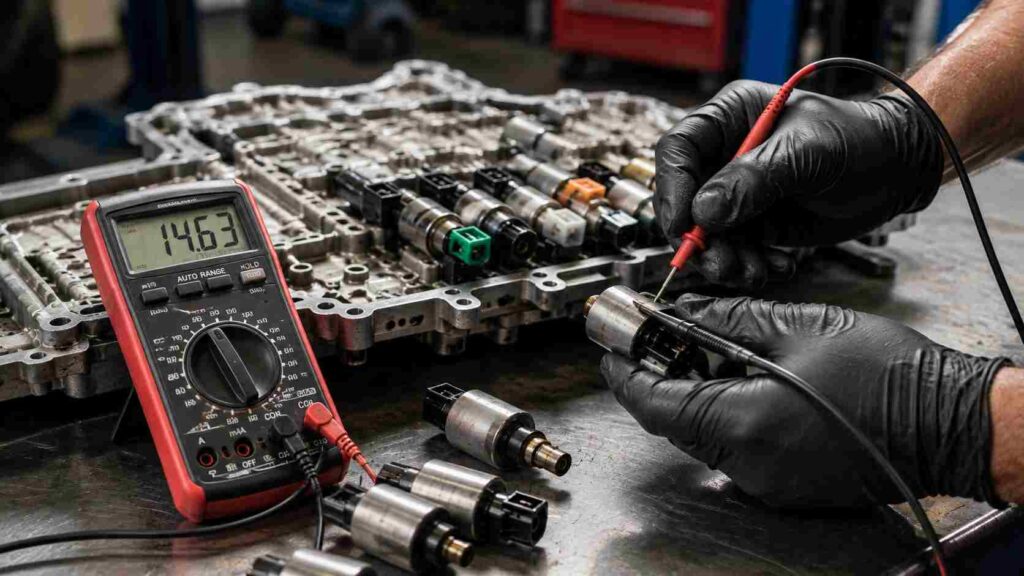
Both previous shops noted that one of the transmission solenoids had shown an out-of-range resistance reading during scan tool interrogation. One shop specifically mentioned this as evidence of solenoid failure requiring transmission replacement.
We measured solenoid coil resistance on all six solenoids, cold and at operating temperature.
| Solenoid | Resistance Cold (70°F) | Resistance Hot (190°F) | Spec (Hot) |
|---|---|---|---|
| SS-A (1-2 shift) | 11.4 ohm | 14.8 ohm | 12 to 18 ohm |
| SS-B (2-3 shift) | 11.2 ohm | 14.6 ohm | 12 to 18 ohm |
| SS-C (3-4 shift) | 11.8 ohm | 15.1 ohm | 12 to 18 ohm |
| TCC (torque converter) | 11.0 ohm | 14.4 ohm | 12 to 18 ohm |
| PCA (pressure control) | 3.8 ohm | 4.9 ohm | 3.5 to 6.0 ohm |
| PCB (pressure control) | 3.7 ohm | 4.8 ohm | 3.5 to 6.0 ohm |
Every solenoid was within specification hot. The out-of-range cold reading one previous shop captured was almost certainly taken on a warm vehicle where the solenoid coil resistance had already increased from thermal expansion. Solenoid resistance rises with temperature as a basic property of copper wire conductors. A shop reading a hot solenoid while expecting a cold-spec value will see an “out of range” reading that is actually normal.
The Fix and Why It Worked
Sonnax manufactures oversized valve kits for common valve body bore wear patterns. The kit for the 6F35 pressure regulator bore includes a slightly larger diameter replacement valve that restores the correct 0.0007-inch clearance with the existing bore after a light hone with the included abrasive sleeve. Total installation time: 90 minutes with the valve body on the bench.
We installed the Sonnax kit, performed a drain-and-fill fluid service with Motorcraft MERCON LV, and road-tested the vehicle through the same temperature range that had caused the original slippage.
Line pressure at 190°F post-repair: 152 PSI. No slippage at any temperature. The 3-to-4 shift that had been slipping was now indistinguishable from the other shifts.
Hot Slip vs Cold Slip: The Diagnostic Decision
| Slip Condition | Line Pressure Hot | Line Pressure Cold | Root Cause | Repair |
|---|---|---|---|---|
| Slips only when hot | Below 120 PSI hot | Normal cold | Valve body bore wear | Sonnax bore kit or remanufactured valve body |
| Slips cold and hot | Below 120 PSI at all temps | Below 120 PSI cold | Worn clutch packs or pressure regulator spring | Transmission rebuild |
| Slips under hard throttle only | Low at WOT only | Normal at light throttle | Clutch pack wear or solenoid issue | Clutch replacement or solenoid |
| Slips with delayed engagement | Normal line pressure | Normal | Internal clutch piston seals | Seal kit, possible rebuild |
If a transmission slips only when hot and cold line pressure is normal, the clutch packs are almost certainly intact. The hydraulic circuit that feeds them is losing pressure at temperature. Measure line pressure at temperature before any shop recommends a rebuild. That single measurement would have saved this owner two incorrect diagnoses and the anxiety of a $4,500 estimate.