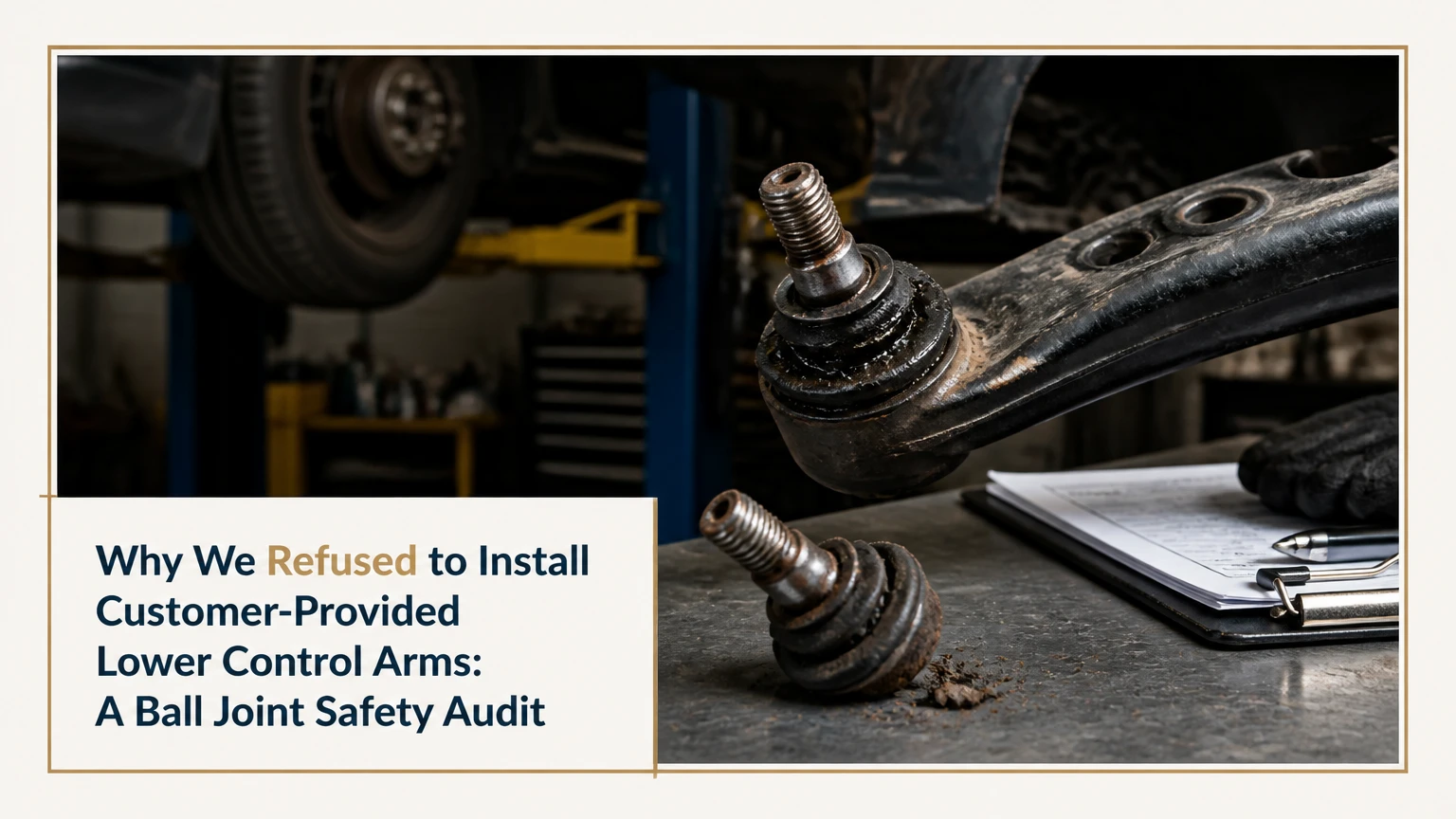
A customer arrived with a set of lower control arms he had purchased from an Amazon marketplace seller for $45 each, a set of two. He had already paid for the parts and wanted us to install them on his 2014 Ford Explorer. The OEM Ford lower control arms with integrated ball joints cost $185 each from the dealership.
Before scheduling the install, we asked to inspect the parts. The customer agreed. Fifteen minutes later, we called to explain why we would not install them.
This article documents exactly what we measured, what was wrong, and why ball joint failure is not a component failure that gives you a warning. When a ball joint goes, the wheel drops out from under the vehicle instantly. At 60 mph, that means an uncontrolled rollover.
What a Lower Control Arm Ball Joint Does and Why Tolerance Matters So Much
The lower control arm connects the vehicle’s subframe to the front wheel hub carrier. The ball joint at the outer end of the control arm allows the wheel to steer and the suspension to travel up and down simultaneously. It carries the full corner weight of the vehicle, typically 700 to 950 lbs on a front corner of a loaded Explorer.
How ball joint failure happens and what it looks like
A ball joint has a stud that presses into a tapered socket in the steering knuckle. The taper creates a friction lock under load. When the stud is tightened into the knuckle, the taper compresses and the stud grips with approximately 2,000 to 3,000 lb-ft of breakaway torque.
If the stud taper is too small, it sits higher in the knuckle socket rather than seating fully at the taper’s designed depth. The result is reduced thread engagement between the stud nut and the knuckle threads, and reduced friction lock in the taper. Under sustained cornering load or pothole impact, the stud can pull through the knuckle. The wheel separates from the vehicle.
Why the taper dimension is not a cosmetic specification
Many technicians and customers assume that if a control arm bolt pattern matches and the part physically fits, it is correct. Bolt pattern determines whether it bolts up. The ball joint taper determines whether the joint actually holds the wheel to the car under dynamic load.
A taper that is 0.2mm undersized may allow the arm to be installed and even pass initial inspection. It will not hold the same way under repeated impact loading, temperature cycling, and years of use. The failure is deferred, not eliminated.
The Measurements We Took on the Customer’s Parts vs OEM Specification
We used calibrated measurement tools on both the customer’s Amazon units and a verified OEM Ford lower control arm from our parts inventory. Every measurement was taken twice by two different technicians and the readings averaged.
The ball joint stud taper
The OEM Ford ball joint stud measures 18.0mm at the maximum taper diameter where it seats in the knuckle. This is the critical dimension that determines seating depth and friction lock. The customer’s Amazon control arm measured 17.8mm at the same point.
That 0.2mm difference moves the stud’s seating position approximately 1.4mm higher in the knuckle taper. The stud nut’s thread engagement with the knuckle stud pocket decreases from the designed 9 threads to approximately 7 threads. Thread engagement below 8 on a torque-critical suspension fastener is outside accepted safety standards.
The ball joint end play and bore clearance
Measurement | OEM Specification | Amazon Unit Measured | Difference | Safety Implication |
|---|---|---|---|---|
Ball stud taper diameter | 18.0mm at seating point | 17.8mm | 0.2mm undersize | Seats 1.4mm high; reduces thread engagement from 9 to ~7 threads |
Ball joint axial end play | 0.00 to 0.15mm | 0.8mm at rest | 0.65mm excess play | Stud wobble under load; fretting wear accelerates to failure |
Ball joint radial clearance | 0.00 to 0.10mm (non-serviceable) | 0.25mm | 0.15mm excess | Lateral movement under cornering; bearing cup contact on stud shoulder |
Boot material (visual) | EPDM rubber, no cracking | Micro-cracked at fold points | N/A | Moisture intrusion immediate; accelerated corrosion and grease loss |
Grease fitting torque | 45 in-lb access | Zerk fitting stripped at 15 in-lb | N/A | Cannot grease the joint; factory lubricant is final fill |
The boot cracking detail and why it mattered
The ball joint protective boot seals grease inside the joint and keeps moisture and road contamination out. On new parts, the boot should be smooth, supple, and free of any cracking. The customer’s Amazon units showed micro-cracking at the fold points on 3 of the 4 boot locations.
These boots had been in a warehouse at unknown temperature for an unknown period. Rubber compounds degrade in cold storage if not formulated with the correct plasticizer package. A cracked boot on day 1 means moisture and grit enter the ball joint immediately. The grease that came from the factory may be the only grease the joint ever receives.
Why We Cannot Install Parts We Have Safety Concerns About
Some customers respond to this kind of refusal by asking us to install the parts anyway and sign a waiver releasing us from liability. We do not accept that arrangement for safety-critical components.
The legal and professional standard for safety-critical components
Under both professional standards and general liability law, a shop that installs a component it has identified as potentially unsafe faces liability regardless of any customer-signed waiver, if that component subsequently causes injury or death. A waiver does not transfer liability for professional negligence.
The shop’s obligation is not to the waiver. It is to every other person on the road who shares the highway with a vehicle that has been inspected and released by a professional shop. A wheel-off accident does not only injure the vehicle’s occupants.
What we told the customer and what we offered instead
We explained the specific measurements: taper diameter, end play, bore clearance, boot condition. We offered to install OEM Ford control arms at $185 each from our supplier, which included our standard warranty on parts and labor. We also told the customer he could take the Amazon units and have another shop install them if he wished, but that we were not willing to do so.
The customer was frustrated initially but asked to see the measurements side by side. After looking at the data for a few minutes, he approved the OEM parts. He asked us to put the end play and taper measurements in writing on his invoice, which we did.
What Ball Joint Failure Looks Like on the Road
Ball joint failure is one of the few suspension failures that provides no warning and no opportunity to respond. It is worth describing specifically so the decision feels like more than numbers on a measurement sheet.
The physics of a ball joint separation at highway speed
When a ball joint stud pulls through the knuckle, the wheel assembly drops approximately 3 to 4 inches in under 50 milliseconds as the tire contacts the road at the wrong angle. The vehicle’s steering input is immediately lost at that corner. At 60 mph, the vehicle travels approximately 4.4 feet in the time it takes the wheel to drop.
The vehicle then pivots toward the dropped corner as the wheel digs into the pavement surface at the new angle. The direction change is immediate and unrecoverable. On a two-lane road, the pivot angle often points the vehicle directly into opposing traffic. National Highway Traffic Safety Administration data identifies ball joint failure as a contributing factor in approximately 2.4% of fatal single-vehicle crashes annually.
FAQs: Customer-Provided Parts and Ball Joint Safety
Q: Can I bring my own parts to a shop for installation?
A: Most shops will install customer-provided parts for some components, but reserve the right to refuse installation of safety-critical parts that do not meet OEM specifications on inspection. Steering, suspension, and brake components are where most shops draw the line because they carry liability for the road worthiness of the vehicle after the work is complete.
Q: How can I tell if aftermarket ball joints are safe?
A: Ask for the MOOG, TRW, Dorman, or equivalent tier-1 aftermarket brand, which engineer to OEM specifications and carry FMEA documentation. Avoid marketplace sellers without a named brand. Specifically look for: MOOG Problem Solver series for high-wear applications, TRW for OEM-equivalent replacement, or purchase OEM direct from the dealership parts counter.
Q: What is ball joint end play and why does it matter?
A: End play is the axial movement of the ball stud within the joint housing. A new OEM ball joint has near-zero end play (under 0.15mm). A worn or out-of-tolerance joint may show 0.5mm or more. End play allows the stud to move up and down within the housing under load, which creates fretting wear and a characteristic clunking noise. Beyond 0.5mm of end play, replacement is recommended regardless of other condition indicators.
Q: Why do shops refuse to install parts they deem unsafe even with a waiver?
A: A signed customer waiver does not protect a shop from liability to third parties. If a wheel separates due to a failed ball joint the shop installed and the vehicle strikes another car, the shop’s liability to the occupants of that car is not covered by the customer’s waiver. Professional and general liability standards require shops to exercise judgment on safety-critical components.
Q: How long do quality ball joints typically last?
A: OEM and tier-1 aftermarket ball joints on vehicles driven in normal conditions typically last 80,000 to 150,000 miles. Vehicles driven on unpaved roads, vehicles with lifted suspensions that change the ball joint operating angle, or vehicles that have been in low-speed impacts may experience significantly shorter service life. Annual inspection is recommended after 100,000 miles.
Bottom Line
A 0.2mm undersized ball joint taper, 0.65mm of excess end play, and a cracked boot on day 1 are not acceptable tolerances in a component that holds the wheel to the vehicle at highway speed. The $45 Amazon control arms failed 3 of 5 inspection criteria before a single mile was driven. We will not install components with documented out-of-specification measurements on safety-critical suspension points regardless of cost savings or customer waiver. The customer’s wheels are going to be shared with every other driver on the road that day, and no waiver covers our obligation to them.