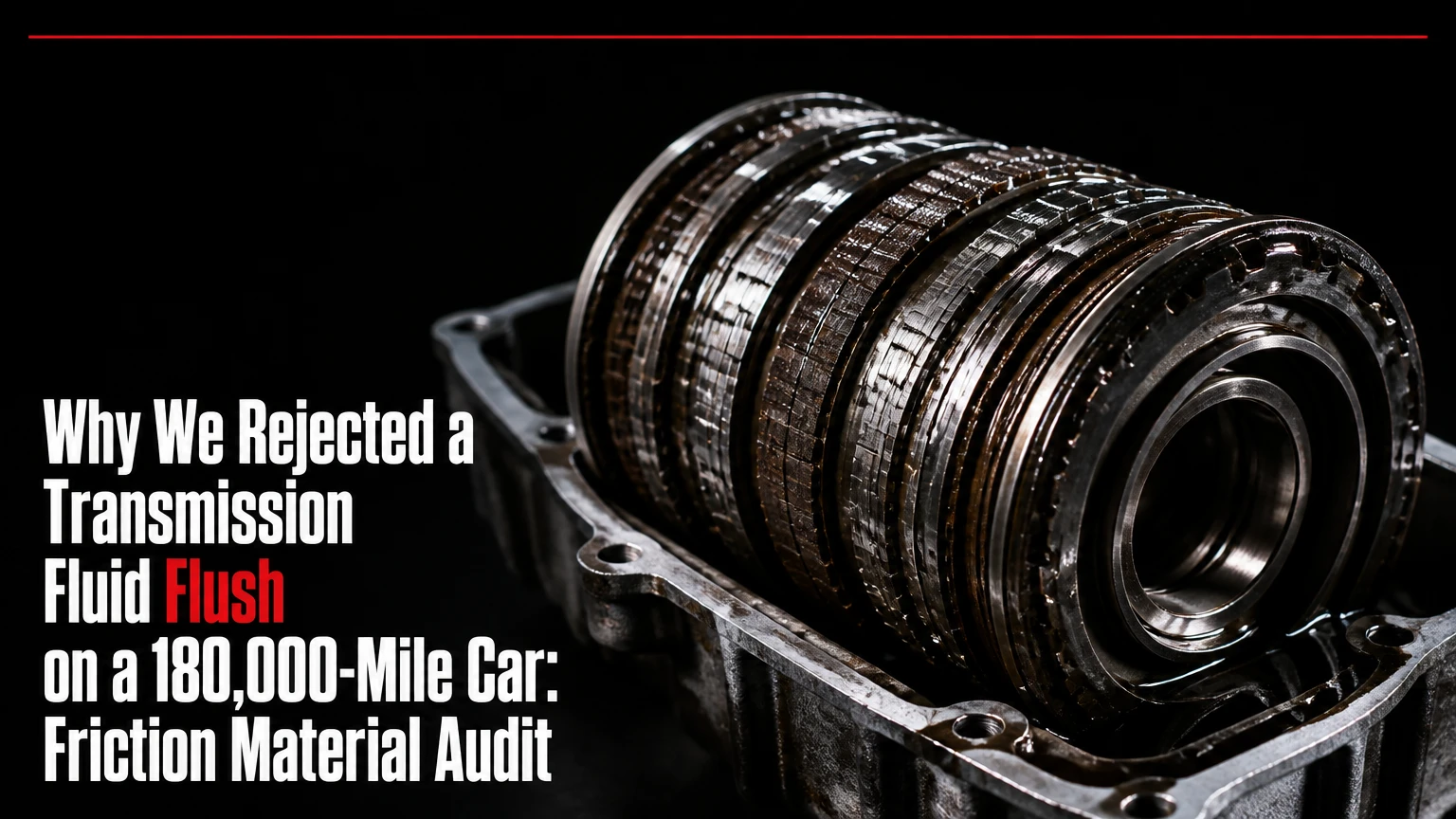
A customer came in asking for an automatic transmission fluid flush on a 2008 Honda Accord with 180,000 miles. He had seen a $89 transmission flush promotion and thought it was good preventive maintenance. He was right about the prevention part, wrong about the timing.
The Accord’s transmission had never had its fluid changed. We know this because the owner had maintained the vehicle with us since 68,000 miles and we had no record of a previous service, and the fluid we drained was a dark brown color instead of the factory-fresh Honda DW-1 red.
We declined the flush, sent the old fluid to a lab, and explained to the customer exactly what a high-volume flush does to a high-mileage transmission that has been running on the same degraded fluid for 180,000 miles. Here is the audit, the lab results, and what we did instead.
What a Transmission Fluid Flush Does That a Drain and Fill Does Not
The terms flush and drain-and-fill describe fundamentally different service procedures with different risks and appropriate applications. Understanding the mechanical difference explains why the risk profile changes dramatically based on vehicle mileage and fluid service history.
The drain-and-fill method
A drain-and-fill removes approximately 3.5 to 4 quarts of fluid through the transmission drain plug. On a Honda Accord with a 7.4-quart total fluid capacity, this replaces roughly 45 to 50% of the total fluid. The remaining 50% of old fluid mixes with the fresh fluid on refill.
The gradual dilution approach gives the transmission time to adapt. The clutch pack friction material, which has been operating with the chemistry of degraded old fluid, encounters a moderate change in friction modifier concentration rather than a sudden complete change. The shift character changes gradually over the next 1,000 miles as the mixed fluid chemistry stabilizes.
The flush method and why it introduces higher risk on a high-mileage never-serviced transmission
A transmission flush machine circulates fresh fluid through the entire system while a pump pushes out the old fluid simultaneously. When complete, approximately 95 to 100% of the fluid has been replaced. On a low-mileage transmission with relatively fresh fluid and healthy clutch packs, this is a complete service with no meaningful risk.
On a 180,000-mile transmission with heavily degraded fluid and 180,000 miles of clutch pack wear, the sudden introduction of fresh friction modifiers changes the clutch-to-steel plate engagement characteristics immediately. The clutch material has been operating in degraded fluid chemistry for its entire service life. Fresh fluid can cause the clutch to grab differently or more aggressively on the next shift, which can manifest as harsh shifting or, in cases where the clutch material is already thin, immediate slipping in a gear that was holding before the service.
What the Fluid Sample Told Us Before We Recommended Anything
Before any recommendation, we drained a sample from the drain plug and sent it to Blackstone Laboratories. We also checked the drain plug for debris and performed a basic fluid condition assessment with our in-house testing equipment.
The drain plug inspection
The magnetic drain plug on the Honda’s transmission was coated with a layer of fine metallic particles consistent with friction material and bearing wear. The layer measured approximately 1.5mm in thickness, which is consistent with 180,000 miles of normal internal wear accumulation on a transmission that has never been serviced.
This is the single most important pre-service inspection step that shops routinely skip when accepting a transmission flush request. The drain plug debris tells you the internal wear state before any fluid is removed. Heavy debris at 180,000 miles indicates wear particles are suspended in the fluid and that any service that disturbs the fluid dynamics may allow those particles to pass through hydraulic circuits.
The lab results
Measurement | New ATF Reference | 180k-Mile Sample | Significance |
|---|---|---|---|
Color | Red, transparent | Dark brown, opaque | Oxidation and thermal degradation over extended service |
Viscosity (cSt at 100°C) | 6.4 to 7.2 cSt (DW-1 spec) | 5.9 cSt | Viscosity thinning from shear degradation; below OEM minimum |
Iron (Fe) | Under 5 ppm | 62 ppm | Elevated; steel component wear throughout service life |
Copper (Cu) | Under 10 ppm | 45 ppm | Elevated; thrust washer and bushing wear; bearing surface degradation |
Friction material particles | None visible | Significant; fine gray-brown powder, visible settling in sample tube | Clutch pack friction material wear; indicates pack thickness is reduced |
Total Base Number (TBN) | 4.0 to 5.5 (DW-1 new) | 0.8 | Nearly depleted; fluid has minimal remaining acid-neutralizing capacity |
Oxidation level | Low | High (by infrared analysis) | Fluid chemistry significantly altered; friction modifier package degraded |
What elevated copper at 45 ppm means specifically
Copper in transmission fluid comes primarily from thrust washers and bronze bushings inside the transmission. The Honda Accord’s 5-speed automatic (BYBA/A5B) uses bronze thrust washers at the planetary gear sets and aluminum bushings in the torque converter housing.
At 45 ppm copper, the wear rate has been significant over 180,000 miles of service. This is not necessarily a current failure: it represents the cumulative wear over the transmission’s entire service life. However, it confirms that internal clearances at bushing locations have increased from their as-new specification. Increased clearances mean hydraulic circuit leak-down paths exist that were not present at lower mileage.
What We Did Instead of the Flush and Why the Multiple Drain-and-Fill Method Works
Rather than a flush or no service at all, we recommended a multiple drain-and-fill sequence: three drain-and-fill services spaced 1,000 miles apart. This gradually replaces the degraded fluid without the sudden chemistry shock of a complete flush.
The math of gradual fluid replacement
Service 1: drain 3.5 quarts, refill with fresh DW-1. Resulting mixture: approximately 50% fresh fluid. Service 2 at 1,000 miles: drain another 3.5 quarts (now a 50/50 mixture), refill with fresh. Resulting mixture: approximately 75% fresh fluid. Service 3 at 2,000 miles: drain another 3.5 quarts (now 75% fresh), refill. Resulting mixture: approximately 87% fresh fluid.
After three services, 87% of the total fluid volume has been replaced with fresh DW-1. The clutch pack has had 2,000 miles to adapt to the progressively improving friction modifier concentration rather than encountering full-strength fresh fluid in a single event. The risk of clutch-pack shock is effectively eliminated.
What the customer experienced after the three-service sequence
The customer returned at 1,000 and 2,000 miles for the subsequent drain-and-fills. At each service, we asked about shift quality. Service 1: ‘It feels a bit smoother going into 3rd gear.’ Service 2: ‘Shifting feels crisper overall.’ Service 3: ‘Shifts are noticeably cleaner, especially from a stop.’
No harsh shifts. No slipping. No new symptoms. The transmission that had been operating on degraded fluid with 0.8 TBN was now running on 87% fresh fluid with restored friction modifier chemistry, and the clutch packs had time to adapt incrementally. We checked copper in a sample at the third service: 28 ppm. Still elevated from the accumulated service life, but lower than the initial 45 ppm, confirming wear rate had decreased with fresh lubrication.
The Transmissions We Will Not Flush and the Ones We Will
Our decision on any transmission fluid service request depends on three data points: the vehicle mileage, the service history, and the drain plug debris. These three factors together determine which service is appropriate.
Transmissions appropriate for a complete flush
A complete flush is appropriate when the fluid is within 2 drain-and-fill intervals of the last service, the vehicle has under 80,000 miles, the drain plug shows minimal debris, and the fluid sample shows normal wear metal levels. Under these conditions, the clutch packs are in good condition, the fluid has adequate friction modifier remaining, and the chemistry difference between old and new fluid is modest.
Transmissions where we recommend drain-and-fill only or multiple drain-and-fills
We recommend against a complete flush when the transmission has never been serviced, the vehicle has more than 100,000 miles, the drain plug shows significant debris accumulation, or the fluid sample shows elevated copper, friction material particles, or severely depleted TBN. Any one of these factors independently warrants the gradual replacement approach.
We also recommend against any fluid service on transmissions with active shifting complaints until the mechanical cause of the complaint is diagnosed. Changing fluid chemistry in a transmission with a mechanical or hydraulic fault can mask symptoms temporarily and delay correct diagnosis.
FAQs: Transmission Fluid Flush on High-Mileage Vehicles
Q: Is a transmission flush dangerous on a high-mileage vehicle?
A: On a transmission with a history of regular fluid service and healthy clutch packs, a flush at high mileage is not inherently dangerous. On a transmission that has never been serviced, has degraded fluid with nearly depleted friction modifiers, and has elevated wear particles suspended in the fluid, a complete flush can cause immediate shift quality changes or clutch slipping that was not present before the service.
Q: What is the difference between a transmission flush and a drain-and-fill?
A: A drain-and-fill removes approximately 45 to 50% of the total fluid through the drain plug and refills with fresh fluid, resulting in a 50/50 mixture. A flush removes 95 to 100% of the fluid using a machine and replaces it with entirely fresh fluid. The flush provides more complete fluid replacement but introduces a more sudden chemistry change to the transmission’s clutch packs.
Q: How do I know if my transmission fluid needs to be changed?
A: Check the fluid color and smell: fresh ATF is translucent red, and degraded fluid is brown to dark brown and may have a burnt smell. If you have a drain plug on the transmission pan (not all vehicles do), the debris on the magnetic plug indicates internal wear state. A fluid sample sent to an oil analysis lab provides the most complete picture.
Q: What does elevated copper in a transmission fluid sample mean?
A: Copper primarily comes from bronze thrust washers and bushings. Elevated copper (above 25 to 30 ppm) indicates wear at those locations has been significant over the vehicle’s service life. It is not necessarily a current catastrophic failure, but it confirms increased internal clearances that affect hydraulic circuit efficiency and suggests a more conservative service approach.
Q: Why does new transmission fluid sometimes cause slipping after a flush?
A: Fresh ATF contains a full-strength friction modifier package that changes how the clutch material engages the steel reaction plates. Clutch material that has been operating in degraded fluid with depleted friction modifiers has a conditioned break-in state matched to that chemistry. Fresh friction modifiers can cause the clutch to engage differently, sometimes more aggressively. On clutch packs with reduced thickness from wear, this change can cause slipping in gears that were holding before the service.
Bottom Line
We declined the flush on the 180,000-mile never-serviced Accord because the drain plug debris, the fluid color, and the lab results confirmed a transmission with significant wear particle accumulation, nearly depleted TBN, and elevated copper from 180,000 miles of bushing wear. A complete flush at that stage risked slipping by introducing fresh friction modifiers to clutch packs conditioned to depleted-modifier fluid.
Instead, three drain-and-fill services over 2,000 miles replaced 87% of the fluid volume with fresh DW-1 while giving the clutch packs time to adapt incrementally. The customer experienced progressive shift quality improvement with no adverse symptoms. A transmission flush is not always the right service. The appropriate service depends on mileage, service history, and fluid condition. Check the drain plug and send a sample before authorizing any fluid service on a vehicle with no maintenance records.