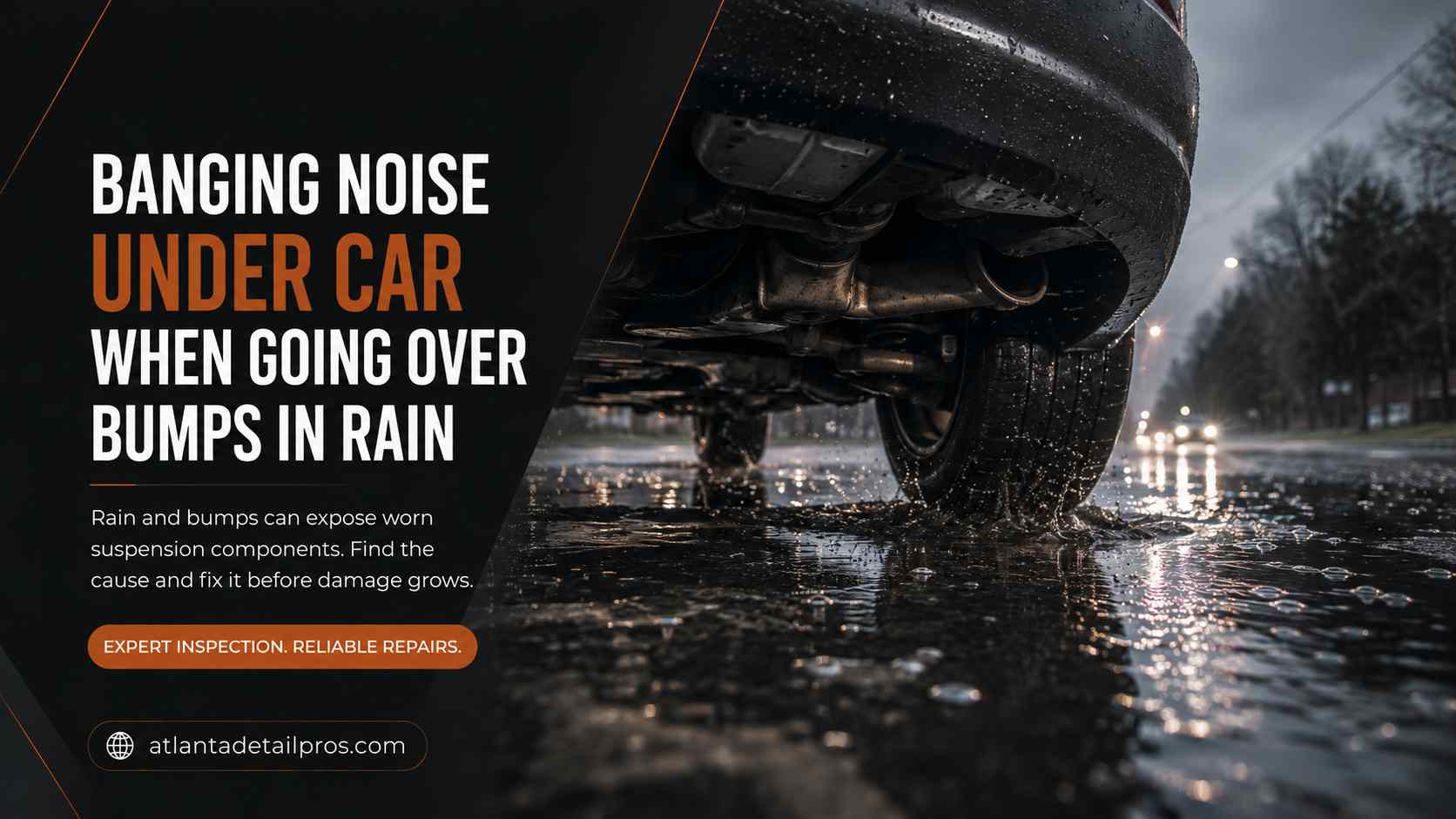
A banging noise under the car that appears specifically when going over bumps in rainy or wet conditions is most commonly caused by a loose splash shield, wheel well liner, or underbody plastic cover that water pressure or spray forces against the vehicle floor or suspension components: creating an impact that does not occur in dry conditions.
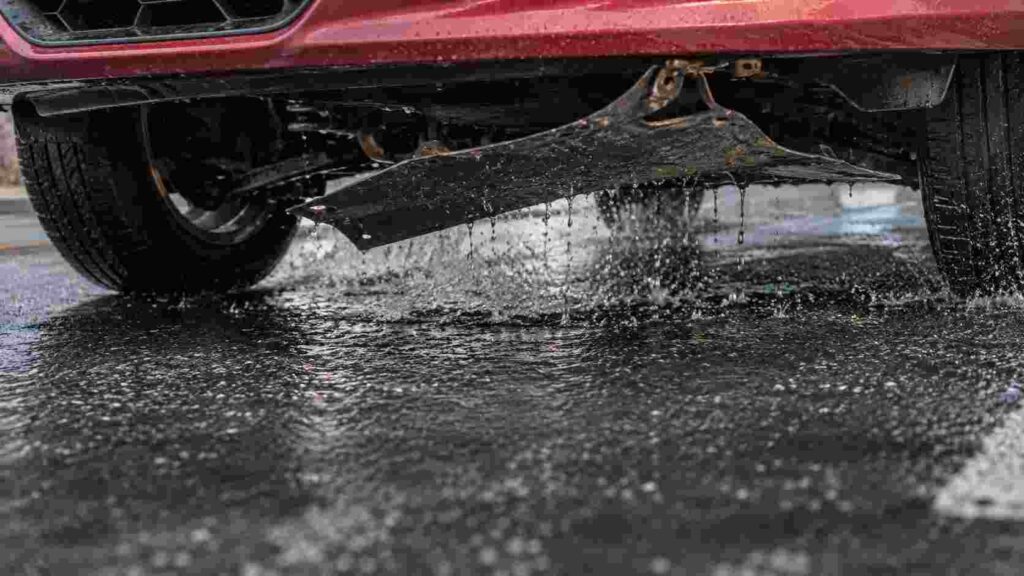
The second most common cause is a worn shock absorber or strut that bottoms out more readily when wet roads create larger effective wheel impacts, combined with reduced suspension damping on surfaces where wheels momentarily lose traction.
What makes this symptom unusual is the rain-specific qualifier. Most automotive noises are either always present or triggered by bumps regardless of weather. When the noise appears or worsens specifically in wet conditions, the water itself is either the direct cause: deflecting a loose component: or a contributing factor that changes how the vehicle interacts with road irregularities.
Why Rain Specifically Changes the Noise: What Most Articles Do Not Explain
Rain affects vehicles in several ways that create or amplify banging sounds that would not occur in dry conditions.
First: water spray from the wheels creates significant pressure and volume underneath the vehicle. At highway speed on a wet road, the rotating tires throw water backward and outward in high-pressure streams. These streams can push loose underbody panels, splash shields, and wheel well liners violently against the chassis floor. The same panels may stay in place during dry-road vibration but are forced against the floor by water pressure at speed.
Second: standing water in road irregularities creates a hydraulic shock when the tire contacts it. A water-filled pothole creates a brief pressure spike as the tire displaces the water, which can produce a harder effective impact than the same pothole when dry. This hydraulic amplification can overwhelm a borderline suspension component that handles the same bump adequately on a dry road.
Third: wet road surfaces reduce tire traction momentarily, which can cause the wheel to briefly skip or rebound differently than it would on a dry surface, creating unusual suspension articulation that produces noises from components with play or wear.
Loose Splash Shields and Wheel Well Liners
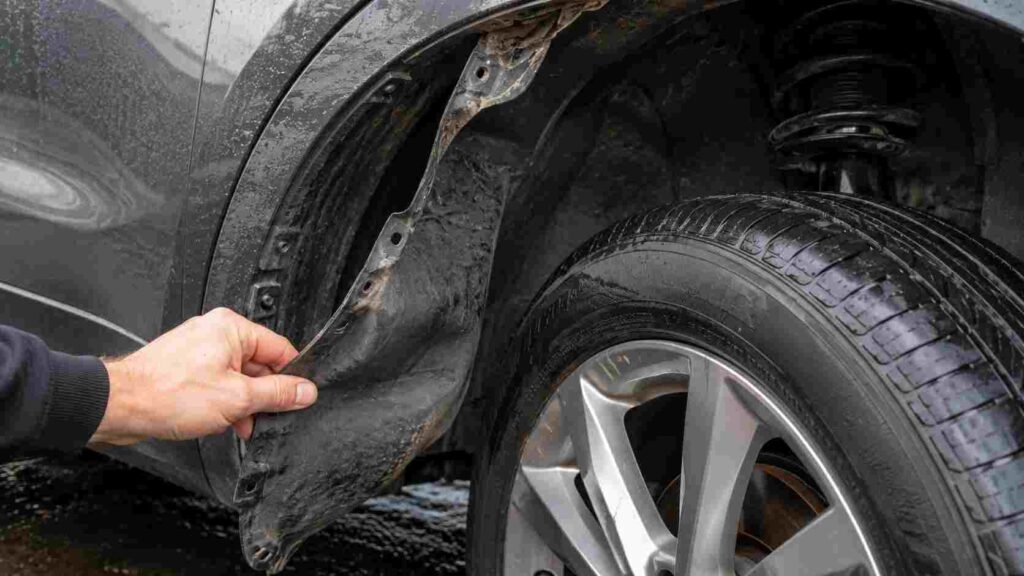
Every wheel well contains a plastic liner that protects the wheel well from mud, water, and road debris. These liners are attached with plastic clips and screws that corrode and break over time. A wheel well liner that has lost several attachment points flaps against the wheel well opening and the tire during normal driving, but water spray from wet roads pushes it more forcefully against adjacent metal, creating a banging sound that is absent on dry roads.
How to check: inspect each wheel well by looking in from the side with a flashlight. Look for the plastic liner along the top and forward edge of the wheel well opening. If any section is visibly sagging, deformed, or has a gap where it meets the fender edge, that section has lost its attachment. Push the liner inward and see if it pops back toward you: a properly attached liner stays in place while a loose one springs back toward the opening.
Repair cost: replacement wheel well liner clips cost $3 to $8 each at auto parts stores. Replacement liners for common vehicles cost $30 to $100 as aftermarket parts. This is one of the few automotive noise sources many owners successfully repair at home.
Underbody Plastic Covers and Engine Splash Shields
Modern vehicles have extensive plastic panels under the engine and along the chassis. These panels are attached with plastic push clips, bolts, and screws that degrade over time. A panel that has lost attachment at one or more points flaps against the chassis at speed and becomes a banging impact when water pressure forces it upward against the floor.
The front underbody cover: often called the engine splash shield or lower engine cover: is the most common offender because it is closest to the road, most exposed to impacts and water, and often disturbed during oil changes when technicians remove and reattach it. An improperly reinstalled engine splash shield that is missing clips after an oil change produces exactly this symptom.
Check specifically: if the banging appeared shortly after an oil change or any recent service involving the underside of the vehicle, the engine splash shield is the primary suspect. A replacement clip typically costs $2 to $5; the complete shield is $30 to $80 as an aftermarket part.
Shock Absorber Bottoming Out on Wet Roads
Wet road surfaces create specific conditions that challenge shock absorbers. The vehicle’s tires have slightly different contact mechanics on wet surfaces, and road surfaces that appear smooth often have micro-irregularities that are more impactful when wet. Additionally, standing water in road imperfections creates the hydraulic amplification described earlier.
A shock absorber that is worn but marginally functional on dry roads may bottom out its bump stop on wet roads because the effective impact of the same bump is harder when wet. This bottoming produces a hard thump or bang from the affected corner. The noise correlation with rain may be the vehicle’s way of telling you the shocks are approaching failure even though they seem adequate in dry conditions.
Diagnosis: perform the jounce test: push firmly down on each corner and release. A worn shock allows multiple bounces before settling. This test does not require rain to reveal worn shock function.
Mud Flap Impacting Suspension or Body
A mud flap that has come partially detached or that has stiffened with age may contact the tire, suspension component, or body panel during wet conditions when water forces it into movement. This contact produces a repetitive banging that corresponds with tire rotation and is specific to rain because the mud flap requires water load to be forced into contact.
Check: visually inspect each mud flap for proper attachment to its bracket and for any evidence of contact marks on adjacent components. Mud flap reinstallation or replacement typically costs $20 to $80 in parts with straightforward installation.
Step-by-Step Diagnosis Guide
| First Check | Second Check | What Each Tells You |
|---|---|---|
| Wheel well liners: push inward, check for loose sections | Does banging come from a specific corner? | Corner-specific noise and loose liner confirm liner is the cause |
| Engine splash shield: look for missing clips; check if recently serviced | Did the noise appear after recent service work? | Recent service and missing clips mean splash shield reattachment needed |
| Jounce test all four corners | Does vehicle bounce more than once? | Multiple bounces indicate worn shocks explaining rain-amplified banging |
| Mud flaps: check attachment and adjacent surfaces for contact marks | Evidence of tire or body contact? | Contact marks mean mud flap repositioning needed |
| Drive on wet road at speed; listen for specific location | Is noise front, rear, or central? | Localization guides which underbody area to inspect first |
Start with the visually obvious: the wheel well liners and engine splash shield. These are the most common causes, the cheapest to fix, and the easiest to identify without lifting the car. If these check out and the noise persists, the jounce test on the shocks is the next step.
Frequently Asked Questions
Why does my car make a banging noise under the car only when going over bumps in rain?
The rain-specific characteristic means water is either directly causing the noise by forcing a loose panel or liner against the chassis, or amplifying the impact of bumps on worn suspension components. The most common direct causes are a loose wheel well liner or underbody splash shield being pushed by water spray. Worn shock absorbers that bottom out on wet-road impacts are the most common mechanical cause.
Can a loose wheel well liner cause a banging noise in rain?
Yes. A wheel well liner that has lost its attachment clips is pushed by water spray from the rotating tire during wet conditions, causing it to bang against the wheel well or chassis. This noise is specific to wet conditions because the water pressure is what forces the liner into impact. In dry conditions, the same loose liner may only produce a flutter or rattle at speed rather than a bang.
How much does it cost to fix a loose splash shield or wheel well liner?
Replacement clips for splash shields and wheel well liners cost $2 to $8 each at auto parts stores and are the first repair to attempt. Complete wheel well liner replacement: $30 to $100 for the part, with 30 to 45 minutes of installation time. Engine splash shield replacement: $40 to $120 for the part.
My banging appeared right after an oil change. Is it related?
Very likely. Engine splash shields are routinely removed and reinstalled during oil changes to access the drain plug, and clips are frequently lost, broken, or simply not reinstalled. A banging from beneath the car that appeared specifically after an oil change is almost always the engine splash shield rattling or banging against the chassis because it was not fully secured. Return to the service facility and ask them to check the shield attachment.
Could worn shock absorbers cause banging only in rain?
Yes. Worn shocks that are borderline functional in dry conditions may bottom out on wet roads because wet surfaces create harder effective bump impacts through hydraulic amplification and different tire-road interaction. If the jounce test reveals that your vehicle bounces multiple times after a push down on each corner, the shock absorbers are likely contributing to the rain-specific banging even if they seem adequate on dry roads.
The Bottom Line
A banging under the car specifically in rainy conditions is the vehicle telling you that water is finding a loose component and forcing it into contact, or that suspension components which are marginal on dry roads are overwhelmed by the more demanding impacts that wet roads create.
Start with the free checks: inspect the wheel well liners and engine splash shield for loose attachment. If the noise appeared after recent service, the splash shield is the primary suspect. If these obvious causes are eliminated, the jounce test at each corner identifies worn shocks as the next most likely cause.
None of these causes require immediate roadside assistance, but none should be ignored indefinitely. A plastic panel that comes off completely at highway speed becomes a road hazard. Worn suspension components progressively reduce vehicle control in exactly the wet, slippery conditions where this noise appears.